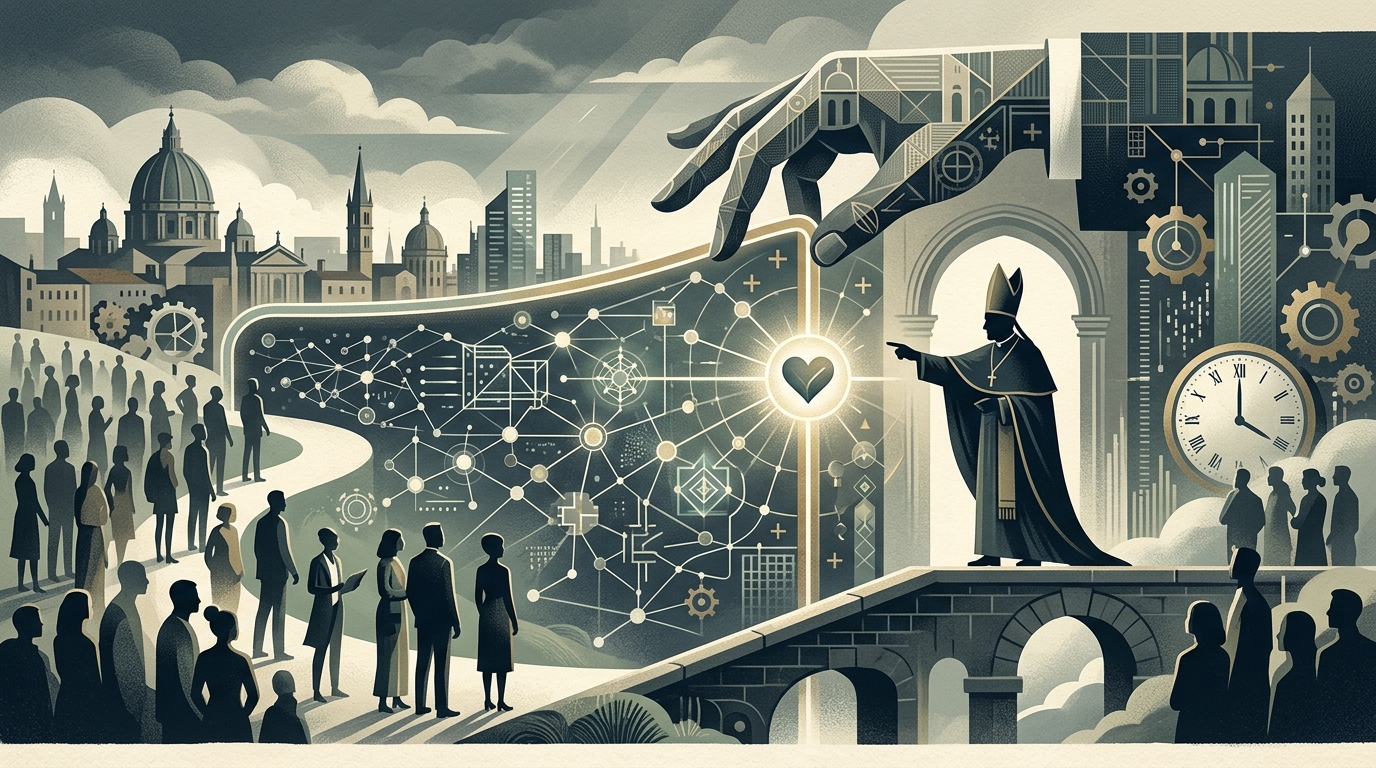
In an era where Artificial Intelligence (AI) is no longer a future scenario but the daily reality of 2026, the voice of the Catholic Church rises to pose the most fundamental question: Where does the machine end and where does the sanctity of human will begin? Pope Leo, speaking from the Apostolic Palace, issued a global appeal for the imposition of binding ethical limits on the development and use of algorithms, introducing the term 'algor-ethics' into the public discourse.
This intervention is not merely a religious stance, but a profound political and social analysis of the risks inherent in a society that hands over the keys of decision-making to 'black boxes' of code. The Pontiff emphasized that technology must remain at the service of humanity and not the other way around, warning that the loss of human control could lead to a new form of 'digital tyranny'.
The Concept of Algorithmic Dignity
A central point of the Pope's address was the protection of 'human dignity' in the face of automation. According to Pope Leo, the trend of judging individuals solely based on data—whether regarding their creditworthiness, access to healthcare, or even judicial judgment—strips the individual of their complexity and spirituality. "An algorithm cannot forgive, it cannot show mercy, and above all, it cannot understand the context of human suffering," he stated emphatically.
The Church proposes a framework where every AI system must be transparent, explainable, and, most importantly, accountable to human entities. What the Pope calls 'algor-ethics' is not a limitation of science, but a moral compass ensuring that innovation does not march over the ruins of social rights. The call is addressed to both Silicon Valley developers and legislators in Brussels and Washington, requesting the creation of an international AI oversight body.
The Digital Divide and Social Justice
Beyond the philosophical aspect, Pope Leo focused on the economic and social implications of AI. He expressed grave concern over the widening gap between nations that possess the technology and those that merely become consumers or victims of automation. AI, if left unregulated, risks becoming a tool for further concentration of wealth and power in the hands of a few tech giants.
- The need for fair distribution of the benefits of automation.
- The protection of workers displaced by the production process.
- The prevention of AI use for manipulating public opinion and weakening democracy.
The Pope highlighted that 'technocratic logic' tends to overlook the poor and the marginalized. If an algorithm is trained on data containing biases, then the injustices of the past will be solidified in the future with mathematical precision. "We cannot allow our future to be dictated by the prejudices of the past encoded into software," he stressed.
A Call for Global Cooperation
Concluding his speech, the Pontiff called for a 'great alliance' between religions, governments, and the scientific community. The Vatican, through the Pontifical Academy for Life, is already working to update the 'Rome Call for AI Ethics,' a document already signed by companies like Microsoft and IBM, as well as representatives of Islam and Judaism.
"Technology is a gift from God, but like every gift, it carries a tremendous responsibility. The question is not whether AI can do something, but whether it should," Pope Leo concluded.
The Vatican's stance in 2026 marks a new era for the Church, which seeks to remain relevant in a rapidly changing world. Instead of excommunicating progress, it attempts to graft it with the values of humanism, reminding everyone that behind every line of code, there is a human life that deserves respect and protection.