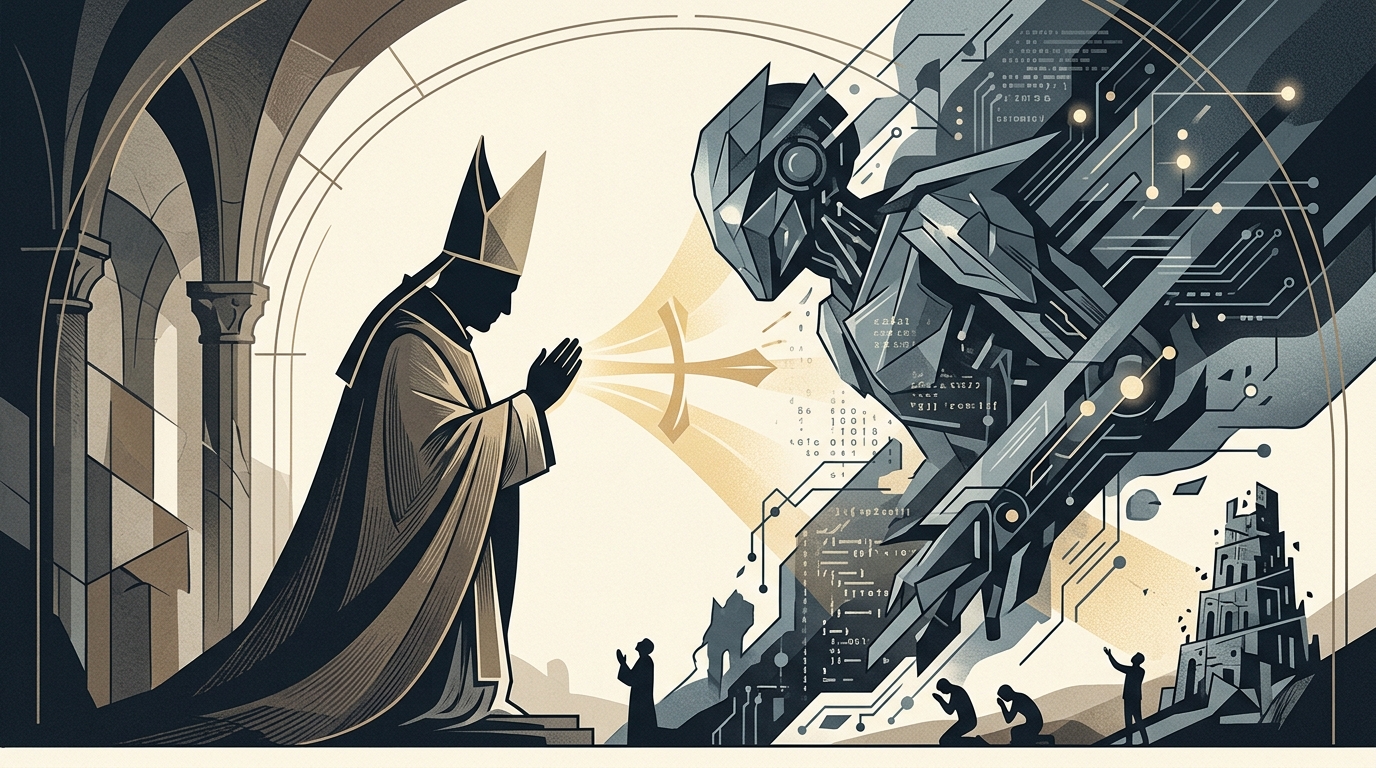
In an era where Artificial Intelligence (AI) is no longer a futuristic scenario but a daily reality permeating every facet of human existence, Pope Leo has issued a resounding warning that echoes through the corridors of power from Silicon Valley to Brussels. Through his latest encyclical and a series of addresses analyzed extensively by The Times, the head of the Catholic Church calls for the "disarmament" of AI—not just in the narrow military sense, but as a comprehensive curbing of its capacity to dominate human will.
This intervention is not merely a religious plea; it is a profound political and ethical analysis of the dangers lurking when decision-making is ceded to opaque algorithms. Pope Leo argues that humanity stands at a critical crossroads where technology threatens to transform from a tool into a sovereign, undermining the very concept of free will.
The Ethics of 'Algor-ethics' (Algoretica)
Central to the Vatican's argument is the concept of "Algoretica" (Algor-ethics). The Pope emphasizes that algorithms are not neutral; they carry the biases, values, and ambitions of their creators. When these algorithms are used to control social benefits, policing, or the shaping of public opinion, they become weapons of enforcement. "We cannot allow a sequence of zeros and ones to decide the fate of a child or the value of a human life," he stated poignantly.
The call for disarmament primarily concerns the removal of "lethal autonomy" from weapons systems. Pope Leo is categorical: the idea of a machine having the power to end a human life without direct human intervention is an "affront" to creation. He calls for an international ban on Lethal Autonomous Weapons Systems (LAWS), arguing that responsibility for violence must always remain in human hands—hands capable of remorse and mercy, qualities that code lacks.
The Threat of Digital Hegemony
Beyond the battlefield, the Pope refers to a more insidious "disarmament": that of data harvesting and psychological manipulation. In his analysis, AI is currently being used to "disarm" the critical thinking of citizens, trapping them in digital bubbles and directing their desires through predictive modeling. This form of dominance, though bloodless, is considered equally dangerous to democracy and spiritual freedom.
- The necessity for human oversight (Human-in-the-loop) in every critical decision.
- The transparency of algorithms used by states and major corporations.
- The protection of vulnerable populations from algorithmic exclusion.
- The promotion of technology that serves peace rather than an arms race.
The Pontiff calls on scientists and developers to become "artisans of peace," embedding ethical safeguards into the very core of AI development. He proposes the establishment of an international agency, under the auspices of the UN, to oversee AI development guided by the common good rather than profit or military superiority.
A Voice in the Memory of the Future
Pope Leo's stance in 2026 reflects a broader shift in global thought. As AI becomes increasingly capable, the need for an ethical framework becomes imperative. The Church, an institution spanning two millennia, positions itself against the speed of technological evolution, reminding us that progress without ethics is merely a path toward self-destruction. "Artificial intelligence must be a mirror of our best version, not a tool for the imposition of our worst," the encyclical concludes.
"True progress is not measured by the complexity of our machines, but by our ability to remain human in an automating world."
In conclusion, Pope Leo's call is not an attempt to halt technology, but an attempt to humanize it. In a world fascinated by the power of algorithms, the Vatican reminds us that sovereignty belongs to humanity, and technology must remain, in all its forms, a humble servant of life.