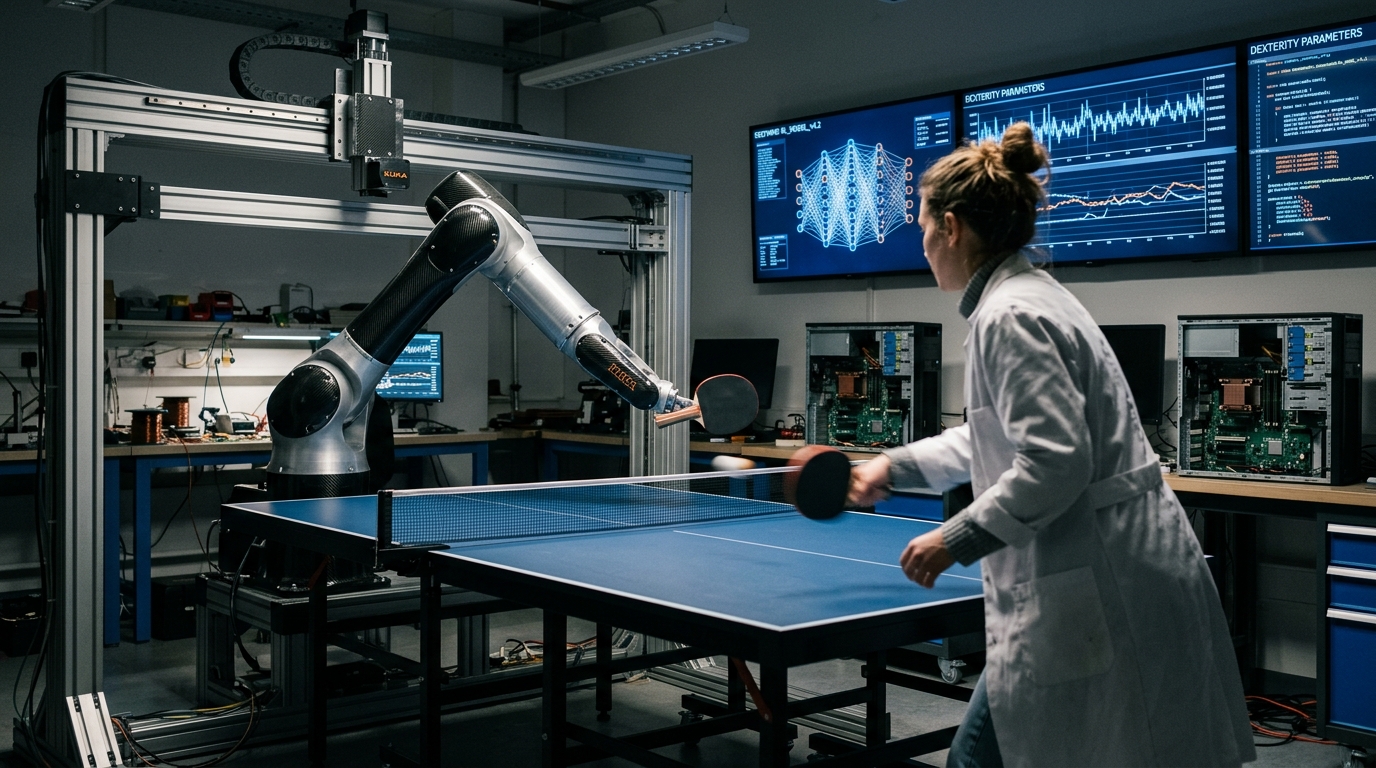
Table tennis is far more than a game of speed. It is a high-stakes ballet of precision, strategy, and lightning-fast reflexes that requires the human brain to process complex data on trajectory, spin, and velocity in fractions of a second. For decades, this combination of physical dexterity and cognitive processing has been the "Holy Grail" of robotics. Today, Google DeepMind announced that its AI-powered robot has reached a level that seriously challenges human players, marking a new era for physical artificial intelligence.
The Technological Prowess Behind the Paddle
The system developed by DeepMind is not a simple machine following pre-programmed paths. It utilizes a hierarchical control architecture that blends "low-level skills" (such as forehands and backhands) with a "high-level controller" that decides which move is most appropriate for each specific situation. The robot’s training was rooted in Reinforcement Learning, where the system learned to play through millions of simulations before ever touching a physical paddle.
One of the most significant hurdles in robotics is the "sim-to-real gap." Physics in a computer simulation is often far cleaner than in the real world, where ball wear, air humidity, and table elasticity come into play. DeepMind researchers bridged this gap by using continuous real-world data collection techniques, allowing the robot to adapt to environmental quirks in real-time. This iterative learning process ensures that the robot doesn't just play a perfect game in theory, but also in the messy reality of a sports hall.
Facing Humans: The Performance Metrics
In a series of competitive matches, the robot faced players of varying skill levels. The results were telling: the system won 100% of matches against beginners and 55% against intermediate players. However, when pitted against advanced athletes, the robot lost every match. This highlights the current limitations of the technology; the robot struggles significantly with high-spin balls (topspin or backspin), as its computer vision system cannot yet "read" the ball's rotation with the same nuance as the human eye.
Human players involved in the study reported a unique experience. Many stated that they felt they were playing against a "skilled but somewhat rigid" opponent. The robot does not tire, does not get frustrated, and does not make errors due to psychological pressure, making it an exceptional training partner. Its ability to return balls with extreme consistency allows athletes to practice specific shots for hours—a task that would be exhausting for a human coach.
Beyond the Table: Broader Implications
Why is Google investing millions to teach a robot to play ping pong? The answer lies in applications that extend far beyond the arena of sports. A robot's ability to interact with dynamic objects at high speed is critical for the future of industrial manufacturing, precision surgery, and domestic caregiving. If a robot can strike a ping pong ball moving at 50 km/h, it can also catch a falling object in a warehouse or perform a delicate maneuver on an assembly line without causing damage.
- Automation: Faster and safer human-robot collaboration in industrial settings.
- Healthcare: Robotic assistants with the necessary gentleness and speed to support the elderly.
- Research: New models for understanding human movement and neuromuscular coordination.
In conclusion, DeepMind's achievement isn't just about the scoreline of a match. It is about proving that artificial intelligence is beginning to acquire a "body" that can function in our chaotic, unpredictable physical world. Table tennis was merely the testing ground. The next step will be integrating this dexterity into general-purpose robots that can assist us in daily life, finally bridging the gap between digital thought and physical action.