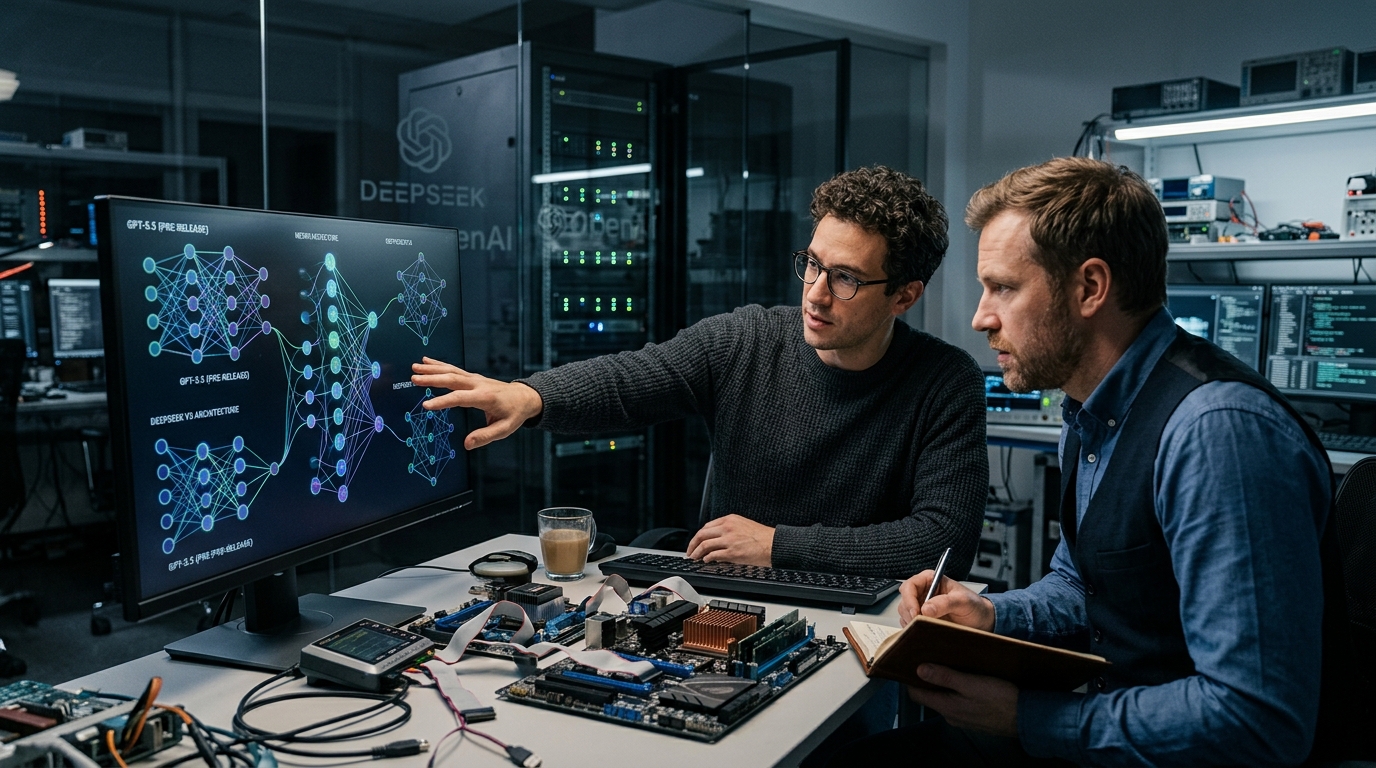
April 24, 2026, will likely be recorded in the annals of technological history as the day the Silicon Valley hegemony over artificial intelligence was challenged in the most profound way. Just hours after OpenAI’s long-awaited release of GPT-5.5, which promised unprecedented levels of reasoning and multimodality, Chinese AI lab DeepSeek unveiled its own next-generation model. This move was not merely a PR stunt; it was a clear declaration of power: China is no longer following the trends—it is co-authoring them in real-time.
The Architecture of Efficiency
DeepSeek’s new model is built upon an advanced Mixture-of-Experts (MoE) architecture, allowing the system to activate only a fraction of its parameters for any given query. This translates into a stunning balance between computational power and performance. While OpenAI appears to rely on the "brute force" of massive Nvidia GPU clusters to fuel GPT-5.5, DeepSeek has demonstrated that algorithmic optimization can deliver similar, if not superior, results at a fraction of the energy and financial cost.
According to initial benchmarks, DeepSeek’s model excels in domains such as coding and advanced mathematics—areas where the Chinese research community has traditionally made heavy investments. The model's ability to handle massive context windows without a corresponding degradation in memory is a technical feat that is forcing engineers in San Francisco to rethink their scaling laws.
The Geopolitical Chessboard and Digital Sovereignty
The timing of the announcement is far from coincidental. At a time when the United States is tightening export restrictions on high-end semiconductors to China, DeepSeek’s success sends a message of resilience. Despite the sanctions, Chinese researchers have managed to train a world-class model using domestic solutions and clever management of existing resources.
- Autonomy: DeepSeek proves that reliance on Western hardware can be mitigated through algorithmic innovation.
- Open-Source Spirit: Unlike OpenAI’s increasingly "closed" ecosystem, DeepSeek continues to lean into a strategy that favors the global developer community.
- Deflationary Intelligence: By slashing the cost per token, DeepSeek is making AI accessible at a scale that American firms are struggling to match economically.
“We are no longer in an era where the West sets the pace and the East simply copies. Today, Beijing is setting the new standards for AI efficiency,” notes a senior analyst at Yicai Global.
The Challenge to OpenAI and Microsoft
The release of GPT-5.5 was seen by many as OpenAI’s definitive answer to its competitors. However, DeepSeek’s immediate counter-move creates a new narrative. The market is beginning to realize that OpenAI’s "moat" is no longer as wide as once thought. If a company can provide 95% of GPT-5.5’s capabilities at 20% of the cost, the economic equation changes dramatically for enterprises worldwide.
Furthermore, DeepSeek appears to have addressed "hallucination" issues in technical documentation more successfully than its predecessors. This makes it highly attractive for industrial applications, from aerospace to biotechnology, where precision is a matter of vital importance. The battle of the models is shifting from the field of general conversation to the field of specialized, high-stakes productivity.
Conclusion: A Bipolar AI World
As we move into the latter half of 2026, the picture is clear: artificial intelligence has become the central arena for superpower competition. DeepSeek represents not just a company, but an entire ecosystem that has learned to thrive under pressure. OpenAI, on the other hand, must now prove that its leadership is not just based on access to capital and chips, but on a sustained innovation that cannot be easily replicated. The end-user, ultimately, is the winner of this clash, as access to PhD-level intelligence becomes cheaper and faster than ever before.