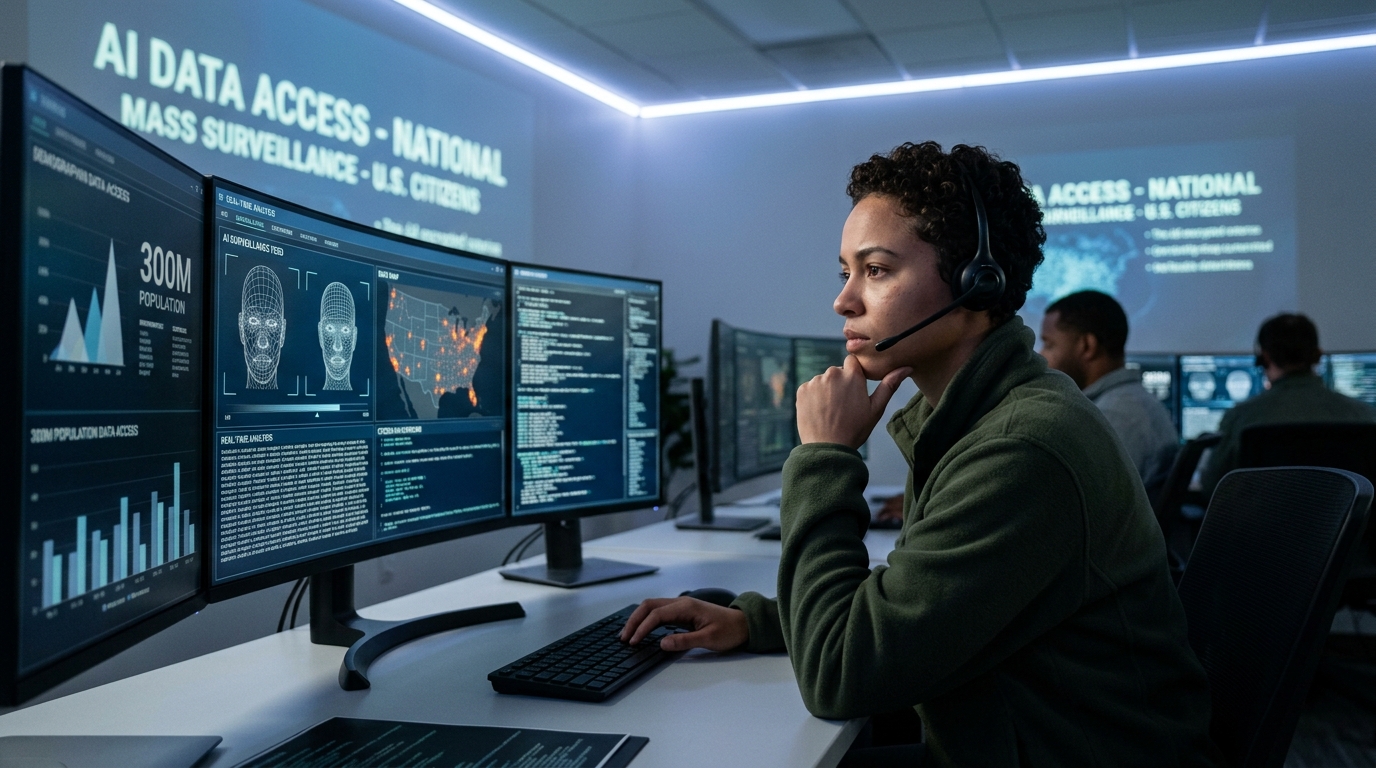
In an era where technology evolves faster than legislation, the United States finds itself at the center of a fierce ethical and political storm. Recent revelations, highlighted by financial outlets and international analysts, describe a scenario reminiscent of a dystopian novel: the full integration of Artificial Intelligence (AI) into the mass surveillance mechanisms of federal agencies. With access to the data of 300 million citizens, the American government appears to have constructed a digital panopticon, where every movement, transaction, and communication is analyzed by algorithms in real-time.
The Architecture of Algorithmic Surveillance
Traditional surveillance required judicial warrants and specific targets. Today, AI enables a shift from "targeted" to "proactive" surveillance. According to the report, agencies such as the FBI, Homeland Security, and the NSA utilize advanced machine learning models to process vast amounts of data sourced from "data brokers." These private intermediaries collect information from mobile apps, browsing history, credit card purchases, and social networks, which they subsequently sell to the state.
The critical point here is the bypass of the Fourth Amendment of the US Constitution, which protects citizens against unreasonable searches. Because the government "purchases" data rather than seizing it, a legal loophole is created, allowing for the monitoring of 300 million people without any judicial oversight. AI does not stop at simple storage; it proceeds to create "psychographic profiles," predicting potential criminal behavior before it even manifests.
Ethical Dilemmas and the Erosion of Democracy
The use of AI in mass surveillance raises fundamental questions about the nature of liberty. When a citizen knows that every action is recorded and evaluated by an algorithm, they inevitably move toward self-censorship. This phenomenon, known as the "chilling effect," undermines freedom of expression and assembly. Furthermore, these algorithms are not infallible. "Predictive policing" often incorporates biases present in historical data, leading to the disproportionate targeting of minorities and marginalized groups.
- The Automation of Suspicion: When AI decides who is "suspicious," transparency is lost.
- The End of Anonymity: The use of biometric data and facial recognition in public spaces eliminates the right to anonymous movement.
- The Concentration of Power: Never in history has a central authority possessed such granular knowledge of the private lives of its population.
Legal Gaps and the Need for a Regulatory Framework
Despite sporadic pushback in Congress, legislation remains desperately behind technological advancements. The FISA (Foreign Intelligence Surveillance Act), originally designed for foreign agents, is now used as a "backdoor" for collecting the data of American citizens. Proponents of these programs cite national security and efficiency in combating terrorism and crime. However, critics point out that the cost to democracy is disproportionately high.
"Liberty is not lost in a single day, but through thousands of small algorithmic decisions made in the dark," states one of the report's authors.
The international community is watching with concern. If the US, which identifies as the "beacon of democracy," adopts methods reminiscent of China's Social Credit System, it sets a dangerous global precedent. The need for an international treaty on digital rights and the ethical use of AI in security is now imperative.
Conclusion: Toward a New Social Contract?
The revelation regarding the surveillance of 300 million citizens is not merely a tech news item; it is a signal of danger. Artificial Intelligence can be a powerful tool for progress, but in the hands of an unchecked state apparatus, it becomes a weapon of suppression. The challenge for 2026 and beyond will be the redefinition of the social contract: how can we enjoy the benefits of technology without sacrificing our very essence as free-thinking individuals.