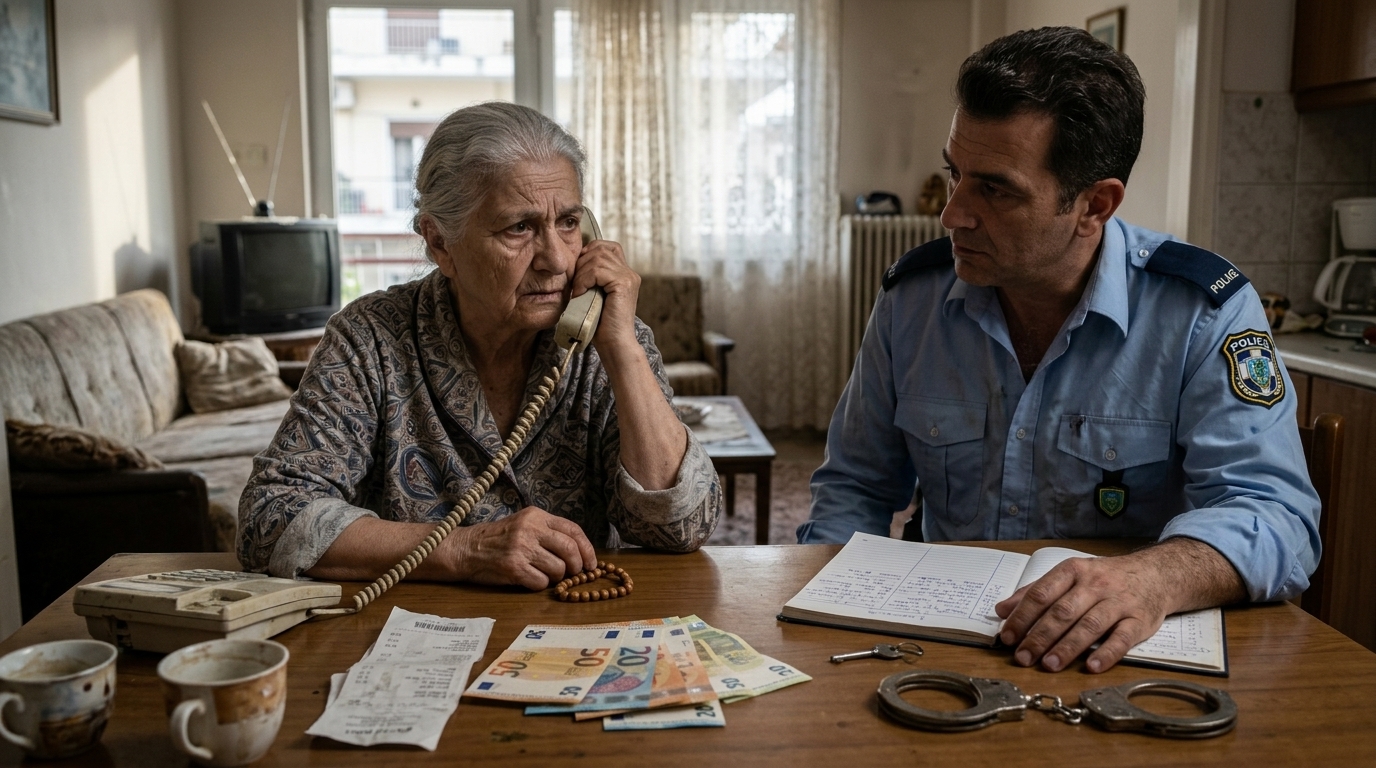
On Saturday, May 23, 2026, the quiet daily life of Kastoria was disrupted by a coordinated deception operation. Within just a few hours, dozens of households were targeted by a couple who, posing as 'collectors,' attempted to extort money through telephone fraud. This incident is not merely an isolated criminal act but a symptom of a broader pathology affecting the Greek provinces: the exploitation of social trust and the vulnerability of the elderly.
The Anatomy of the Scam: Psychological Pressure and Social Engineering
The method used by the couple in Kastoria follows the classic manual of 'social engineering.' The perpetrators did not rely on sophisticated hacking software but on the oldest weakness of the human psyche: fear and a sense of urgency. They presented themselves as employees of collection agencies or public services, claiming that there were outstanding debts that had to be settled immediately to avoid seizures or legal sanctions.
The choice of Kastoria, a city with a strong sense of local community, was not accidental. In such areas, reputation and social standing play a decisive role, and the threat of 'public exposure' due to debts acts as a powerful lever of pressure. The perpetrators, working as a team, managed to make dozens of calls in a very short time, creating a climate of panic that spread from phone to phone.
The Technological Mutation of Crime
Although in this specific case the perpetrators used traditional phone calls, the Hellenic Police warn that we are on the threshold of a new era for 'vishing' (voice phishing) scams. With the rise of Artificial Intelligence, criminals now have the ability to use 'deepfake' voices, imitating relatives or known lawyers of the victims. In Kastoria, the couple relied on their acting skills, but the threat remains the same: the ability to bypass the victim's logic through emotion.
Authorities point out that 'burner phones' and prepaid cards make tracking the perpetrators extremely difficult. Despite the immediate mobilization of local police authorities, prevention remains the only effective weapon. Informing citizens that no public service or bank asks for passwords or immediate cash payment over the phone is vital.
The Social Dimension: Targeting the Elderly
The saddest element of these attacks is the systematic targeting of the elderly. In a country like Greece, where the digital transition has not equally included all age groups, the elderly remain exposed. The scamming couple knew that older people tend to show greater respect for 'authorities' and are less suspicious of telephone demands.
- Never give personal information or bank codes over the phone.
- Verify the caller's identity by asking for a return phone number from an official source.
- In case of pressure, hang up and contact a trusted person or the police.
"Fraud does not target the wallet, but the trust that binds our society together," a local government official in Kastoria noted.
Conclusions and Outlook
The barrage of calls in Kastoria serves as a reminder that security in the 21st century is not just about locked houses, but also about open phone lines. Addressing the phenomenon requires a holistic approach: a stricter framework for issuing SIM cards, continuous citizen education, and strong social cohesion that will act as a safety net for the most vulnerable. Kastoria today is the example; tomorrow it could be any other city. Vigilance is our only defense.