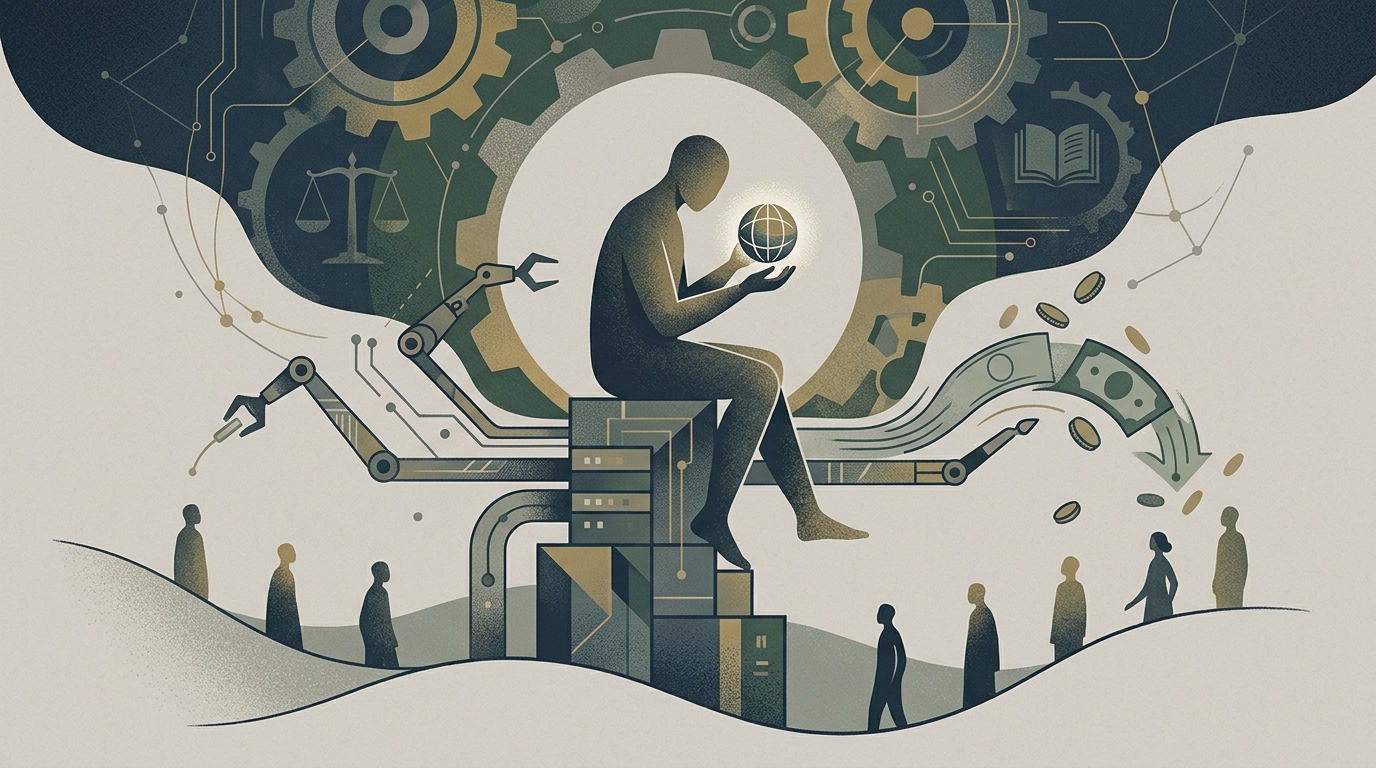
The rapid evolution of Artificial Intelligence (AI) is no longer just transforming the way we work; it is rewriting the very social fabric of modern economies. As automation and large language models begin to replace not only manual labor but also sophisticated cognitive functions, the debate over Universal Basic Income (UBI) has shifted from the fringes of economic theory to the center of Silicon Valley’s political agenda. Elon Musk, Sam Altman, and other tech leaders are now openly signaling a warning: work, as a primary means of survival, may soon become obsolete.
The End of Work and the Rise of 'Universal High Income'
Elon Musk has recently pushed the conversation a step further, introducing the concept of "Universal High Income." According to Musk, AI will lead to an era of unprecedented abundance where goods and services are produced with minimal cost. In this scenario, the problem will not be a lack of resources, but rather their distribution. "There will be no shortage of goods or services," Musk argues, "but we must find a way to ensure everyone has access to them, as traditional employment disappears."
This concern is far from unfounded. Statistical data from 2025 and early 2026 show a clear trend: tech companies, financial institutions, and creative industries are reducing their workforces, replacing them with AI agents capable of operating 24/7 without a salary, insurance, or the need for rest. What was once considered a science-fiction scenario is now a daily reality for thousands of workers who see their roles being automated out of existence.
Silicon Valley’s Strategy: Philanthropy or Self-Preservation?
But why are the world’s wealthiest individuals—those who traditionally oppose high taxation and state intervention—suddenly becoming advocates for a radical redistribution of wealth? The answer lies in the economic viability of capitalism itself. If AI leads to mass unemployment, who will buy the products and services these tech giants produce? In this context, UBI is not just a humanitarian proposal; it is a mechanism to maintain a consumer base.
- Preserving Social Cohesion: Mass unemployment without a safety net inevitably leads to social unrest and political instability.
- Stimulating Consumption: UBI ensures that money continues to circulate in the market, fueling the revenues of tech corporations.
- Ethical Legitimacy: By promoting UBI, tech leaders attempt to soften the backlash against AI, positioning themselves as part of the solution rather than the source of the problem.
OpenAI’s Sam Altman has already funded one of the largest UBI studies in the United States, arguing that technology must create wealth that is shared by everyone. However, critics point out that this model risks creating a society entirely dependent on a handful of tech behemoths, leading to a new form of corporate paternalism.
Political Challenges and the Question of Funding
The big question remains: who will foot the bill? Proposals range from a "Robot Tax" to taxing data usage and the massive profits generated by AI. In Europe, the debate is already intense, with several member states considering pilot programs. However, political resistance remains high. Conservative circles fear that UBI will destroy the incentive to work and lead to hyperinflation, while the left worries it will be used as a pretext to dismantle the welfare state and public services.
"Universal Basic Income is no longer an option; it is a necessity for the survival of our democratic system in the age of super-intelligence," states a recent analysis by the Brookings Institution.
Furthermore, there is the psychological impact of a post-work society. Work provides people with more than just income; it offers purpose, structure, and social integration. A society where income is completely decoupled from effort requires a radical re-evaluation of human values. What will people do with their free time? Will they turn to the arts, education, and community service, or will they sink into lethargy and digital isolation?
Conclusion: Toward a New Social Contract
The support of Musk and other leaders for UBI marks the end of one era and the beginning of another. We are facing a new social contract where technology is not just a tool for production but the primary financier of human existence. This transition will be painful and fraught with conflict, but Silicon Valley’s admission that the current economic model is failing is the first step toward shaping the future. The gamble is whether this future will be a utopia of abundance for all or a new form of digital feudalism.