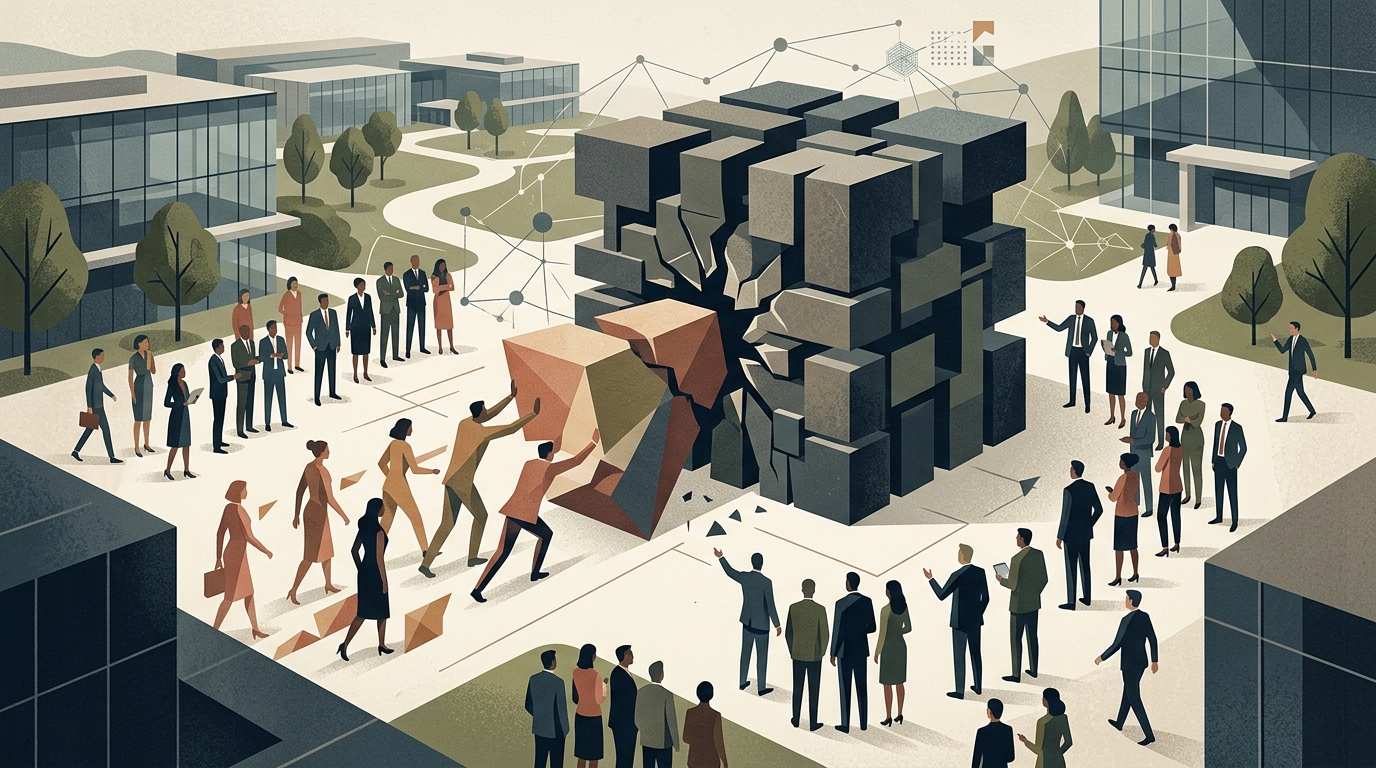
The era of unbridled expansion and free perks in Silicon Valley appears to have vanished. What began in 2022 as a necessary correction following the hiring frenzy of the pandemic has now morphed into a continuous, "silent" process of restructuring. Major tech firms—from Google and Amazon to Meta and Microsoft—continue to announce job cuts, even as their profits hit historic highs. The question looming over the global economy is clear: Is this a transient phase of adjustment, or a harsh new reality for the technology sector?
The Pandemic's Legacy and the "Efficiency Diet"
To understand the present, we must look at the recent past. During 2020 and 2021, the tech industry experienced an artificial euphoria. With the world confined to their homes, demand for digital services skyrocketed, leading companies into a hiring binge. However, the return to normalcy, coupled with rising interest rates and inflation, forced CEOs to re-evaluate their strategies. Mark Zuckerberg of Meta famously dubbed 2023 the "Year of Efficiency," a slogan that has now been universally adopted across the industry.
The layoffs of 2024 and 2025 are no longer just about survival; they are about optimizing profit margins. Wall Street investors no longer reward growth at any cost but prioritize profitability and lean operations. This paradigm shift has created an environment where tech workers, once the most sought-after professional group in the world, now feel increasingly disposable.
Artificial Intelligence as a Catalyst for Reallocation
The most significant factor fueling this new wave of layoffs is the rapid ascent of Generative Artificial Intelligence (AI). There is a subtle but critical difference in how AI is impacting employment today: companies are not merely replacing humans with algorithms; they are reallocating their capital. The billions of dollars saved from the salaries of laid-off workers are being funneled directly into Nvidia GPUs and the construction of massive data centers.
In many instances, we are witnessing a "skills replacement" phenomenon. A company might lay off 500 employees in marketing or customer support while simultaneously attempting to hire 50 specialized AI engineers with mid-six-figure salaries. This structural shift suggests that tech employment is not necessarily shrinking in absolute numbers over the long term, but it is transforming at such a pace that the existing workforce is struggling to keep up.
The Erosion of the Tech Social Contract
For decades, working at a Big Tech company was considered the "golden ticket." The perks were legendary: gourmet food, on-site massages, unlimited PTO, and the sense of belonging to a family changing the world. This "social contract" has now been shredded. Employees are realizing that, despite the "mission-driven" culture, they remain lines on a balance sheet.
- The loss of job security is leading to a decline in morale and creativity.
- A "culture of anxiety" is replacing the culture of innovation.
- Remote work, while popular, has made employees more easily replaceable in a globalized labor market.
This shift has profound implications for the psychology of new graduates. Universities are seeing students pivot toward more traditional and stable sectors as the luster of Silicon Valley fades under the weight of constant cuts.
The Global Impact and the Future of Work
While the US remains the epicenter of these changes, the ripples are felt globally. In Europe, where labor laws are stricter, companies face higher costs for mass layoffs, leading to more strategic, long-term planning rather than the abrupt cuts seen in California. However, the pressure to compete with AI-driven American firms is forcing European tech leaders to adopt similar lean methodologies.
"We are not merely in an economic downturn of the sector; we are at a reset point for humanity's priorities regarding labor and technology," market analysts suggest.
In conclusion, the new wave of layoffs is not a temporary storm that will pass. It is the dawn of an era where technology will be produced with fewer hands and more algorithms. The challenge for society and political leaders will be managing this transition, ensuring that the progress of AI does not lead to a permanent class of the "technologically unemployed," but to a new form of creative and meaningful employment.