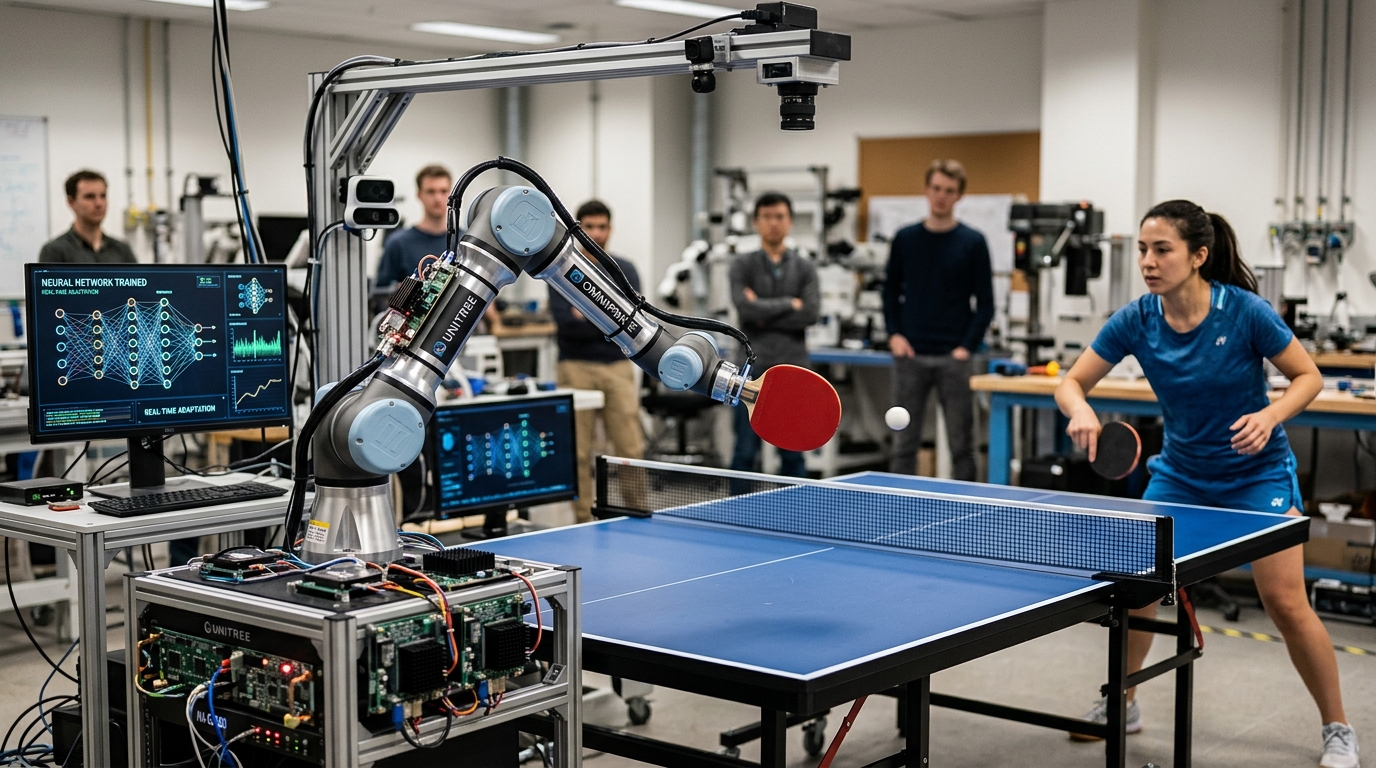
For decades, Artificial Intelligence (AI) confined its triumphal moments to the world of "pure" data and abstract strategy. From Deep Blue defeating Garry Kasparov in chess to AlphaGo stunning the world of Go, machine dominance was primarily about computational power and predicting moves in a static, controlled environment. However, the recent emergence of robotic systems capable of competing with humans in table tennis (ping pong) moves the battle from the digital to the physical realm, proving that AI is finally acquiring a "body" and reflexes that approach human levels.
The Challenge of Physical Reality
Table tennis is not merely a game of speed. It is a complex dance of physics, where aerodynamics, ball spin, and split-second decision-making play a decisive role. Unlike chess, where thinking time is often abundant, a table tennis player has fractions of a second to perceive the ball's trajectory, calculate its speed and spin, and execute a precision movement. For a robotic system, this requires the seamless cooperation of three pillars: computer vision, reinforcement learning (RL), and high-speed mechanical actuators.
Researchers at Google DeepMind, who lead this field, utilized a "sim-to-real" approach. The robot was first trained in a virtual environment where physics was perfectly controlled, allowing it to play millions of games within a few hours. The real challenge, however, was transferring this knowledge to the real world, where lighting conditions, paddle wear, and the unpredictable movements of a human opponent introduce a degree of noise that traditional computing struggles to manage.
From Amateurs to Professionals
The test results are striking. The robotic system managed to win 100% of matches against beginner players and approximately 55% against intermediate-level players. This success rate suggests that the machine has moved past the "experimental prototype" stage and entered the realm of functional capability. Nevertheless, against professional athletes, the robot still falls short. Professionals employ extremely complex spins and deceptive movements that the system has not yet learned to fully decode.
The machine's failure against top-tier players is just as instructive as its victories. It reveals the limits of current technology in understanding human psychology and strategic deception. A professional player doesn't just hit the ball; they "read" their opponent's body posture. The robot, for now, focuses almost exclusively on the ball. The next phase of research will involve integrating systems that analyze the opponent's body language, making the machine a truly intelligent competitor.
Implications Beyond Sports
But why does the scientific community invest so many resources in a game? The answer lies in the applications of "general-purpose robotics." The skills required for table tennis—such as eye-hand coordination at high speeds and adaptation to changing environments—are the same ones required for robots working in warehouses, assisting in surgeries, or providing elderly care. If a robot can return a ball moving at 50 kilometers per hour, it can certainly catch a falling object or navigate safely through a factory floor filled with people.
- Improved Autonomy: The ability to learn from mistakes in real-time reduces the need for pre-programmed movements.
- Human-Machine Interaction: Sports provide a safe framework for studying how humans react when collaborating or competing with robots.
- Reduced Production Costs: Improvements in sim-to-real algorithms mean that robot training will become faster and cheaper in the future.
In conclusion, a robot's victory at the ping pong table is not a simple demonstration of technological prowess, but a milestone on the path to creating machines that understand and interact with the physical world with the same ease that we humans take for granted. The gap separating the robot from the professional athlete is narrowing every day, and with it, the distance between science fiction and everyday reality.