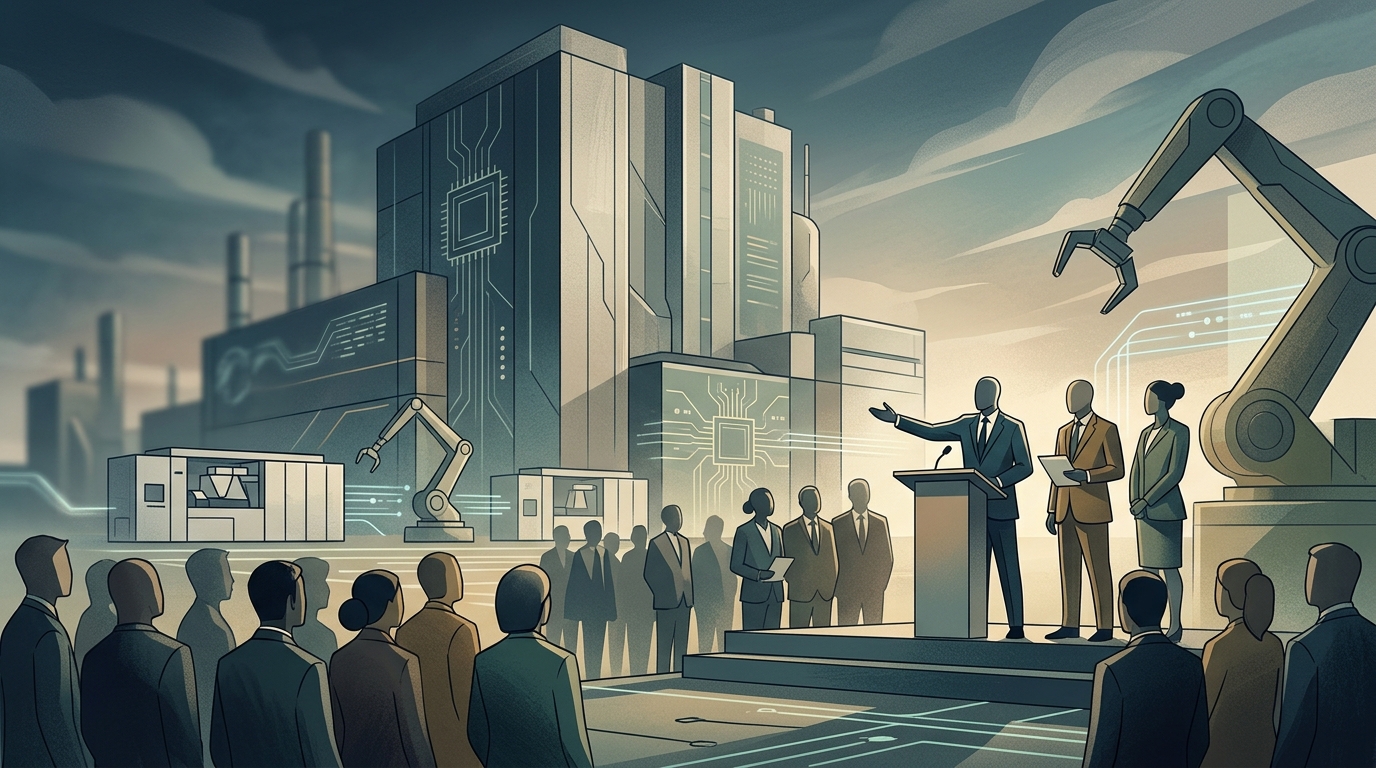
As we navigate the spring of 2026, the global tech sector has been rocked by an announcement that transcends mere business—it is a geopolitical statement of intent. Amazon and Anthropic, the primary rival to OpenAI, have unveiled a strategic commitment totaling a staggering $100 billion. This investment, largely directed toward Amazon Web Services (AWS) infrastructure, marks the definitive shift from the era of AI experimentation to the era of industrial-scale Generative Artificial Intelligence.
The Architecture of an Alliance: Why Now?
This move does not occur in a vacuum. As 2025 demonstrated that the global appetite for computational power (compute) exceeds all previous forecasts, Amazon has decided to play its strongest hand: infrastructure. The $100 billion is not just liquidity; it is a multi-year roadmap for constructing massive data centers and developing specialized semiconductors, such as the Trainium and Inferentia processors. Anthropic, for its part, secures the "fuel" its Claude models require to evolve into Artificial General Intelligence (AGI) systems.
This strategic pivot places AWS at the very heart of the AI ecosystem, making it the indispensable "landlord" of the digital pipelines through which global knowledge will flow. For Anthropic, the deal offers a level of stability that OpenAI has often lacked due to internal governance crises and its complex, sometimes friction-filled relationship with Microsoft. Here, the relationship is clinical: Amazon provides the body (infrastructure), and Anthropic provides the mind (algorithms).
The Chip Wars and Independence from Nvidia
A critical dimension of this deal is the gradual decoupling from Nvidia's near-monopoly. Amazon is funneling billions into its proprietary chip design, aiming to offer Anthropic—and by extension, AWS enterprise clients—a more cost-effective and energy-efficient alternative. The $100 billion scale allows for the development of custom solutions that optimize the training of Large Language Models (LLMs) in ways that general-purpose GPUs simply cannot match.
- Deployment of next-generation Trainium chips for accelerated model training.
- Construction of carbon-neutral data centers to satisfy stringent EU regulations.
- Exclusive Anthropic access to early-stage hardware prototypes.
Geopolitical and Social Implications
The concentration of such immense power within two entities raises significant questions. While Anthropic markets itself as a "safety-first" and responsible AI firm, its tethering to a titan like Amazon sparks concerns regarding the independence of its research. Furthermore, this investment serves as a direct rebuttal to European and Chinese efforts to build sovereign AI infrastructures. The United States, through private capital, is cementing a digital hegemony that will be difficult to challenge in the coming decade.
"It is no longer about who has the best algorithm, but who owns the largest factory of intelligence," market analysts suggest.
In conclusion, the Amazon-Anthropic pact represents the final bulwark against the dominance of Microsoft and Google. It is a $100 billion wager that the future of human productivity will be written in Claude's code, hosted on Amazon's clouds. The remaining question is whether the competition can keep pace with this capital intensity, or if we are drifting toward a global oligopoly of intelligence.