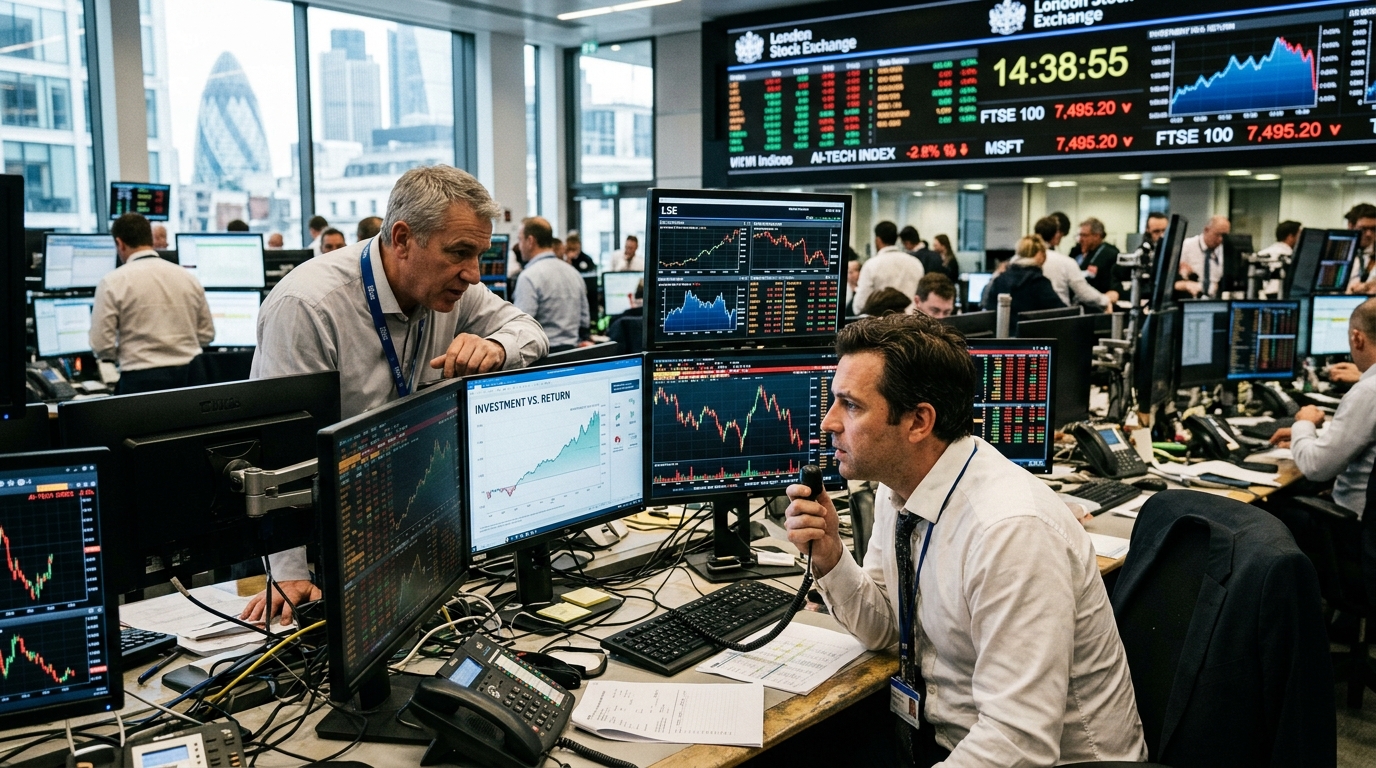
The history of financial markets is often a succession of cycles of euphoria followed by painful landings. Today, the Bank of England (BoE) argues that we may be at the peak of such a cycle, with Artificial Intelligence (AI) at the heart of a potential "bubble." In its latest Financial Stability Report, the UK's central bank issued a clear warning: asset prices, particularly in the US tech sector, are "stretched" to a degree not justified by economic fundamentals.
The Anatomy of a Warning: Stretched Valuations
The BoE is not the first to express reservations, but the weight of its institutional role adds a new dimension to the concern. According to the Financial Policy Committee (FPC), asset valuations remain high relative to historical data, despite the high-interest-rate environment. Market concentration in a few massive tech companies—the so-called "Magnificent Seven"—creates a systemic risk. If expectations for AI profitability are not met soon, the correction will not only affect Silicon Valley but the entire global financial system.
The BoE's argument focuses on the fact that investors seem to be pricing in a "soft landing" scenario for the economy, ignoring the risks of persistent inflation and geopolitical tensions. The divergence between stock prices and real bond yields suggests that risk appetite is at levels that historically precede major corrections.
AI: Revolutionary Technology or Speculative Vehicle?
Artificial Intelligence is undoubtedly a transformative force. However, its stock market representation reminds many analysts of the dot-com era in the late 1990s. The BoE points out that while AI promises a massive increase in productivity, the timing and scale of this increase remain uncertain. Companies are spending billions on infrastructure (chips, data centers), but converting these investments into net profits for the broader economy is still in its early stages.
- Over-reliance on Nvidia and the semiconductor supply chain.
- Increase in corporate debt to fund AI projects.
- Risk of sudden liquidity withdrawal in case of disappointing quarterly results.
The concern is intensified by the fact that the derivatives market and leveraged positions have increased, meaning a small dip could trigger a domino effect of liquidations. The BoE emphasizes that non-bank financial institutions (hedge funds, private equity) are particularly exposed, and the lack of transparency in these sectors could hide systemic traps.
The Interest Rate Factor and Geopolitical Instability
A crucial point of the BoE's analysis concerns the relationship with interest rates. Although markets expect cuts from the Fed and the ECB, borrowing costs remain high compared to the previous decade. This means the "free money" that fueled tech growth is gone. AI companies must now prove their value in an environment where capital has a cost.
Meanwhile, the geopolitical situation—from Ukraine to the Middle East and Sino-American relations—represents a "black swan" that markets tend to underestimate. A sudden disruption in energy prices or semiconductor production in Taiwan could be the pin that pops the bubble. The BoE calls on investors and banks to strengthen their capital buffers and prepare for high-volatility scenarios.
Conclusion: Towards a Necessary Rebalancing?
The Bank of England's warning is not necessarily a prediction of doom, but a plea for reason. AI will change the world, but the path to that change is rarely a straight line up. The current excess may need a "healthy" correction to remove speculative pressures and leave behind players with real value. For policymakers, the challenge is to ensure that a potential drop in tech stocks does not turn into a new global financial crisis.