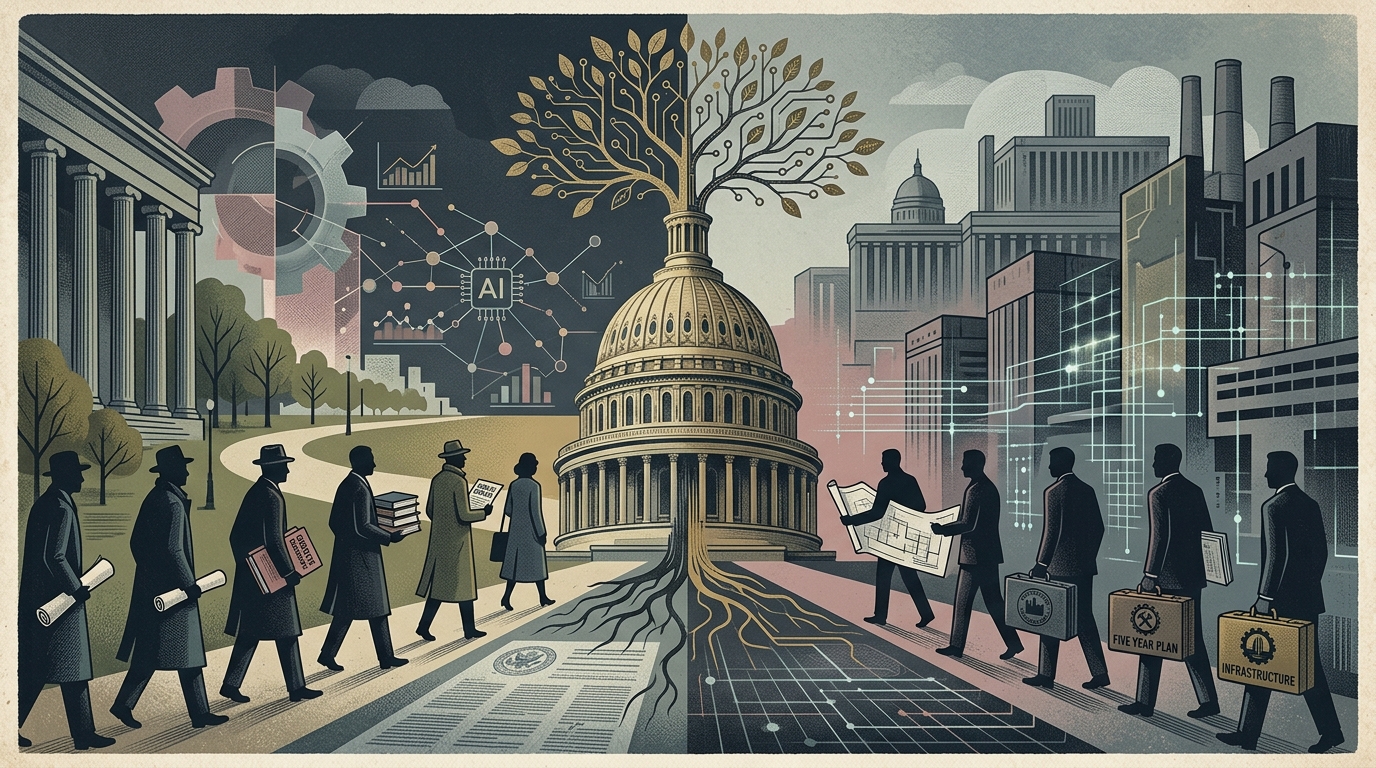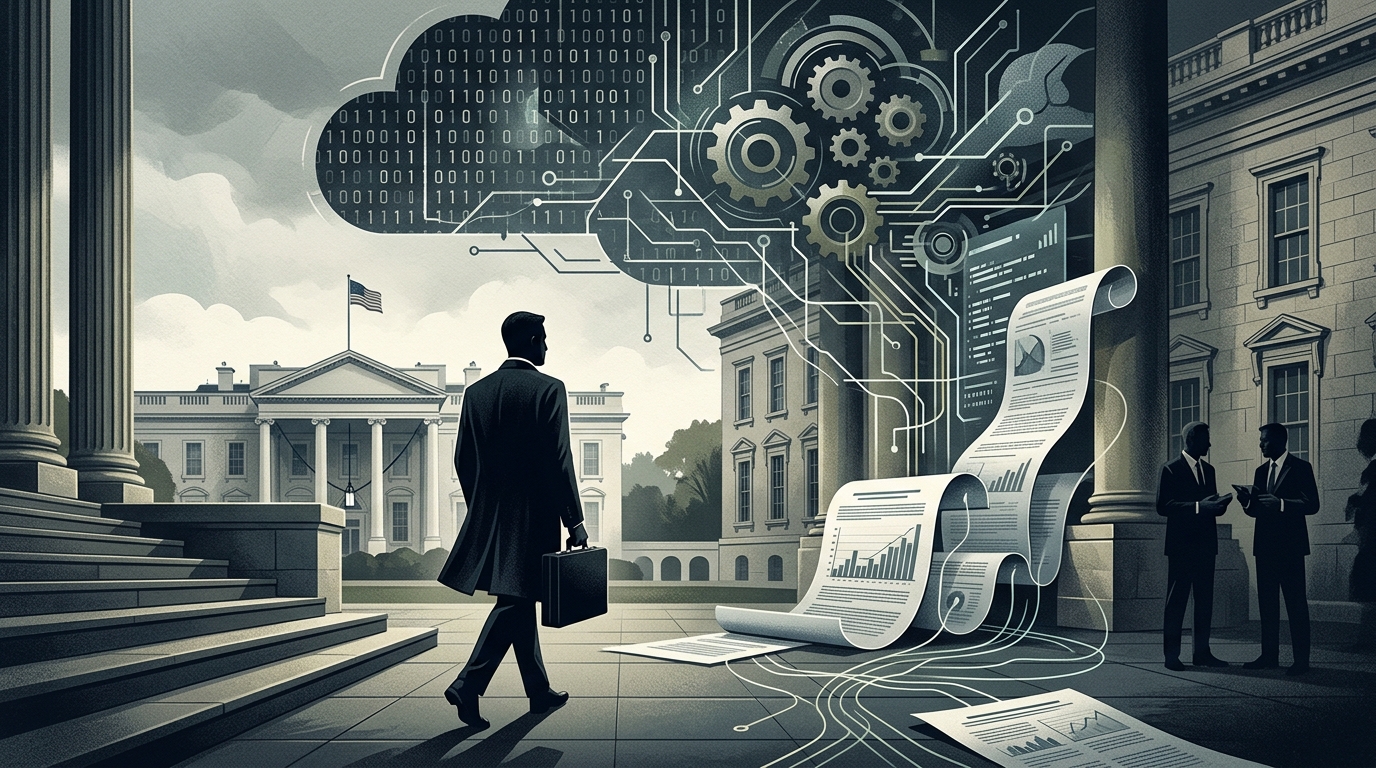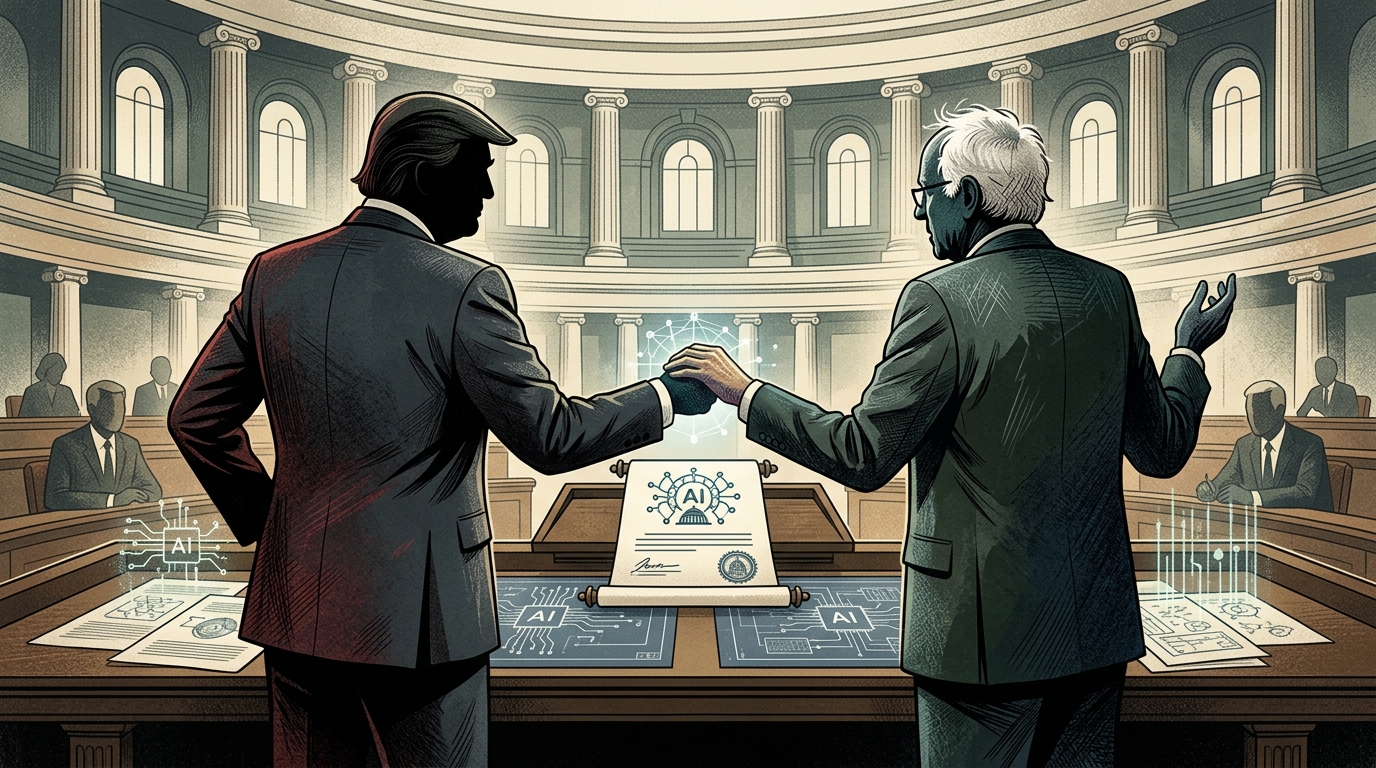
In the hyper-polarized landscape of contemporary American politics, finding common ground between Donald Trump and Bernie Sanders usually feels like a feat of political alchemy. Yet, the meteoric rise of Artificial Intelligence (AI) is achieving the seemingly impossible. A landmark report by the Los Angeles Times highlights an emerging consensus: the notion that AI infrastructure—specifically compute power and data—is far too consequential to be left exclusively in the hands of a few Silicon Valley titans. This pivot toward 'technological statism' signals a definitive end to the era of laissez-faire dominance in the tech sector.
The Horseshoe Theory of Tech Policy
This convergence is best understood through 'horseshoe theory,' which posits that the far-left and far-right often bend toward each other on core issues of power and institutional skepticism. For Bernie Sanders and the progressive wing of the Democratic Party, the argument for public ownership or robust public utility models stems from a commitment to social equity. AI, they argue, is trained on public data—the collective output of human knowledge—and its dividends should not be sequestered by the shareholders of Microsoft, Google, or OpenAI. Their concern is the 'automated inequality' that could arise if productivity gains are not redistributed to the public.
Conversely, Donald Trump and the 'America First' movement view AI through the lens of national security and the existential competition with China. For the populist right, relying on private corporations—which often harbor globalist interests or 'woke' cultural agendas—is a strategic liability. The proposal for an 'AI Manhattan Project' is gaining traction within MAGA circles. In this vision, the federal government wouldn't just regulate AI; it would own and operate the massive supercomputing clusters necessary to train next-generation models, ensuring they reflect national interests rather than corporate whims.
The Battle for 'Compute Sovereignty'
At the heart of this debate lies 'compute'—the raw processing power required to run AI. Currently, developing frontier models requires billions in capital expenditure for Nvidia chips and massive energy infrastructure. This has created a natural monopoly. Sanders advocates for the creation of a 'National AI Research Resource' (NAIRR) that would provide free or subsidized compute to academics and startups, lowering the barrier to entry created by Big Tech. Trump, despite his traditional deregulatory stance, appears to agree that 'national compute' is as vital to 21st-century power as the electrical grid or the interstate highway system were in the 20th.
"We cannot outsource the future of our civilization to five CEOs in Menlo Park and Mountain View. AI is a public utility, much like water or electricity," sources close to both camps have noted.
This rhetoric is sending shivers through Silicon Valley, which has enjoyed decades of operational autonomy. Industry lobbyists argue that public ownership will stifle innovation and render the U.S. less competitive against China's state-backed AI champions. However, this argument is losing its sting as even conservatives begin to view Big Tech as an 'internal adversary' that controls the flow of information and suppresses dissenting speech.
Global Economic Implications
If the United States moves toward a public-private partnership model with significant state ownership in AI, the global ramifications will be profound. The European Union, already a leader in regulation through the AI Act, may be forced to rethink its own industrial strategy. 'Sovereign AI' is becoming the new global mantra. Nations no longer want to merely consume AI services; they want to own the stacks. This is ushering in a new era of technological protectionism, where data and compute are treated as strategic reserves, much like oil was treated in the previous century.
In conclusion, the Trump-Sanders convergence is not a mere political fluke. It is a structural reaction of political power to a technology that threatens to transcend it. Whether the motivation is protecting the labor force or projecting national strength, the state is re-entering the tech economy with a vengeance. Silicon Valley may soon find itself answering to a shareholder it never anticipated: the public, or at least, the politicians who claim to speak in its name. The coming years will determine if AI remains a private gold mine or becomes the most significant public utility in human history.