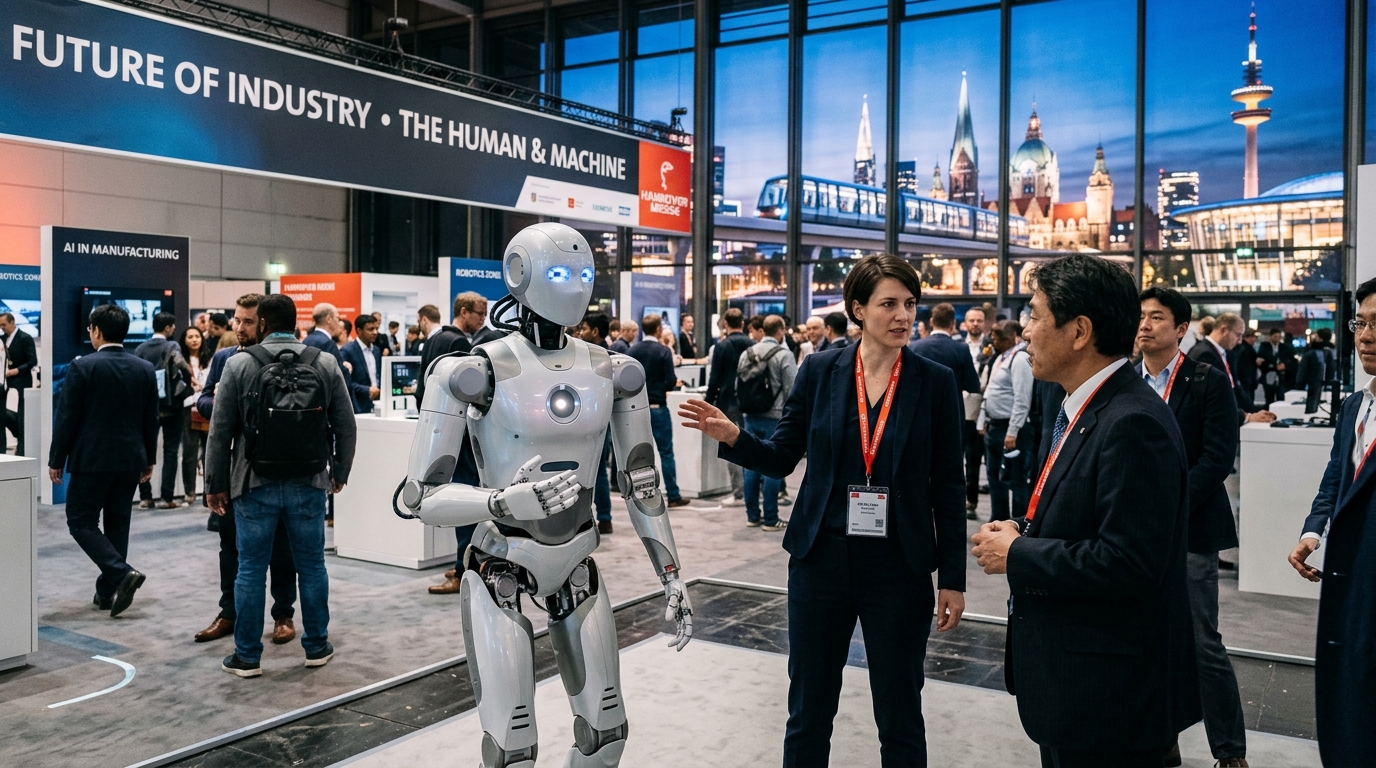
In the sprawling halls of Hannover Messe, Germany's iconic industrial trade fair, the clatter of gears and pneumatic systems has been replaced by the near-silent hum of high-performance servo motors. This year, 2026, we are no longer standing on the threshold of change; we have walked through the door. Humanoid robots, once the subject of ridicule or sci-fi tropes, are now the undeniable reality of heavy industry.
The Convergence of AI and Mechanical Engineering
What we witnessed in Hannover is not merely an evolution in robotics, but the full integration of Large Language Models (LLMs) and Vision-Language-Action (VLA) models into physical embodiments. Robots like Figure 02 and Apptronik’s new Apollo no longer execute pre-programmed paths. Instead, they "understand" their environment through end-to-end neural networks, allowing them to adapt to unpredictable changes on the production line in real-time.
Germany's own Neura Robotics showcased the 4NE-1, a humanoid designed to work seamlessly alongside human workers, recognizing not just commands but intent. The difference from the past is profound: robots now possess a form of "industrial common sense." If an object slips, the robot catches it mid-air. If a human steps in its path, the robot recalculates its trajectory in milliseconds without triggering an emergency shutdown.
Solving Europe's Demographic Deadlock
For Germany, the necessity for these machines is not a matter of luxury, but of economic survival. With an aging population and a growing shortage of skilled labor—estimated at hundreds of thousands of vacancies annually—the German "Mittelstand" (the small and medium enterprises that form the backbone of the economy) is turning to automation en masse.
"We aren't replacing people; we are filling gaps that no one wants to fill anymore," a senior executive from a major automotive tier-one supplier noted during a keynote.
The conversation has shifted from "if" robots will take our jobs to "how" we can maintain our manufacturing base in Europe without them. Humanoids offer a unique advantage: versatility. They can operate in infrastructure designed for humans, using the same tools and navigating the same stairs, avoiding the astronomical costs of completely redesigning a factory for traditional, fixed robotic arms.
Geopolitical Competition: USA, China, and Europe
The Hannover Messe also highlighted the gap Europe is racing to close. While American firms like Tesla with Optimus and Chinese companies like Unitree with the G1 are showing impressive strides in walking speed and manufacturing cost, Europe is doubling down on precision and safety standards. Germany is betting on the quality of its sensors and actuators, sectors where it has traditionally held global dominance.
- Cost: Prices have plummeted. A humanoid robot that cost €250,000 three years ago is now approaching the €40,000-€60,000 range.
- Autonomy: Battery life has reached the 8-10 hour mark, effectively covering a full work shift.
- Dexterity: Robotic hands can now handle fragile components with the same finesse as a human technician.
However, the challenge remains scaling. China has announced targets for mass-producing humanoids by the end of 2026, putting immense pressure on European manufacturers to accelerate their commercialization. The question is no longer who has the most impressive prototype, but who can flood the market with thousands of reliable, industrial-grade units.
Conclusion: A New Social Contract?
As humanoid robots become a common sight in factories, and soon in logistics warehouses, society is being forced to redefine the meaning of labor. Hannover Messe 2026 demonstrated that the technology is ready. Whether institutions, labor unions, and educational systems are equally prepared remains to be seen. The "rise of the humanoids" is not a threat from the future, but a reflection of the urgent needs of the present.