In the modern landscape of medical imaging, the sheer volume of data generated daily is often overwhelming. One of the most critical issues in pulmonology is the management of "incidental findings"—small spots on the lungs, known as pulmonary nodules, discovered during CT scans performed for unrelated reasons. While most nodules are benign, a small minority represent early-stage lung cancer. Madigan Army Medical Center (MAMC) in Washington State is now at the forefront of addressing this issue, leveraging advanced Artificial Intelligence to create an automated Pulmonary Nodule Registry.
The Problem of "Lost" Patients
The challenge faced by major medical institutions, such as those within the U.S. Army, is not a lack of diagnostic tools but the administrative complexity of follow-up care. When a radiologist identifies a small nodule, clinical guidelines typically require repeat imaging at six, twelve, or twenty-four-month intervals. However, in a dynamic environment like the military, where patients frequently relocate or change insurance plans, a significant percentage of these patients are "lost to follow-up." This gap can be fatal, as a treatable nodule may progress to metastatic cancer by the next time the patient enters a clinical setting.
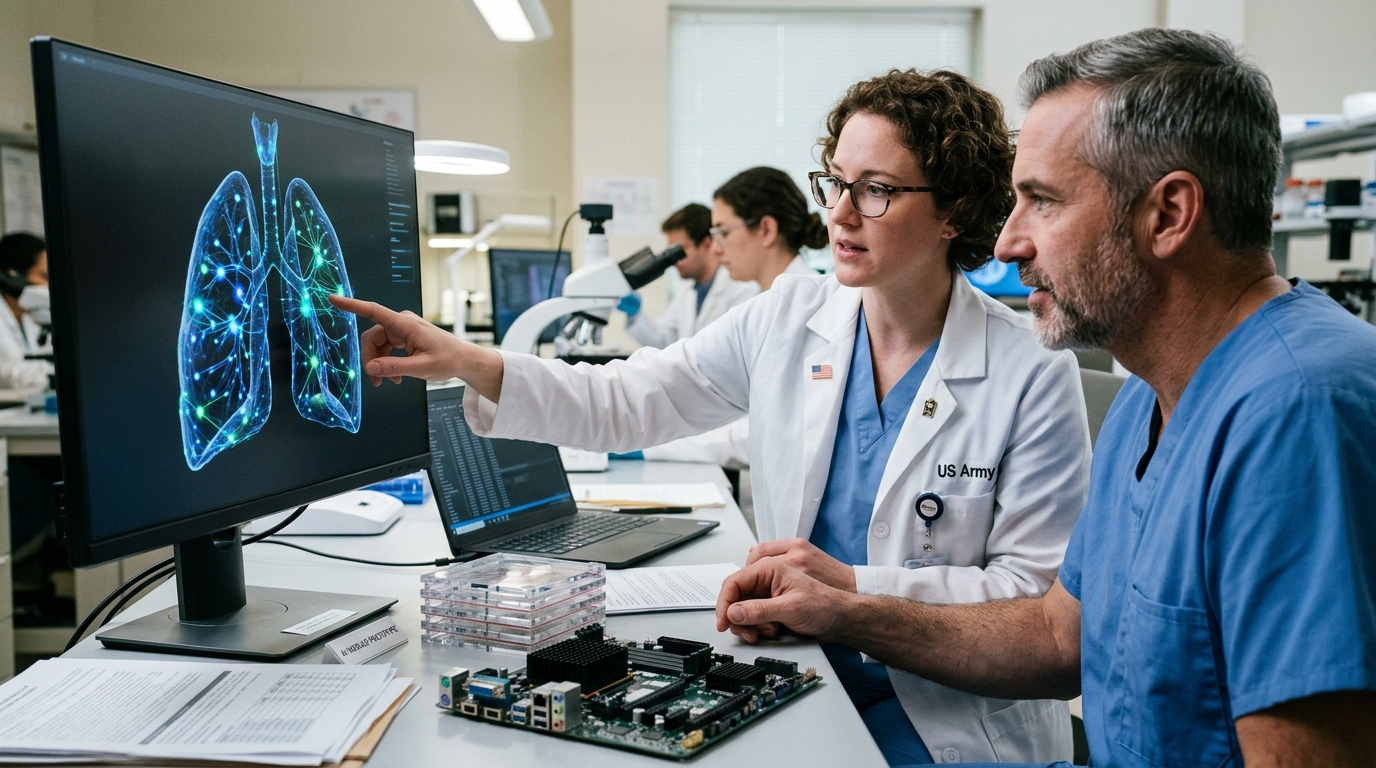
Madigan’s new system employs Natural Language Processing (NLP), a branch of AI, to "read" thousands of radiology reports in real-time. It detects keywords indicating the presence of nodules and automatically enrolls the patient into the registry, alerting care coordinators. This eliminates the need for manual data entry, which is prone to human error and extremely time-consuming.
Technology Supporting Clinical Decisions
The use of AI at Madigan does not replace the physician but serves as a vigilant digital sentry. The software evaluates nodule characteristics—size, shape, density—and compares them against international standards such as the Fleischner Society guidelines. In doing so, the system can prioritize patients based on risk levels. Patients with nodules displaying suspicious features are fast-tracked for biopsies or further investigation, while low-risk patients are monitored appropriately without placing an unnecessary burden on the healthcare system.
- Automated scanning of thousands of radiology reports daily.
- Reduction in time between nodule discovery and treatment initiation.
- Integration of data across various clinics within the military health system.
- Improved survival rates through early intervention at Stage 1.
According to program leads at Madigan, the introduction of AI has already shown impressive results in follow-up accuracy. "This isn't just about technology; it's a paradigm shift in how we manage the health of soldiers and their families," stated medical corps officials. The system's ability to recognize patterns that might escape a fatigued physician at the end of a long shift is proving invaluable.
Toward a National Standard of Care
The success of Madigan Army Medical Center is not an isolated event but part of a broader strategy by the Defense Health Agency (DHA) to integrate AI across the spectrum of military medicine. This model is expected to be scaled to other military treatment facilities and could potentially serve as a blueprint for the Veterans Affairs (VA) system and the private sector in the United States.
"AI allows us to close the holes in our safety net. No patient should discover they have terminal cancer because a note on a scan from two years ago was overlooked," says a source from Madigan’s medical staff.
However, the adoption of such systems brings forth challenges, particularly regarding data privacy and the ethical use of AI. Within the Army environment, data security is paramount, and Madigan’s system operates within a strictly controlled and encrypted network. The challenge for the future will be maintaining this security as the system interconnects with more databases, providing a holistic view of population health.
In conclusion, Madigan’s Pulmonary Nodule Registry is tangible proof that Artificial Intelligence, when applied with a specific goal and medical oversight, can save lives. By transforming disorganized data into structured, actionable information, medical science is taking a giant leap toward proactive and personalized care, reducing the human cost of one of the era's most lethal diseases.