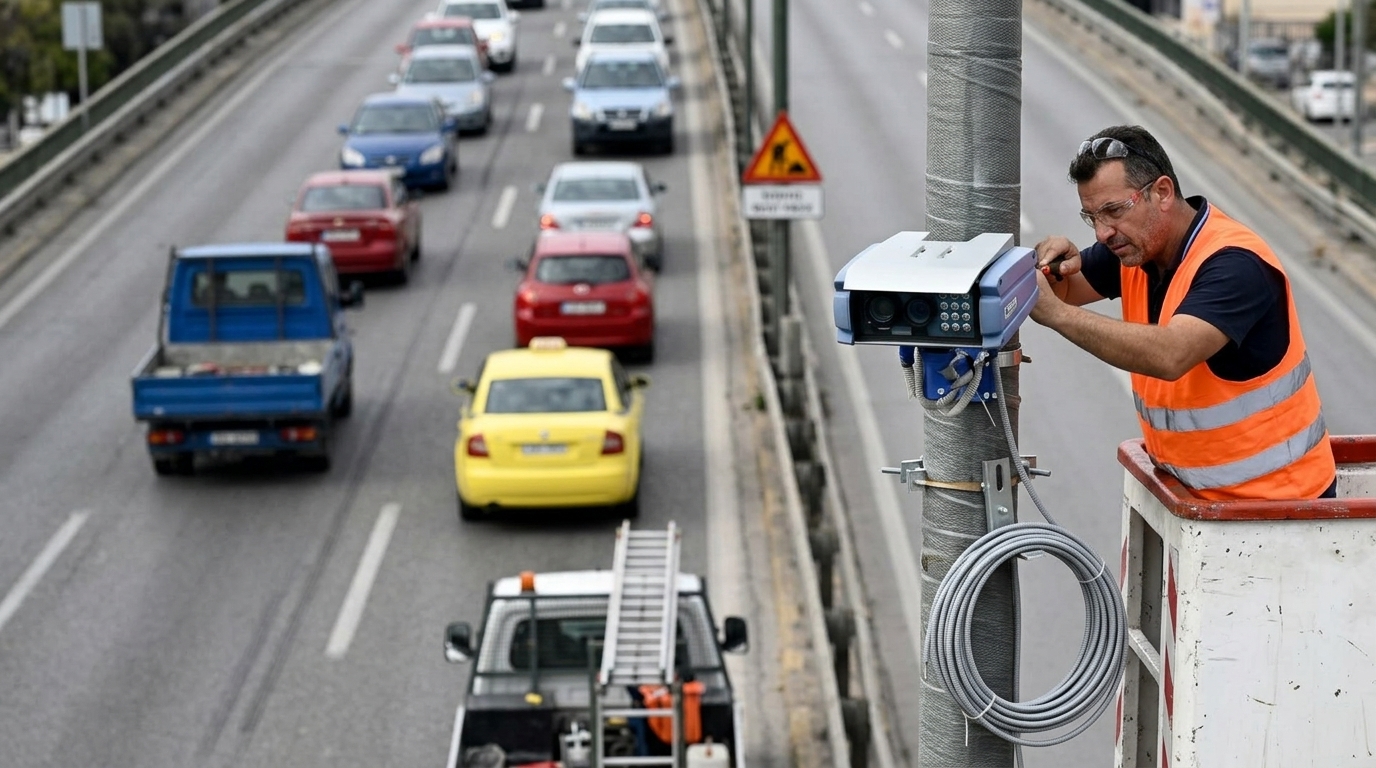
June 5, 2026, marks a pivotal moment for public safety and Greece's digital transformation. The ambitious project for the procurement and installation of 1,000 "smart" traffic monitoring cameras, which had encountered bureaucratic and technical hurdles in previous months, is officially restarting. The publication of the new tender on the European procurement portal (TED) is not merely an administrative act, but the starting point for a radical shift in driving culture and law enforcement on Greek roads.
Technological Superiority and Capabilities of the New Systems
The new cameras will bear no resemblance to the outdated systems of the past. These are high-definition devices equipped with Artificial Intelligence (AI), capable of operating under any weather conditions and during the night. The system will focus on three primary violations that are the most frequent causes of serious road accidents: running red lights, using a mobile phone while driving, and failing to wear a protective helmet or seatbelt.
According to the specifications, the cameras will feature Automatic Number Plate Recognition (ANPR) software, which will connect in real-time to the databases of the Ministry of Infrastructure and Transport, the Hellenic Police, and the Independent Authority for Public Revenue (AADE). This interconnectivity ensures that the validation of the violation will occur automatically, without the need for human intervention at the initial stage, thereby reducing the chances of subjective judgment or the "erasing" of tickets.
Road Safety: An Urgent Necessity
Greece unfortunately remains high in European Union rankings regarding the number of road fatalities and serious injuries per million inhabitants. Attica, with its heavily burdened road network, is the epicenter of the problem. The installation of 1,000 cameras aims to create an "invisible net" of protection. A driver's psychology changes when they know that the probability of detecting a violation is nearly 100%.
- Reduction of red-light violations by 40% within the first year.
- Automated delivery of fines via the Gov.gr Wallet.
- Freeing up Traffic Police personnel for other critical services.
- Collection of traffic data to improve urban transportation planning.
The government maintains that the project is not revenue-focused but purely preventative. However, critics point out that the revenue from fines will be substantial, raising questions about the management of these resources and their reinvestment into road infrastructure projects.
The Privacy Issue and GDPR Compliance
One of the greatest challenges in implementing the project was ensuring the privacy of citizens. The Hellenic Data Protection Authority (HDPA) has set strict rules. The cameras will record only the rear of the vehicle and the license plate in cases of violation, while the faces of drivers and passengers will be automatically "blurred" by the software, unless their disclosure is necessary to certify a specific violation (e.g., mobile phone use).
"Technology must serve the human being, not monitor them indiscriminately. The balance between safety and freedom is the key to society's acceptance of this system," state sources from the Ministry of Digital Governance.
Data storage will take place on secure state servers, with strict access protocols and a specific retention period, after which the data will be permanently deleted. This framework is essential to avoid legal entanglements that could lead to the cancellation of fines in courts.
Economic Impact and Timeline
The project's budget is significant and is partially funded by European resources. The tender process is expected to be completed by the end of 2026, with the full operation of the system scheduled for 2027. The winning contractors will undertake not only the supply and installation but also the maintenance of the network for a decade.
This restart serves as a reliability test for the Greek administration. The successful implementation of the 1,000 cameras will serve as a model for other Greek cities, such as Thessaloniki and Patras, where road safety issues are equally intense. In an era where "Smart Cities" are becoming a reality, digital road enforcement is an inevitable, albeit controversial, step toward the future.