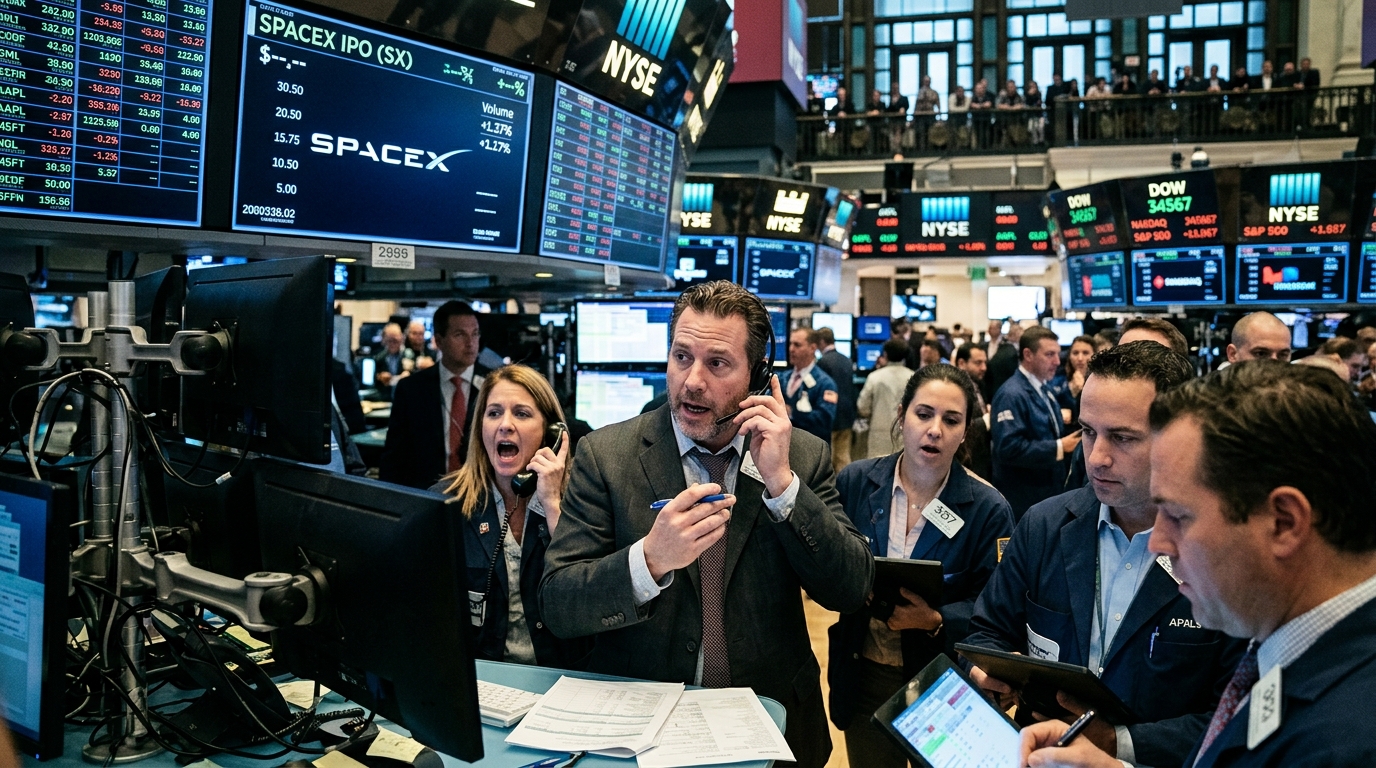
In a historic moment for global capital markets and the aerospace industry, Elon Musk’s SpaceX has become the epicenter of unprecedented investor interest. According to reports from Bloomberg, the company’s $75 billion initial public offering (IPO) has already garnered orders that significantly exceed the number of available shares. This development, occurring just days after the official start of the deal’s marketing to institutional investors, underscores the market's unwavering confidence in Musk’s vision for space exploration and dominance.
Strategic Oversubscription and the Starlink Engine
The demand for SpaceX shares is not merely a sign of speculative fervor but a resounding vote of confidence in its business model's long-term viability. For years, the company relied on private funding rounds, maintaining a veil of exclusivity. By finally opening its doors to public investors, SpaceX is offering a stake in its multi-faceted empire, ranging from rocket launches to global satellite communications. Analysts point to Starlink, the company's satellite internet constellation, as the primary driver of this demand. With Starlink’s profitability having stabilized in 2025 and its subscriber base growing exponentially, investors see a rare opportunity to combine disruptive technological innovation with steady, recurring cash flows.
The oversubscription of the offering means that SpaceX now has the luxury of hand-picking "high-quality" investors. The company is expected to prioritize long-term institutional funds that understand the high-risk, high-reward nature of the space economy. It is increasingly likely that the share price will be set at the top end of the initial range, potentially pushing the company’s post-IPO valuation toward the $250 billion mark.
Starship: The Game-Changer
Beyond the financial performance of Starlink, investor attention is fixated on the Starship program. The massive, fully reusable launch system, which has completed a series of successful orbital flights in early 2026, promises to reduce the cost of reaching space by an order of magnitude. This technological lead creates a near-monopoly for SpaceX, as competitors like Jeff Bezos’s Blue Origin and Europe’s Arianespace struggle to match Musk’s rapid iteration cycle.
“You aren’t just buying a rocket company; you are buying a ticket to the infrastructure of the next economic revolution,” noted a senior investment banker on Wall Street.
The success of Starship is also vital for NASA’s Artemis program, with SpaceX serving as the primary partner for returning humans to the lunar surface. This deep integration with the U.S. government provides a geopolitical “moat,” making the company an essential asset for national security. However, this reliance on government contracts is also a point of scrutiny, with some analysts warning against the concentration of such critical capabilities within a single private entity.
Regulatory Hurdles and Global Competition
Despite the euphoria, the path to the public market is not without obstacles. SpaceX faces rigorous oversight from the Federal Aviation Administration (FAA) regarding the environmental impact of its frequent launches, as well as from the Securities and Exchange Commission (SEC) concerning financial transparency. Furthermore, Elon Musk’s persona remains a double-edged sword. Investors worry that his involvement in multiple high-stakes ventures—Tesla, X, and xAI—could distract from SpaceX’s operational requirements during this critical growth phase.
Additionally, the global market for satellite internet is becoming increasingly crowded. Amazon’s Project Kuiper is preparing for its own operational deployment, and China is accelerating the development of its low-Earth orbit constellation. SpaceX must prove it can maintain its first-mover advantage while continuing to lower costs for consumers and maintaining healthy margins for its new shareholders.
Conclusion: A New Era for Wall Street
The SpaceX IPO is poised to be the largest in U.S. history, potentially eclipsing the record-breaking debut of Saudi Aramco. If current demand trends hold, June 5, 2026, will be remembered as the day space transitioned from a scientific frontier to a central pillar of global capitalism. For retail investors, while direct access to the IPO might be limited, the stock’s listing on the secondary market will open a new world of both immense opportunity and significant risk.
- The $75 billion IPO size reflects only a fraction of the company's total estimated value.
- Massive oversubscription indicates a high level of market liquidity seeking high-growth assets.
- SpaceX is evolving from a founder-led startup into a global institutional powerhouse.