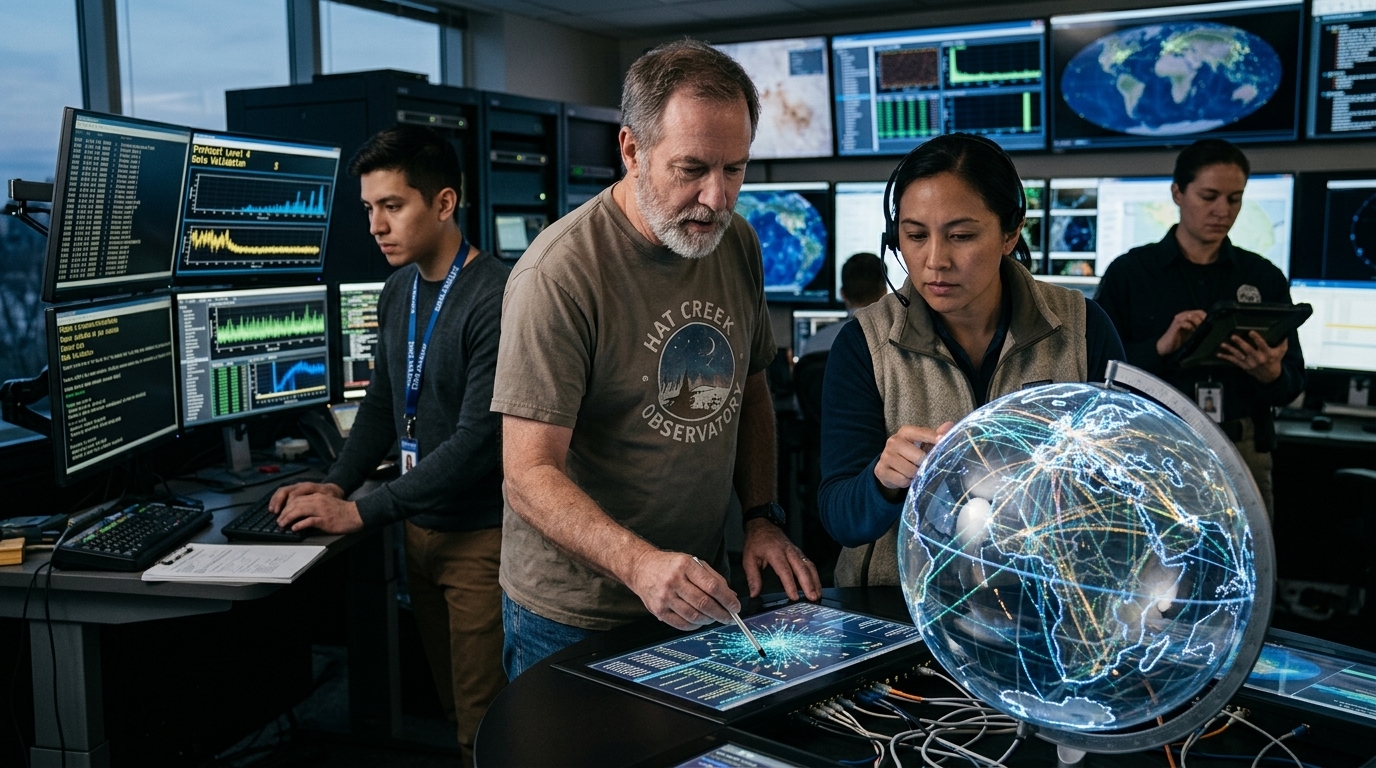
For decades, the Search for Extraterrestrial Intelligence (SETI) was confined to the realms of science fiction or fringe research programs with meager funding. However, as radio telescope technology advances and Artificial Intelligence allows us to sift through cosmic noise with unprecedented precision, the question is no longer just whether we are alone, but what we will do the moment we receive a response. A team of leading scientists from the University of St Andrews, in collaboration with the SETI Post-Detection Hub, recently presented a comprehensive eight-point action plan, aiming to serve as humanity's roadmap for first contact.
The need for such a protocol is imperative. The last internationally recognized framework was drafted in 1989 by the SETI community, an era when the internet was in its infancy and the geopolitical balance was entirely different. Today, the speed of information and the polarization of social media make the management of such news a potentially explosive issue. The new plan focuses not only on the technical analysis of the signal but also on the social, legal, and political implications of a discovery that would forever alter the course of our species.
The Eight Pillars of Cosmic Diplomacy
The action plan begins with the fundamental stage of verification. Before any announcement, the signal must be confirmed by multiple independent observatories worldwide to rule out human interference, technical error, or natural phenomena. This is followed by transparent communication: the news must not be kept secret by any government but disseminated to the scientific community and the public simultaneously to prevent conspiracy theories.
One of the most critical points is collective decision-making regarding a response. The question of "to reply or not?" is perhaps the most divisive in astrobiology. Some argue that revealing our location could be dangerous (the "Dark Forest" theory), while others believe silence would be a lost opportunity for the advancement of knowledge. The protocol proposes the creation of a permanent body under the auspices of the UN, representing humanity as a whole rather than just the major powers.
The Role of AI in Translating the Unknown
In this process, Artificial Intelligence (AI) plays the role of a "digital Champollion." A message from the stars will not be in English or Greek; it will likely be based on mathematical concepts or physical constants. Large language models and machine learning algorithms are the only tools we possess to identify patterns in semantic systems that have no connection to human biology or culture.
AI can analyze the structure of the signal, identify repeating sequences, and suggest possible interpretations. However, scientists warn: AI is trained on human data. There is a risk of "anthropomorphizing" the message, projecting our own biases and fears onto a completely foreign intelligence. The action plan envisions the creation of specialized "think tanks" where linguists, anthropologists, and AI experts will collaborate to avoid misinterpretations that could lead to interplanetary misunderstandings.
Social Resilience and the Future
Finally, the plan emphasizes long-term management. Receiving a signal will not be a one-day event but a process that could last centuries, given the vast distances of space. We must prepare society for the existential crisis that will follow. How will religions react? How will the economy be affected? The SETI Post-Detection Hub argues that education and critical thinking are our only defenses against panic.
Humanity stands at a crossroads. For the first time in history, we are not just looking at the stars with awe but organizing the bureaucracy of first contact. Perhaps preparing for the "other" is ultimately the best way to understand ourselves and unite as a planet, even before the first "hello" arrives from the void.