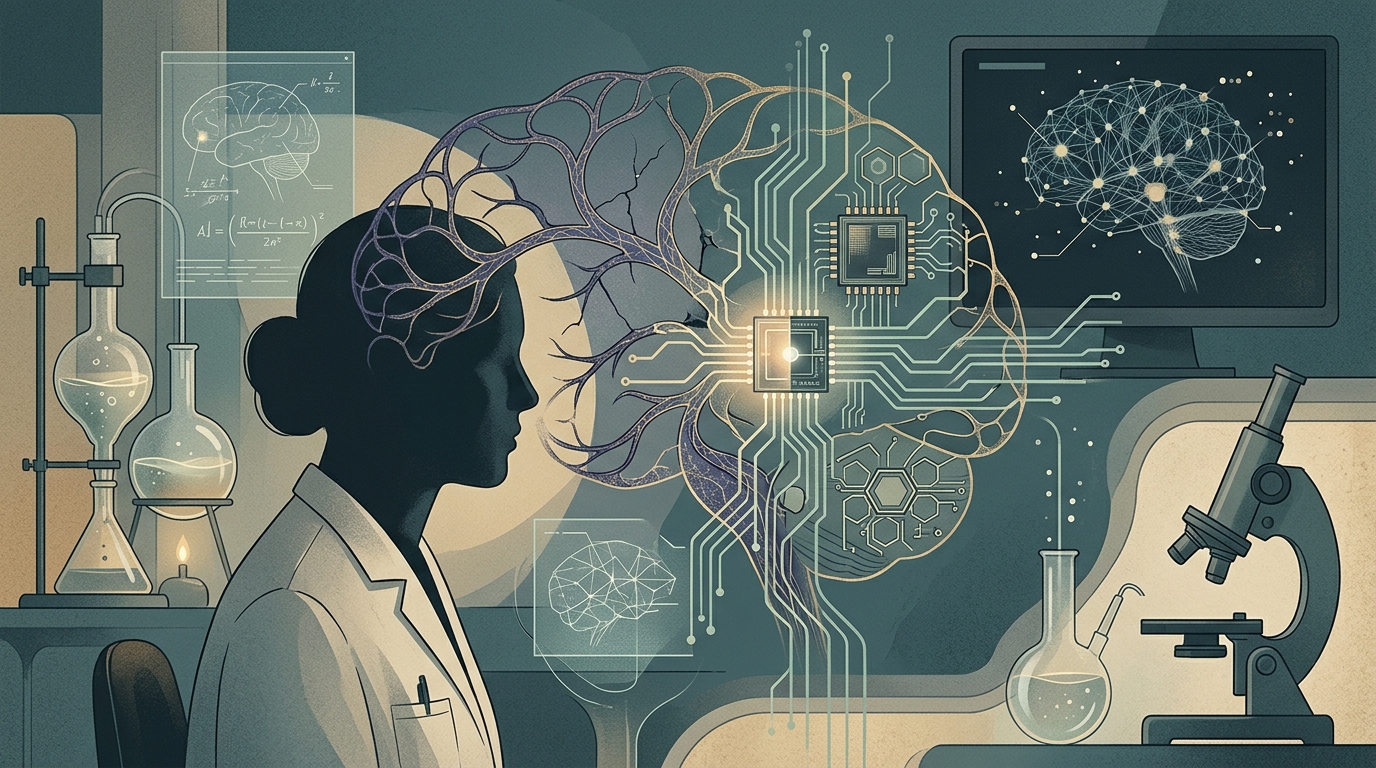
In the vast landscape of modern neuroscience, few figures bridge the gap between biological complexity and computational power with the acuity of Gabriel Kreiman. The Harvard professor, renowned for his pioneering research on visual processing and memory, proposes a provocative thesis: the human brain, while the most sophisticated organ in the known universe, is riddled with "bugs" that Artificial Intelligence (AI) can not only understand but also fix.
Biological Heritage and Its Limitations
Our brains were not designed for the 21st century. They are the product of millions of years of evolution, optimized for survival on the savanna rather than processing massive data streams or making split-second decisions in a digital environment. Kreiman points out that we are bound by cognitive biases, limited working memory, and a propensity to see patterns where none exist.
According to Kreiman, AI offers both a "mirror" and a "tool." While current algorithms are inspired by the structure of neural networks, their superiority lies in their ability to operate without the biological constraints of fatigue, emotional bias, and energy bottlenecks. AI can process information with an objectivity that humans, by nature, lack.
AI as a Cognitive Prosthetic
Kreiman’s core idea is not about replacing humans but augmenting them. Imagine AI systems acting as "cognitive crutches," correcting perceptual errors in real-time. For instance, in medical diagnosis, a radiologist’s brain might overlook a detail due to visual fatigue. An AI system, trained on millions of images, never tires and can point out what the human brain missed.
- Correcting visual illusions and perceptual gaps.
- Enhancing memory through intelligent information retrieval systems.
- Filtering information to prevent cognitive overload.
This approach shifts the narrative from "AI vs. Human" to "AI for Human." Kreiman argues that by understanding how the brain fails, we can build machines that are more robust, and in turn, these machines will help us become "better" humans, at least on a functional level.
Ethical Dilemmas: What Does it Mean to "Fix" the Brain?
However, Kreiman’s proposal is not without risks. If we begin using AI to "fix" the way we think, who defines what is "correct"? Human creativity often stems from the very "errors" and idiosyncrasies of our thought processes. The complete elimination of cognitive biases could lead to a sterile, hyper-rational society devoid of empathy or artistic intuition.
"The brain is a miracle, but it is a miracle with limits. AI is the first technology that allows us to see beyond our biological ceiling," Kreiman notes in his lectures.
Furthermore, there is the issue of access. If "fixing" the brain becomes a privilege for the few, we risk creating a new class of "cognitively enhanced" individuals, deepening social inequalities. Kreiman warns that technology must be developed with inclusivity and ethical frameworks in mind.
The Future of Human-Machine Collaboration
As we move toward 2030, Kreiman’s research at Harvard points to a path where neuroscience and computer science become one. The development of neuromorphic chips that mimic neuronal function but with the precision of silicon is already underway. The vision is a symbiotic relationship where AI will not just be a tool on our phones but an extension of our very nervous system.
In conclusion, Gabriel Kreiman invites us to accept our imperfections not as flaws, but as opportunities for evolution. Artificial Intelligence, in its noblest form, may be the medium that allows us to transcend our biological limits and unlock the true potential of the human spirit.