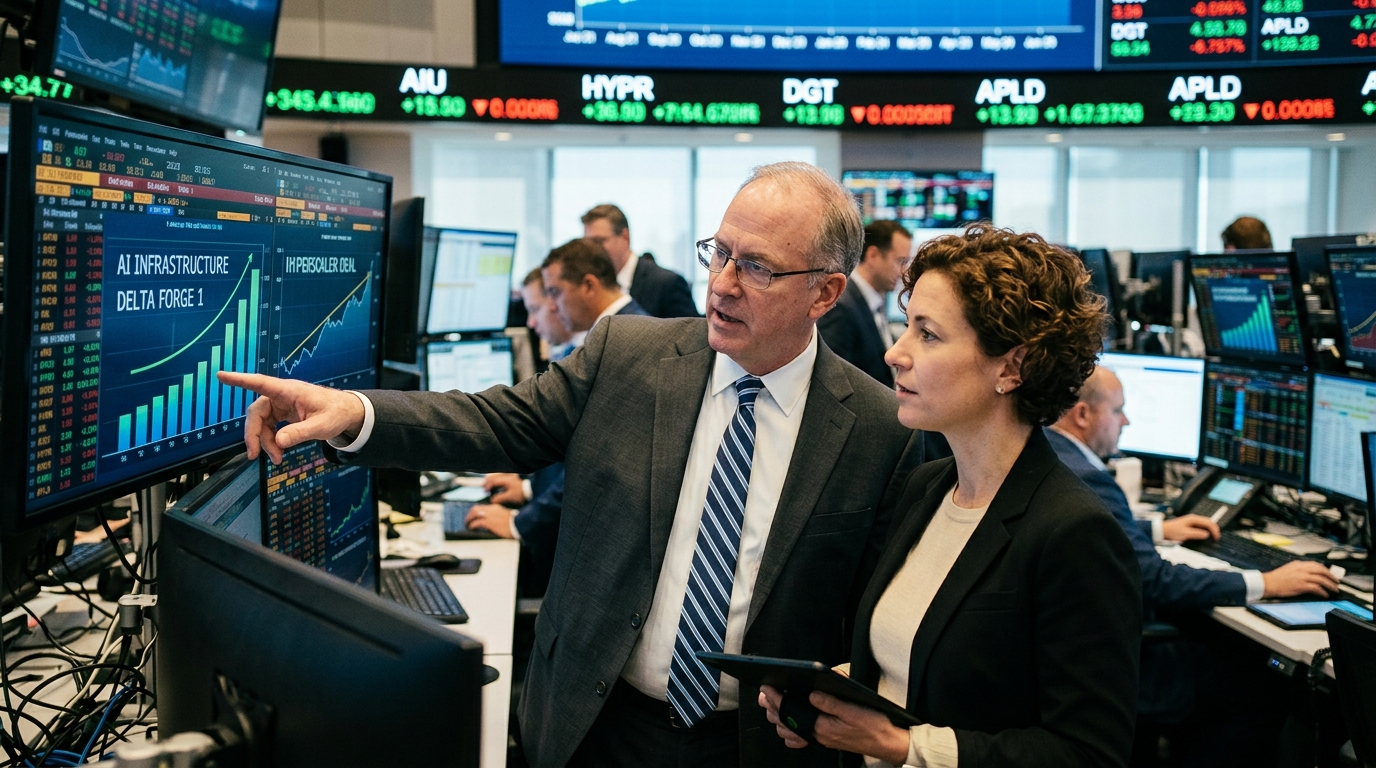
In the vast landscape of North Dakota, where oil rigs and farmland once defined the horizon, a new form of industrial power is emerging: the "AI Factory." Applied Digital Corporation (APLD) recently announced a landmark agreement with a high investment-grade hyperscaler tenant for its Delta Forge 1 campus. This move is not merely a win for the company's balance sheet; it underscores a titanic shift of capital toward the physical infrastructure required to sustain the generative AI revolution.
The Strategic Significance of Delta Forge 1
Delta Forge 1 is far from a conventional data center. With a total capacity of 430 MW, it stands as one of the world's largest purpose-built facilities for High-Performance Computing (HPC) and AI workloads. The agreement pertains to the initial phase of the project, which will house the massive computational needs of a major tech titan. While the specific name remains confidential, the "high investment-grade" designation points directly to industry leaders like Microsoft, Google, or Amazon.
The choice of Ellendale, North Dakota, is a masterstroke of logistics. The region offers some of the lowest energy costs in the United States and a climate that facilitates natural cooling, drastically reducing operational overhead. In an era where power grid access has become the primary bottleneck for AI scaling, Applied Digital has secured a literal "energy oasis," making it an indispensable partner for hyperscalers hungry for capacity.
From Blockchain to AI Hegemony
Applied Digital’s trajectory is emblematic of the broader technological evolution. Originally founded as Applied Blockchain, the company pivoted early, realizing that the true value lay not in mining volatile cryptocurrencies but in owning and managing the "digital real estate" of the future. This rebranding and focus on AI Factories is a strategic bet that is now paying off as the demand for specialized compute space reaches a fever pitch.
- Next-Generation Infrastructure: Delta Forge 1 incorporates advanced liquid cooling systems, a non-negotiable requirement for the latest generation of chips, such as NVIDIA’s H100 and Blackwell architectures.
- Financial Stability: Securing a high-credit tenant ensures predictable, long-term recurring revenue, allowing APLD to de-risk its capital expenditures and fuel further expansion.
- National Security & Sovereignty: Concentrating such immense compute power within U.S. borders bolsters the nation’s technological autonomy in the global race for AI supremacy.
The Energy Challenge and the Path Ahead
The primary challenge facing Applied Digital—and the industry at large—is sustainability. A 430 MW campus consumes as much electricity as a mid-sized city. The company has committed to leveraging local renewable energy sources, particularly the region's abundant wind power. However, criticism regarding the environmental footprint of AI Factories remains a point of contention for activists and regulators alike.
"We aren't just building buildings with servers. We are building the engine that will generate the knowledge of the future," an APLD executive noted during a recent investor briefing.
The Delta Forge 1 deal is likely just the opening act. As AI models grow in complexity, the requirement for facilities capable of handling massive power densities will increase exponentially. By securing the land, the power permits, and now the anchor tenants, Applied Digital is positioning itself at the vanguard of this new industrial era.
Conclusion
Applied Digital's announcement is a vote of confidence in the physical layer of the AI stack. In a world often obsessed with software and algorithms, APLD serves as a reminder that artificial intelligence has a physical footprint. It is made of miles of fiber, sophisticated cooling arrays, and, most importantly, vast quantities of power. The success of Delta Forge 1 will likely serve as the blueprint for how the United States constructs its digital future.