Pediatric medicine has always occupied a delicate intersection between rapid technological advancement and the necessity for a deeply personalized touch. As we move through May 2026, Artificial Intelligence (AI) has transitioned from a futuristic promise to a critical frontline tool in clinical diagnosis. Children’s National Hospital in Washington, D.C., a global leader in pediatric care, is currently spearheading a transformation in how AI is deployed within radiology, specifically tailored to the unique biological requirements of children.
The Challenge of the Developing Body
Implementing AI in pediatric radiology is fundamentally more complex than in adult medicine. A child is not merely a "small adult." From infancy through adolescence, the human body undergoes profound shifts in anatomy, physiology, and tissue composition. For instance, growth plates in a child's bones can easily be misinterpreted by an algorithm trained solely on adult data as fractures or traumatic injuries.
Children’s National Hospital identified this gap early in the AI boom. Their researchers emphasize that the vast majority of commercially available AI models were developed using adult datasets, making their direct application to pediatric patients not only inaccurate but potentially hazardous. Developing algorithms that comprehend the "developmental continuum" is the central challenge. This requires massive amounts of high-quality data across various age groups—a resource that is notoriously difficult to aggregate due to the rarity of certain pediatric conditions and the stringent privacy protections surrounding minors' medical records.
From Bench to Bedside: Clinical Integration
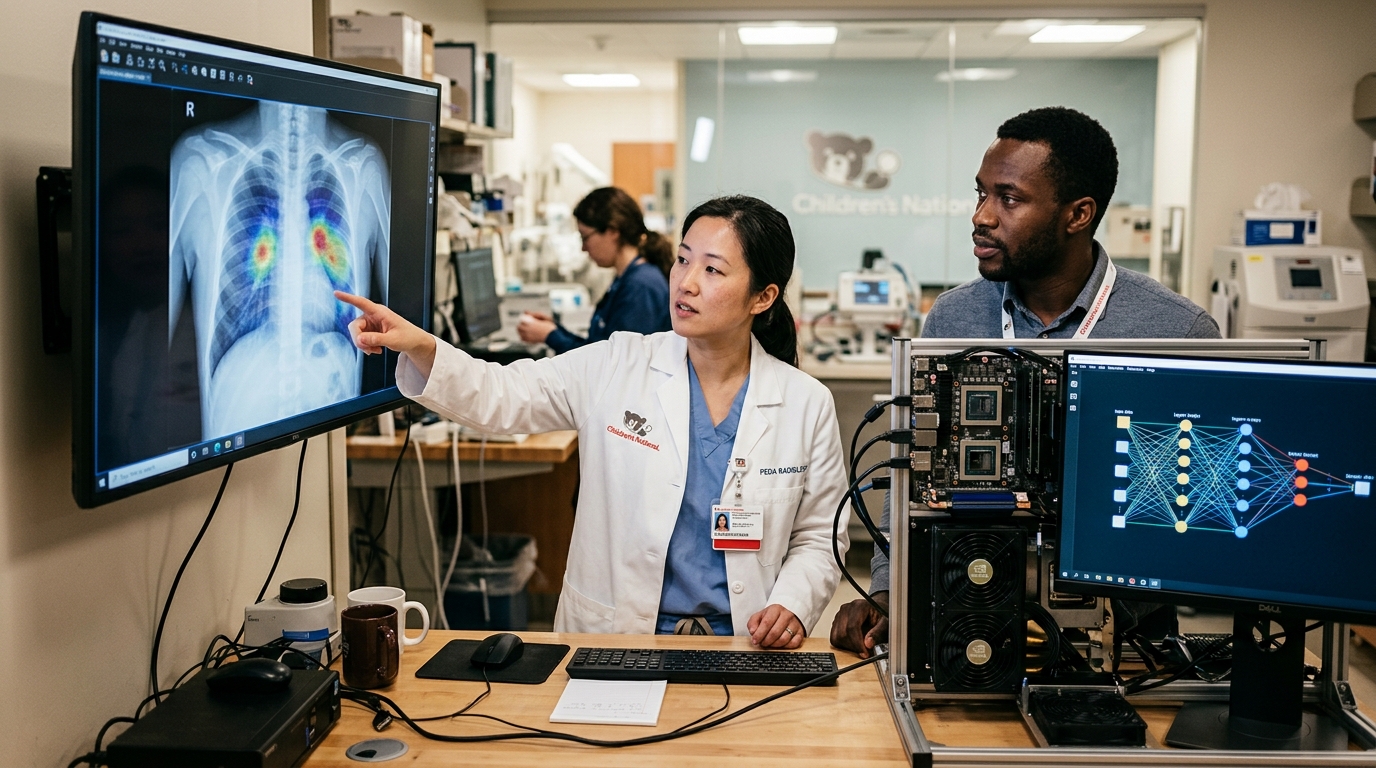
The true innovation at Children’s National lies not just in the creation of these algorithms, but in their seamless integration into the clinical workflow. "Clinical deployment" means that the radiologist does not have to exit their primary software or delay a diagnosis to consult an external AI tool. Instead, the system operates in the background, triaging urgent cases such as pneumothorax (collapsed lung) or internal hemorrhaging, and flagging suspicious findings in a matter of milliseconds.
- Automated Bone Age Assessment: One of the most successful applications is the determination of bone age, a process traditionally prone to inter-observer variability. AI can now perform this with precision exceeding human benchmarks, aiding in the diagnosis of endocrine and metabolic disorders.
- Radiation Dose Optimization: AI is being utilized to reconstruct high-quality diagnostic images from low-dose scans, significantly reducing the lifetime radiation exposure for pediatric patients.
- Rare Disease Detection: By identifying subtle patterns invisible to the human eye, AI algorithms assist in spotting rare genetic syndromes from standard X-rays or MRIs, leading to earlier intervention.
"AI does not replace the pediatric radiologist; it provides them with a second set of eyes that never tires and has been trained on a global library of cases," says the research leadership at the hospital.
Ethics, Bias, and the Global Horizon
Despite the optimism, the clinical deployment of AI brings forth serious ethical questions. Who is liable when an AI-driven diagnosis fails? How can we ensure that algorithms do not harbor biases against specific ethnic or socioeconomic groups, especially when training data is scarce? Children’s National is addressing these concerns through the lens of "Explainable AI" (XAI), ensuring that the logic behind an algorithmic suggestion is transparent and verifiable by the attending physician.
Looking ahead, the primary challenge is scalability. While a premier institution in Washington can sustain the infrastructure for cutting-edge AI, the ultimate goal is to bring these tools to community hospitals and developing nations where specialized pediatric radiologists are in short supply. AI has the potential to democratize high-quality diagnostic care, acting as a force multiplier in regions where human expertise is a rare luxury. The path carved by Children’s National Hospital serves as a blueprint for a new era of pediatric medicine—one where technology is harnessed to protect the world's most vulnerable and valuable population.