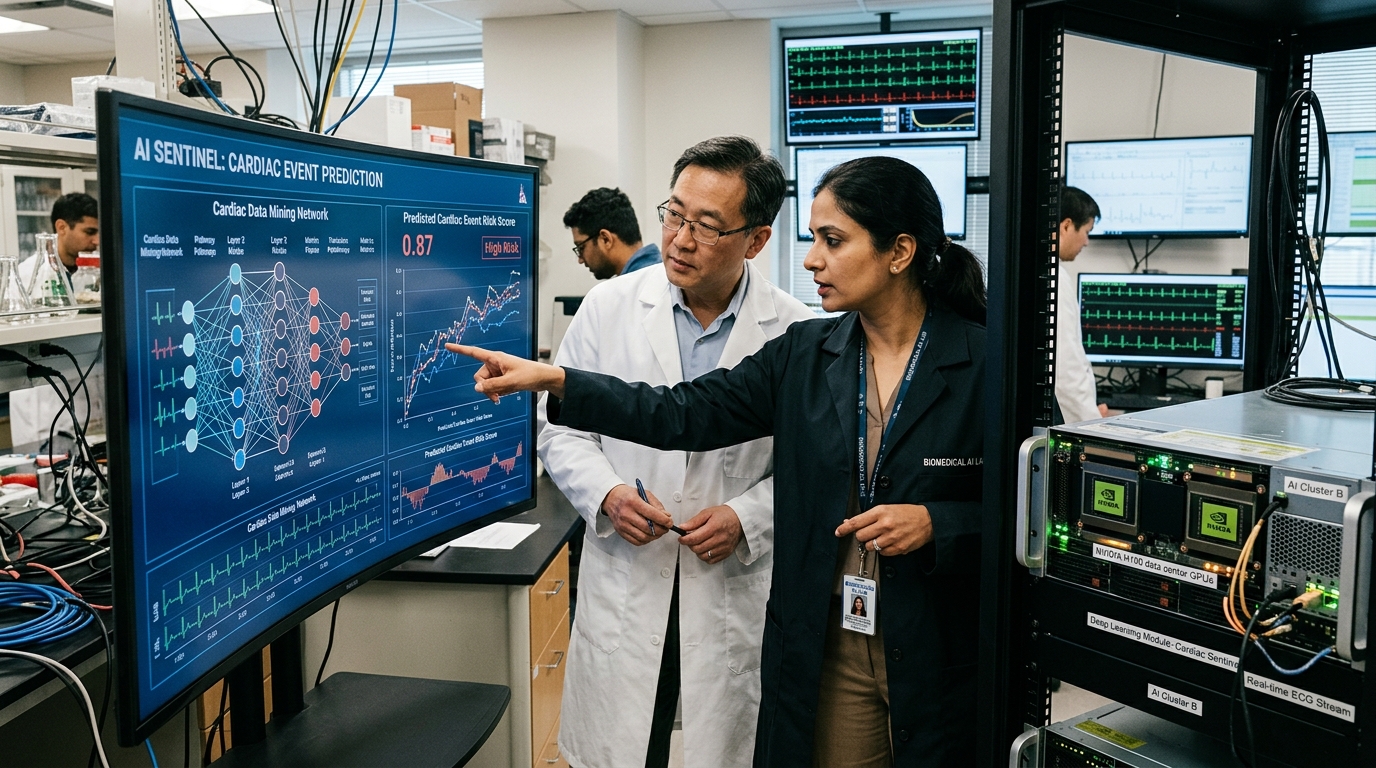
Sudden cardiac arrest (SCA) remains one of the most formidable "silent killers" of the modern era. Despite significant strides in medical science, the ability of clinicians to predict which patient is at immediate risk of a sudden cessation of heart function has historically been limited to statistical probabilities and generalized markers. However, a new generation of Artificial Intelligence (AI) models is poised to transform this landscape, offering unprecedented accuracy in risk prediction through the exhaustive mining of patient data.
Beyond Traditional Metrics
For decades, the primary tool for cardiologists in assessing the risk of sudden cardiac death has been the Left Ventricular Ejection Fraction (LVEF). While useful, LVEF is often an imperfect predictor; many individuals who suffer from SCA do not exhibit a low ejection fraction, while others with low values may never experience a life-threatening arrhythmic event. AI is stepping into this gap by analyzing not just a single metric, but the entirety of a patient's digital medical footprint.
These new models, developed by leading research institutions, utilize deep learning techniques to comb through thousands of electrocardiograms (ECGs), blood test results, imaging reports, and comprehensive medical histories. The key to their success lies in identifying subtle, non-linear correlations and patterns that are invisible to the human eye. For instance, a minute variation in the T-wave of an ECG, combined with a specific electrolyte profile and a history of certain comorbidities, might trigger a high-risk alert from the AI, whereas an experienced cardiologist might find the individual components unremarkable.
From Data to Clinical Implementation
The application of these models is no longer confined to theoretical research. Hospital systems across the United States and Europe are beginning to integrate these algorithms directly into Electronic Health Records (EHR) systems. The process is increasingly automated: the system continuously monitors new data entries and, if a high-risk threshold is crossed, it issues a proactive alert to the attending physician. This allows for timely interventions, such as the implantation of an Internal Cardioverter Defibrillator (ICD) or the optimization of pharmacological therapy, long before a catastrophic event occurs.
- Historical data analysis to identify predisposing genetic and environmental factors.
- Continuous monitoring via wearable devices that feed real-time data into AI assessment engines.
- Personalized risk scoring that transcends broad demographic categories like age or gender.
"We are no longer looking at a static snapshot of the heart; we are observing a living, breathing movie of data," notes a lead researcher in the field.
Ethical Hurdles and the Future of Diagnostics
Despite the palpable excitement, the deployment of AI in cardiology raises significant ethical and practical questions. The "black box" problem—the difficulty in explaining exactly how an AI arrived at a specific risk score—remains a central concern. Clinicians must be able to trust the algorithm, but they also need to understand its rationale to justify invasive procedures or long-term medication changes. Furthermore, the risk of "false positives" could lead to unnecessary surgeries and significant psychological distress for patients.
The future, however, points toward the development of "Digital Twins." In this paradigm, every patient would have a digital replica of their cardiovascular system, upon which AI could simulate various treatments and predict future complications with mathematical precision. The shift from reactive medicine (treating after the event) to proactive, predictive medicine (preventing the event) is now on the horizon, with AI at the helm of this transformation.
In conclusion, the ability of AI models to mine vast patient datasets represents one of the most promising frontiers in modern medicine. While human judgment remains irreplaceable, the augmentation provided by intelligent systems could mean the difference between life and death for millions. The challenge in the coming years will be ensuring equitable access to these technologies, so that the AI "guardian angel" is not a luxury reserved for the few, but a standard of care for all.