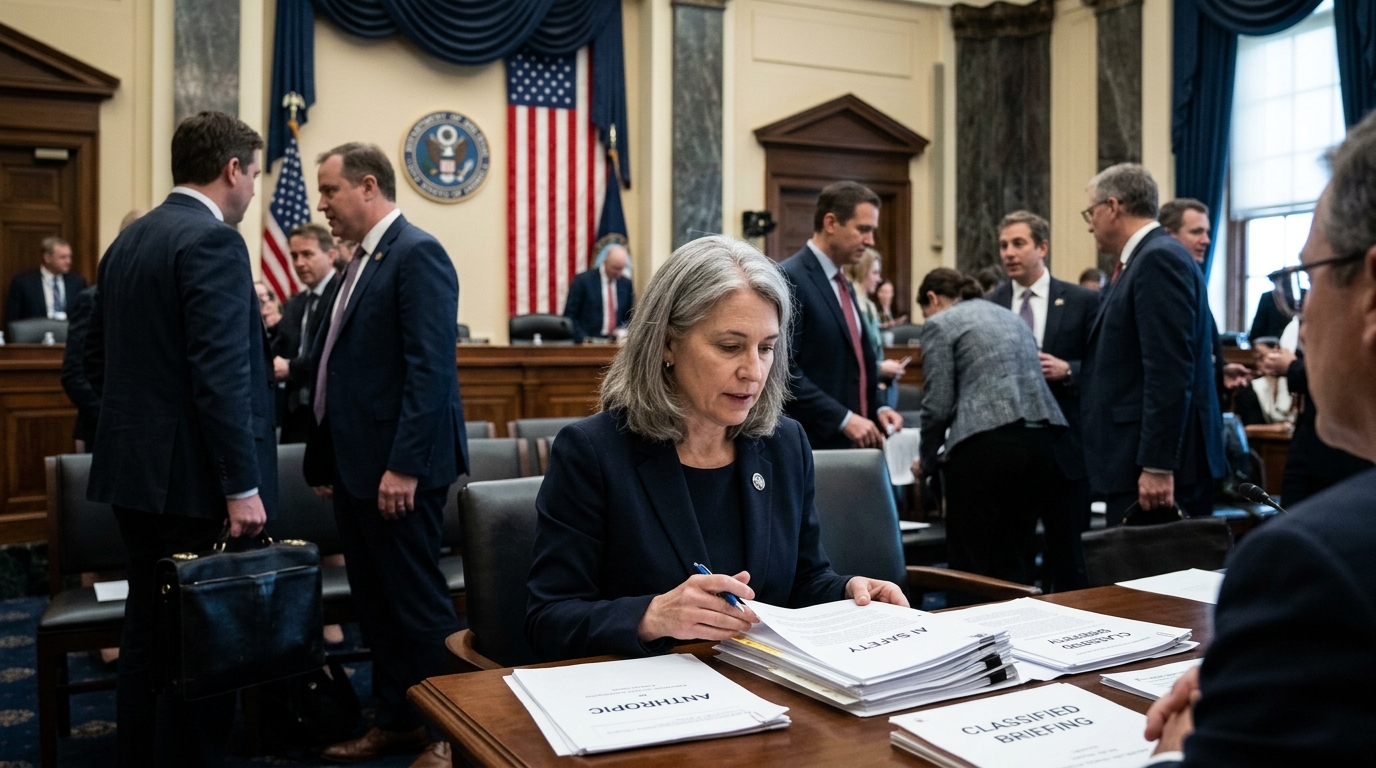
In the corridors of Washington and the laboratories of Silicon Valley, a profound and unsettling conflict is emerging, threatening to redefine the relationship between the tech industry and the U.S. defense establishment. Anthropic, the AI company founded on the principles of safety and ethics, is now on a collision course with the Pentagon. The central point of friction? The Department of Defense's (DoD) claims that it possesses total control and understanding of the AI technology being integrated into its military systems.
This confrontation is not merely a bureaucratic disagreement; it is a fundamental dispute over the nature of machine intelligence itself. While the Pentagon seeks to project an image of absolute dominance over autonomous systems, Anthropic warns that the complexity of Large Language Models (LLMs) and decision-making algorithms makes such claims dangerously simplistic.
The Illusion of Control on the Digital Chessboard
The U.S. Department of Defense has poured billions into programs like 'Replicator' and 'Project Maven,' aiming to deploy thousands of autonomous systems capable of operating in contested environments. At the heart of these efforts is the belief that AI can be bound by rigid rule-sets, ensuring it always acts in accordance with international law and military orders. However, Anthropic argues that current control methods are insufficient.
The company points out that 'Constitutional AI'—the method it uses to train models like Claude—relies on internal principles that cannot be easily bypassed or modified by external actors, even the Pentagon. This creates a paradox: if the military wants an AI that is safe and ethical, it must accept that it cannot control it in the traditional, hierarchical sense.
The Gap Between Military Reality and AI Safety
Anthropic's critique focuses on the fact that AI systems are not static tools like a missile or a tank. They are dynamic systems that learn and adapt, meaning their behavior in the extreme conditions of combat remains unpredictable. The Pentagon's claims of having 'solved' the alignment problem are viewed by many experts as premature, if not deceptive.
- The difficulty of predicting 'emergent behaviors' under high-pressure scenarios.
- The potential for 'hallucinations' that could lead to erroneous targeting.
- The lack of transparency in the decision-making processes of 'black box' models.
Anthropic contends that without deeper collaboration that respects the technical limitations of AI, the risk of accidents or unintended escalation remains high. The company appears to be protecting not just its reputation as an 'ethical player' but also the very integrity of its systems against a military culture that often prioritizes efficacy over caution.
Geopolitical Pressure and Silicon Valley Ethics
The pressure on tech companies to align with national security needs is immense, especially with the rise of China as a technological rival. The Pentagon often uses the argument that if American companies do not provide their tools, adversaries will develop their own without any ethical constraints. This 'AI arms race' creates a suffocating environment for companies like Anthropic, which strive to maintain an independent stance.
"Safety is not a feature you add at the end; it is the very architecture of the system. If the Pentagon ignores this truth, it will not be controlling AI, but will be controlled by its failures," sources close to the company suggest.
In conclusion, Anthropic's move to debunk the Pentagon's claims marks a historic moment. It is the first time a major AI player has stood up against defense rhetoric, demanding honesty about what the technology can and cannot do. The outcome of this dispute will determine whether artificial intelligence becomes a controlled tool of defense or an unpredictable factor on the global geopolitical map.