As we move through the first half of 2026, the European Union is facing the harshest truth in its modern history: the widening gap between legislated climate targets and the material reality of their implementation. The "Fit for 55" package, which mandates a 55% reduction in greenhouse gas emissions by 2030 compared to 1990 levels, is no longer a distant promise but a pressing deadline just four years away.
The Industrial Challenge and Energy Costs
Transitioning to a low-carbon economy requires a radical restructuring of Europe's industrial fabric. However, reality is proving far more complex than the models developed in Brussels. Europe's energy-intensive industries—from steel and aluminum to chemicals—are facing an existential dilemma. High energy costs in Europe, compared to the US and China, make "green" production economically unviable without massive subsidies.
Despite the introduction of the Carbon Border Adjustment Mechanism (CBAM), the risk of "carbon leakage"—the relocation of production to third countries with laxer environmental rules—remains high. Europe is struggling to balance climate leadership with the preservation of its industrial base, an equation that currently seems impossible to solve without significant concessions.
Infrastructure and Grids: The Invisible Barrier
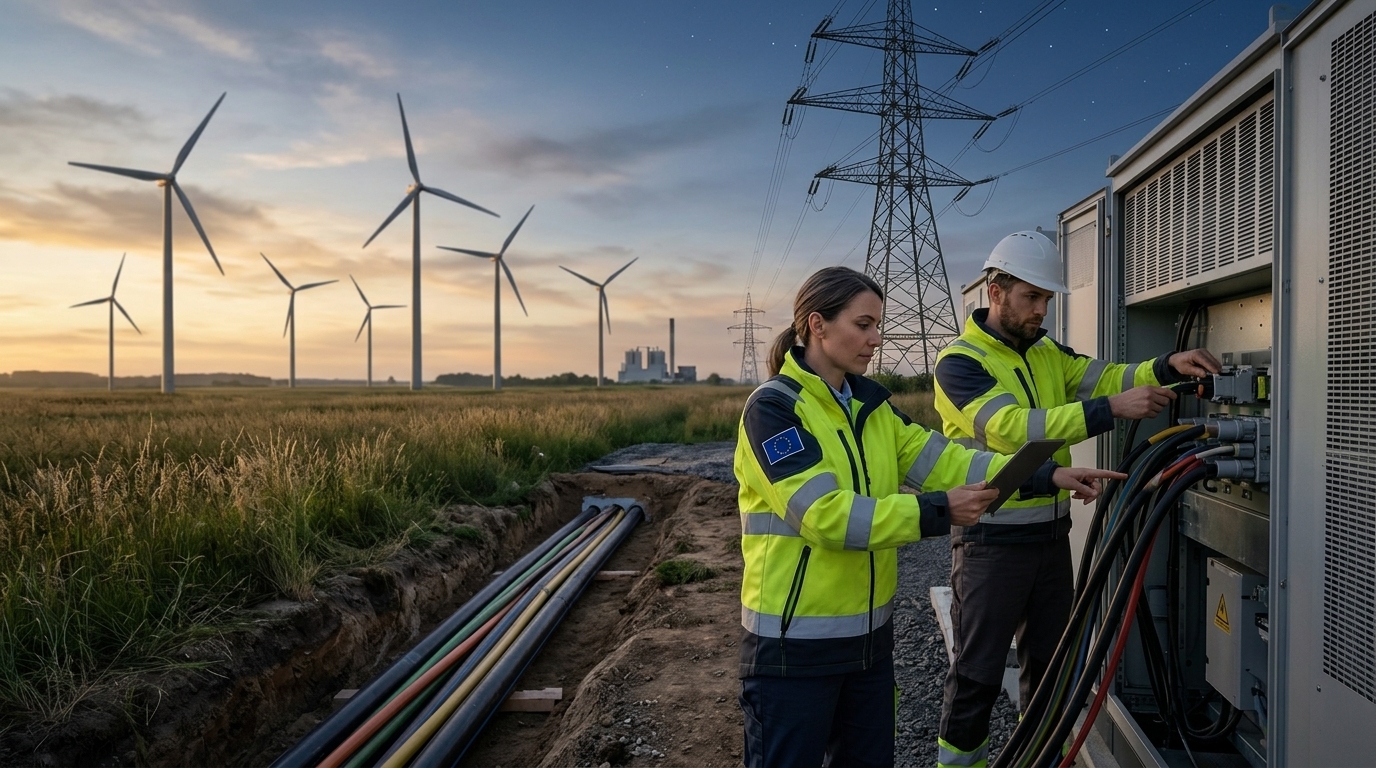
One of the biggest obstacles to achieving the 2030 goals is not a lack of technology, but the state of electricity transmission grids. To absorb energy from renewable energy sources (RES), Europe needs a gargantuan infrastructure upgrade. According to recent estimates, investments of hundreds of billions of euros are required for grids alone.
- Permitting delays for new RES projects remain a major thorn in the side of the process.
- The shortage of critical raw materials (such as lithium and rare earths) leaves Europe dependent on China.
- Large-scale energy storage remains at an experimental or prohibitively expensive stage for most countries.
Without a modern, interconnected, and smart grid, green energy produced is often wasted because the system cannot handle it, creating economic losses and discouraging investors.
The Social Dimension and Political Backlash
The green transition is not just a technical issue; it is deeply political and social. The farmer protests witnessed across Europe in previous years were just the tip of the iceberg. The rising cost of living, partly fueled by carbon taxes and the cost of residential energy upgrades, is creating a volatile mix.
"You cannot ask citizens to save the planet when they are struggling to make ends meet," notes a social policy analyst in Brussels.
The rise of populist and euroskeptic parties is often fueled by opposition to environmental regulations. The European Commission is now called upon to prove that the transition will be "just," otherwise it risks a social uprising that could blow the entire Green Deal structure apart.
Conclusion: From Theory to Practice
As 2030 approaches, Europe must choose: will it stick to targets that seem unattainable under current conditions, risking deindustrialization, or will it adapt its strategy based on the actual capabilities of the economy and society? The answer is not easy, but it is necessary. Climate change does not wait, but the economic survival of an entire continent cannot be relegated to a secondary priority either.