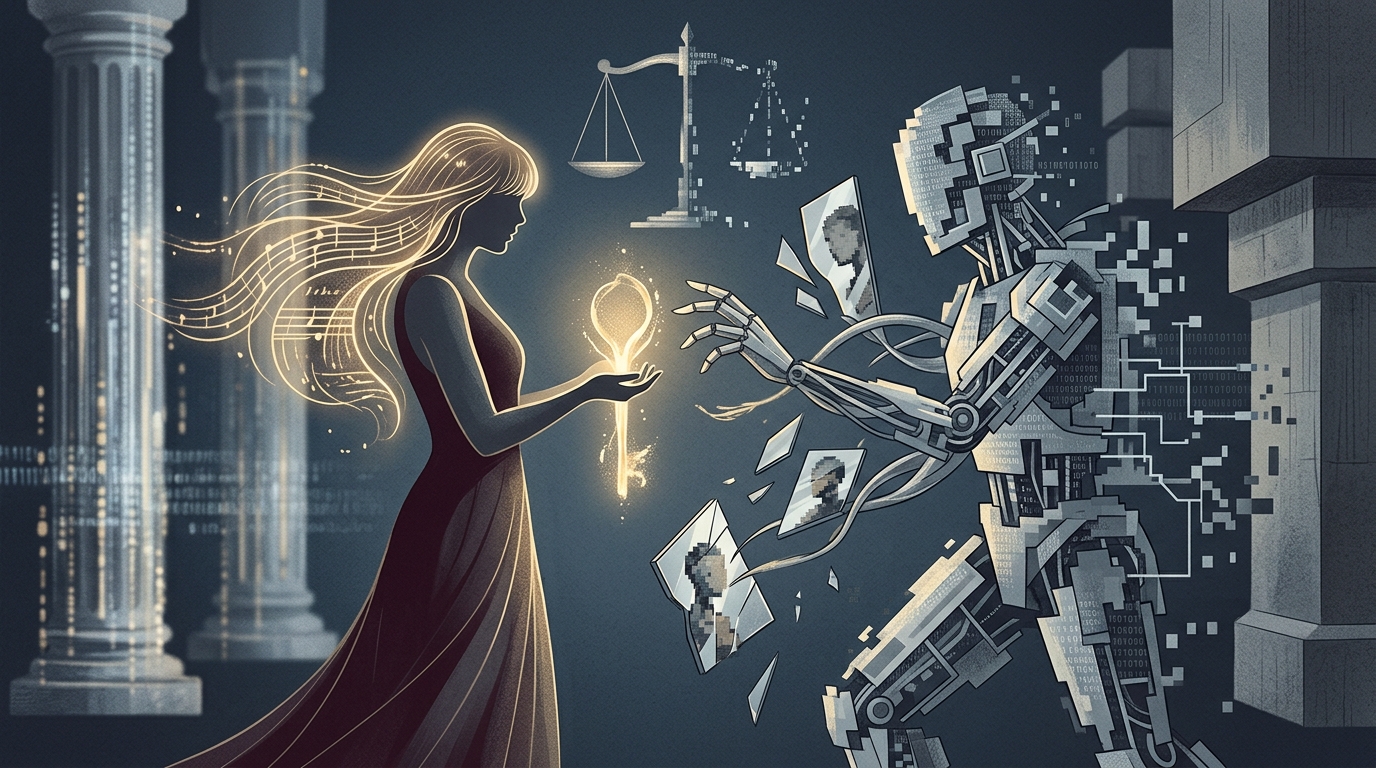
Taylor Swift is no longer just a pop star; she is an economic powerhouse, a cultural phenomenon, and, increasingly, the front line of defense for human creativity against the unchecked rise of Artificial Intelligence. As we move through 2026, Swift finds herself at the center of a historic legal collision, seeking to secure trademarks and establish legal barriers to prevent "AI clones" from exploiting her voice, image, and artistic style.
The Trademark Strategy
Swift’s recent move to file trademark applications specifically targeting the use of her identity in Generative AI environments represents a pivot in celebrity brand strategy. Until recently, image protection relied on the "Right of Publicity," which varies significantly from state to state in the US and is often inadequate for the borderless nature of the internet. Swift, however, is attempting to transform the very "essence" of her artistic persona into a protected commercial entity.
This approach isn't just about stopping deepfakes, like the malicious images that circulated in early 2024 and sparked global outrage. It is about controlling the economic value of her voice. With the rise of tools that can generate "new" Swift songs in seconds, the threat is not just ethical but deeply financial. If the market is flooded with free, AI-generated content that sounds exactly like Swift, the value of her authentic work is threatened with dilution.
The Legal Vacuum and Political Pressure
Swift’s battle is being fought in an environment where legislation is struggling to keep pace with technology. Despite the passage of laws like the ELVIS Act in Tennessee, which protects artists' voices from AI misappropriation, the US remains in a gray zone at the federal level. Swift is leveraging her massive influence—and her army of "Swifties"—to lobby Congress for the passage of the NO FAKES Act.
- Voice as Property: The demand to treat vocal timbre and style as a unique property asset.
- Platform Accountability: The need for major tech companies to filter content that violates personality rights.
- Parody vs. Theft: The difficult balance between freedom of expression and commercial exploitation.
Legal analysts point out that if Swift wins these battles, she will create a "fortress" around human identity. However, there is a counter-argument: could excessive fortification of intellectual property rights stifle creativity and innovation? For Swift, the answer is clear: creativity requires a creator, not an algorithm recycling stolen data.
The Ethics of Imitation in the Digital Age
The issue transcends the narrow confines of the music industry. If a billionaire like Swift struggles to protect her image, what hope does the average citizen have? Swift is acting as the "canary in the coal mine" for a race involving the digital rights of everyone. AI technology has the ability to decouple creation from the creator, turning human experience into mere data for processing.
"Art is the deposition of the human soul. When we replace it with statistical probabilities, we don't just lose our jobs; we lose our humanity," she reportedly stated at a recent private music industry summit.
Ultimately, Taylor Swift is not fighting technology itself, but the anonymity and lack of accountability it often brings. Her success will be judged not only in the courts but also in the conscience of consumers: will we continue to seek authentic human connection, or will we settle for the perfect, yet hollow, digital imitation?