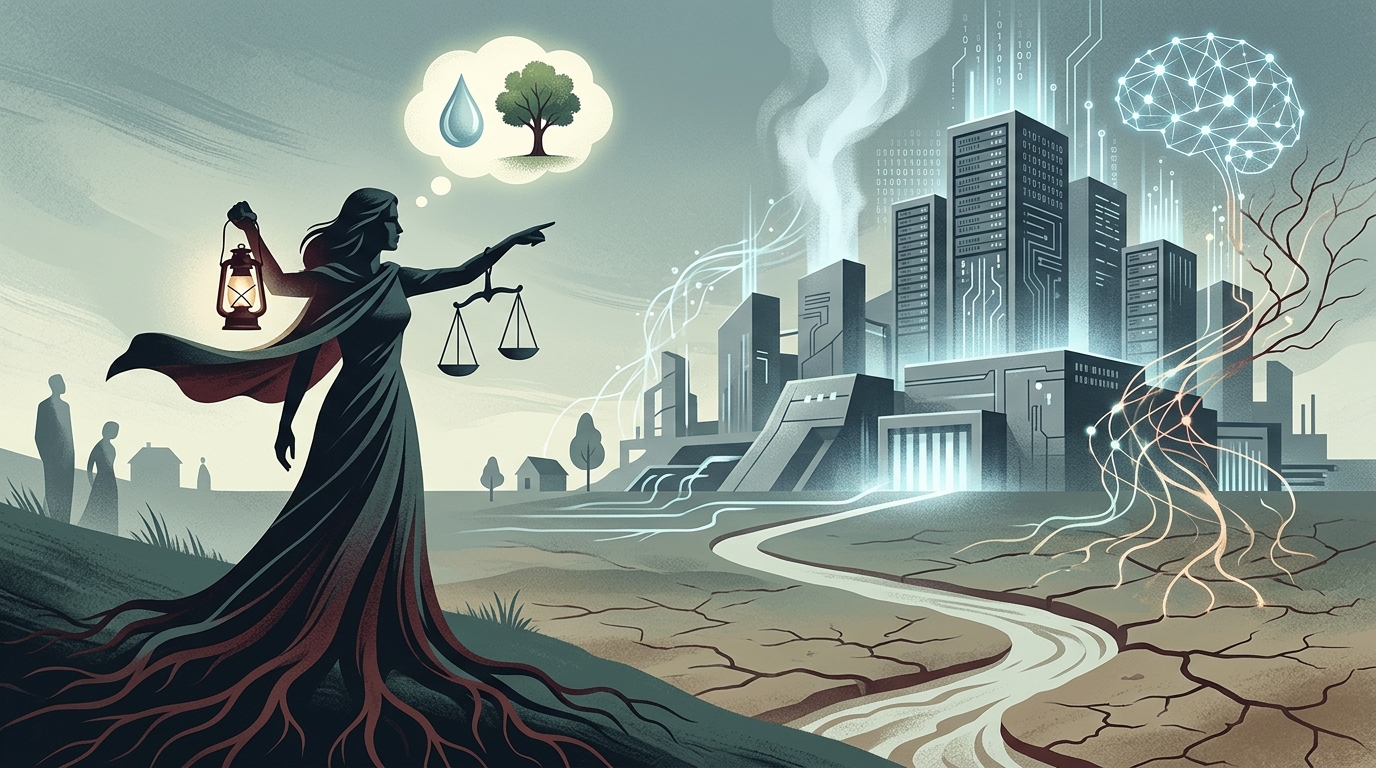
Behind the lightning-fast answers of ChatGPT and the stunning visuals generated by diffusion models lies an invisible and extremely costly reality: a colossal consumption of natural resources. While public discourse often focuses on AI risks regarding employment or misinformation, a new report from the United Nations University (UNU-INWEH) brings to light a more immediate, existential threat. By 2030, Artificial Intelligence is expected to consume amounts of water capable of meeting the needs of 1.3 billion people — approximately one-sixth of the global population.
The Invisible Infrastructure and the Cost of Cooling
Why is AI so 'thirsty'? The answer lies in data centers, the massive facilities housing thousands of GPUs (Graphics Processing Units). These chips, essential for training and running Large Language Models (LLMs), generate enormous amounts of heat. To prevent overheating and equipment failure, sophisticated cooling systems are required. Most of these rely on evaporative cooling, a method that is energy-efficient but water-intensive.
According to the report, every time a user submits a series of 10 to 50 questions to a model like GPT-4, the system 'consumes' about half a liter of water. Multiplying this number by the billions of daily interactions worldwide reveals the scale of the problem. Consumption is not limited to direct cooling but extends to the generation of the electricity powering these centers, which often requires water for hydroelectric plants or for cooling thermoelectric units.
Geopolitical Tensions and Local Communities
The issue is not just quantitative but also geographical. Many of the world's largest data centers are located in regions already facing water scarcity. In Arizona, USA, for instance, the expansion of tech giants' facilities has sparked intense backlash from local communities, as industrial water use competes with residential and agricultural consumption. The UN report warns that without a strict regulatory framework, the AI 'arms race' could exacerbate the global water crisis, disproportionately affecting developing nations where infrastructure is already fragile.
Furthermore, AI energy demand is expected to surge by 160% by 2030. This meteoric rise threatens to derail green transition efforts, as tech companies often turn to any available energy source, including fossil fuels, to fill the gap left by renewables during peak hours.
Corporate Responsibility: Promises vs. Reality
Silicon Valley heavyweights — Microsoft, Google, and Meta — have pledged to become 'water positive' by 2030, meaning they intend to return more water to the environment than they consume. However, critics point out that these pledges often rely on accounting tricks and offsets that do not solve local water shortages. Transparency remains a significant hurdle, as companies rarely disclose precise consumption data per facility, citing trade secrets.
The solution requires a radical reassessment of how we design technology. The shift toward 'Green AI' is not just about using renewable energy, but also about creating more efficient algorithms that require less computational power. Simultaneously, the adoption of closed-loop cooling systems, which recycle water instead of evaporating it, is imperative, despite higher installation costs.
Conclusion: Digital Progress on a Finite Planet
The United Nations University report serves as a warning shot. Artificial Intelligence has the potential to solve some of humanity's most difficult problems, from medical diagnosis to climate modeling. However, if the cost of this progress is the exhaustion of the sources of life, then the price is far too high. Sustainability cannot be an afterthought or a section in an annual CSR report; it must be at the core of AI architecture.