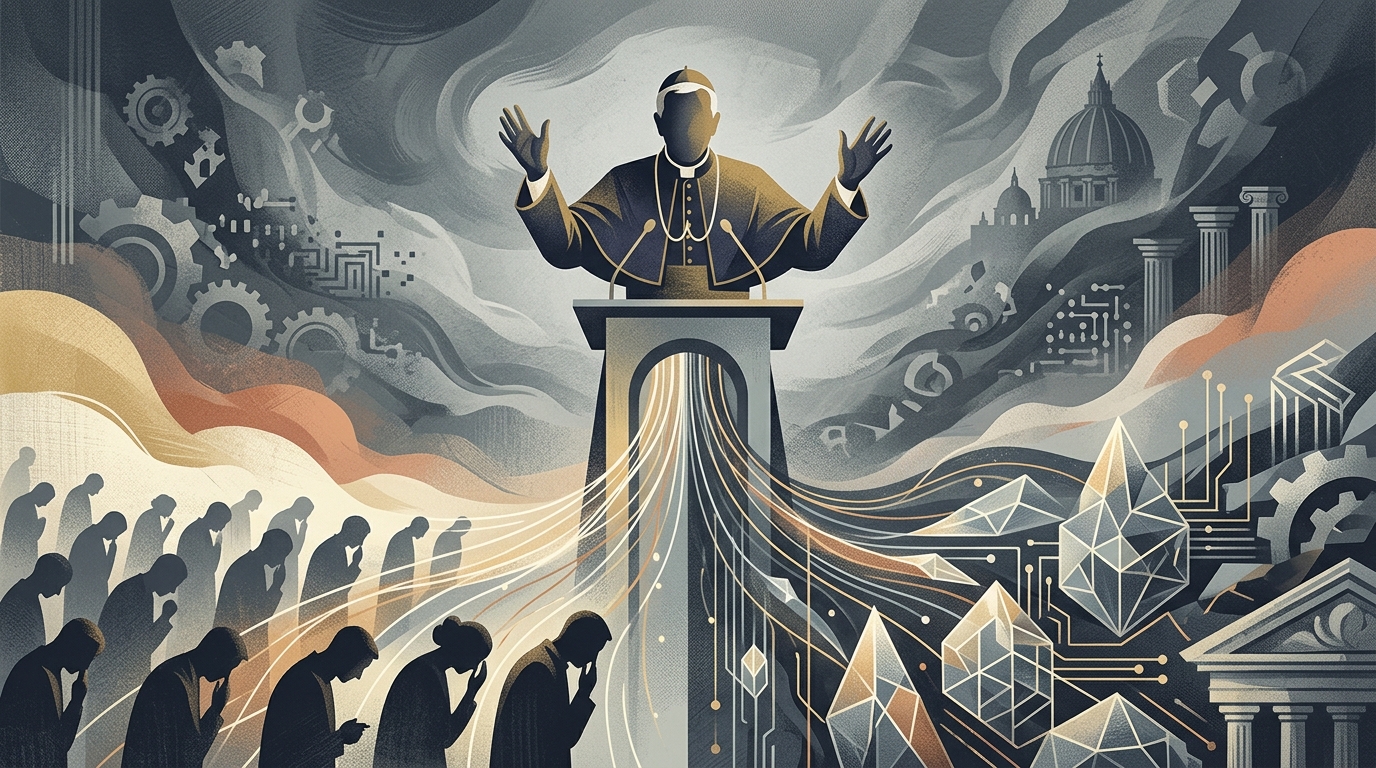
In an era where technological progress appears to move at speeds far exceeding society's capacity to internalize them, the Vatican has made a historic intervention. Pope Leo XIV, through an extensive letter to the global community, has placed Artificial Intelligence (AI) at the forefront of the Catholic Church’s ethical agenda, characterizing it as one of the greatest challenges to human nature in the 21st century.
The letter, titled "The Spirit and the Machine," is not limited to a simple technical analysis but delves deep into the existential consequences of automating judgment. The Pontiff argues that the gradual outsourcing of human will to algorithms carries the risk of transforming society into a mere collection of data points, stripped of its metaphysical and ethical dimensions.
The Concept of 'Algor-ethics'
A central pillar of the Pope’s intervention is the promotion of "algor-ethics." This term combines algorithms with ethics, emphasizing that code is never neutral. "Every line of code contains a value judgment," the letter states. Pope Leo XIV emphasizes that if algorithms are not designed with the protection of the vulnerable in mind, they will inevitably replicate and amplify existing social injustices.
Particular emphasis is placed on the transparency of AI systems. The Vatican calls on Big Tech companies to open the "black boxes" of their algorithms, enabling oversight of decisions that affect the lives of millions—from healthcare access and employment to the administration of justice. The concern is clear: a society governed by opaque mathematical formulas is a society that has lost its freedom.
The Threat of Depersonalization
In one of the most poignant sections of the letter, the Pope refers to the risk of "depersonalization." He argues that constant interaction with machines that mimic human consciousness could lead to an erosion of human relationships. "Love, compassion, and forgiveness cannot be codified," writes Leo XIV.
- The replacement of human contact by digital assistants in elderly care.
- The use of AI to generate fake news that polarizes societies.
- The dependence of the youth on algorithms that dictate desire and identity.
The Pontiff warns that technology must not become a new idol. Instead, it must remain a tool at the service of humanity, always maintaining "human agency" in every critical decision.
A Call for a Global Treaty
The letter goes beyond theory. Pope Leo XIV calls upon the international community and world leaders to forge a binding international treaty for the regulation of Artificial Intelligence. He proposes the creation of an international body, under the auspices of the UN, to oversee the development of AI and ensure it is not used for warfare or the suppression of human rights.
"We cannot allow the future of humanity to be decided by the stock market valuations of Silicon Valley corporations. Technology is a common heritage of humanity and must serve the common good," the Pope emphasizes.
This intervention comes at a time when the European Union and the United States are struggling to find the balance between innovation and regulation. The Vatican's voice, carrying moral weight for billions of believers, is expected to significantly influence public discourse, reminding us that behind every screen and every processor, there is a human soul demanding respect.