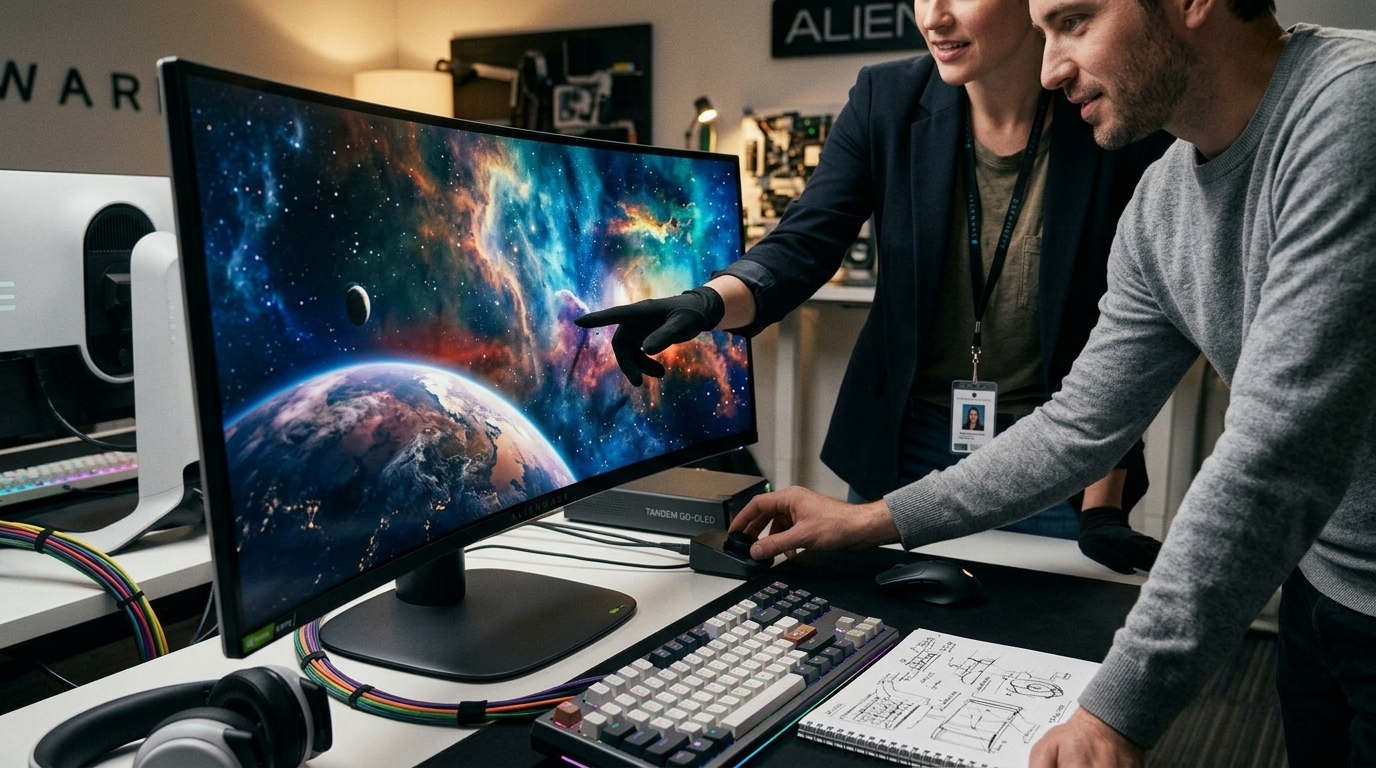
It was 2022 when Alienware, Dell's gaming arm, sent shockwaves through the industry by introducing the AW3423DW, the world's first QD-OLED monitor. Four years later, at Computex 2026 in Taipei, the company aims to repeat history by unveiling a successor that isn't just an incremental improvement, but a technological leap addressing the two biggest thorns in OLED technology: brightness and text clarity.
The Tandem QD-OLED Revolution
The headline news from Alienware's booth is the introduction of Tandem QD-OLED technology. Borrowing the logic first seen in high-end tablets and automotive displays, the Tandem structure utilizes two emissive layers stacked on top of each other. The result is twofold: a dramatic increase in peak brightness and a significant reduction in the stress placed on each individual layer, promising to nearly eliminate the fear of burn-in.
According to early benchmarks, the new monitor can reach 2,000 nits in HDR content—a figure previously thought unattainable for QD-OLED at monitor scale. This means in-game explosions or sun reflections in digital landscapes will have an almost natural intensity, while maintaining the perfect blacks that established OLED as the king of contrast.
Penta RGB Stripe: The End of Blurry Text
One of the most persistent complaints from users of previous QD-OLED generations was "text fringing"—a slight blur or color shadow around letters caused by the triangular subpixel arrangement. Alienware, in collaboration with Samsung Display, introduced the Penta RGB Stripe structure.
This new architecture rearranges subpixels in a way that closely mimics traditional LCD panels without sacrificing color fidelity. For the professional who uses their monitor for work (coding, writing, spreadsheets) in addition to gaming, this change is perhaps more significant than the brightness boost itself. Text clarity is now at a 4K IPS level, making the monitor a true multi-purpose powerhouse.
Competition and Strategic Positioning
Alienware's move comes at a time when competition from LG and its WOLED panels is fiercer than ever. With the addition of technologies like Micro Lens Array (MLA), LG had managed to close the brightness gap. However, with Tandem QD-OLED, Alienware appears to be reclaiming the innovation lead.
- Refresh rates reaching 360Hz at 1440p resolution.
- 99.5% DCI-P3 color space coverage.
- A new passive cooling system featuring graphene for silent operation.
The question remains: the price. While Alienware hasn't announced exact figures, Tandem technology is traditionally expensive to produce. However, history has shown that Dell has a knack for bringing these technologies to market at prices that, while premium, remain accessible to the enthusiast segment.
Conclusion: The Maturation of a Technology
Computex 2026 marks the transition of OLED from an "impressive but flawed" choice to a fully mature solution for every use case. Alienware didn't just upgrade a product; it redefined what we expect from our computer displays. With Tandem QD-OLED, the distance between digital representation and visual reality shrinks further, offering an experience that is as delightful for the eyes as it is reassuring for long-term hardware durability.