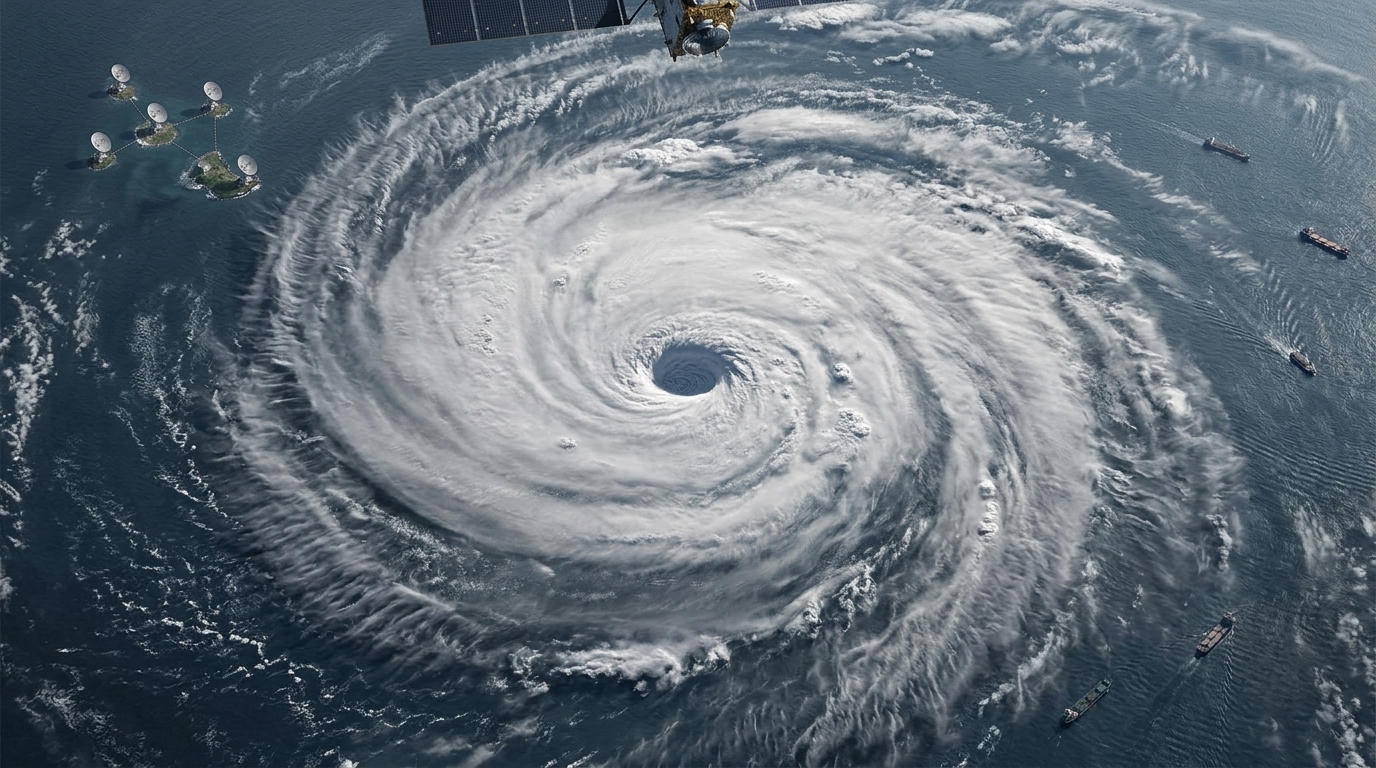
As June 2026 unfolds, Southeast Asia finds itself once again confronted by the raw power of nature. Typhoon Jangmi, a tropical cyclone that formed in the Philippine Sea, is moving with a menacing slowness toward the north-northwest. However, this year’s typhoon season is fundamentally different from those of the past. Thanks to a new generation of satellites and advanced machine learning algorithms, humanity is monitoring the phenomenon with unprecedented detail, turning dread into data and uncertainty into actionable foresight.
The Anatomy of a Giant from Space
Images released by meteorological agencies, including Japan’s JMA and Europe’s Copernicus, reveal the terrifying structure of Jangmi. The storm's 'eye'—a perfect circle of calm amidst total chaos—is surrounded by dense cloud walls reaching record heights in the troposphere. The utilization of the Himawari-9 satellite, in conjunction with the Sentinel network, allows scientists to observe not just the shape of the clouds, but their top temperatures, wind speeds at various altitudes, and water vapor content in real-time.
What sets this year’s imagery apart is the sheer resolution. In 2026, hyperspectral imaging technology allows for the dissection of storm layers with such precision that meteorologists can predict 'rapid intensification'—a phenomenon that previously claimed thousands of lives due to a lack of early warning. Jangmi is not just a storm; it is a laboratory of physics in motion, and our satellites are the microscopes.
Artificial Intelligence: The Invisible Meteorologist
Behind the stunning visuals lies the true revolution: Artificial Intelligence. The data harvested from space is processed instantaneously by deep learning models that compare Jangmi’s structure with thousands of historical typhoons. This enables the creation of simulations that predict its path with an accuracy of just a few kilometers, five days before potential landfall.
- Precise identification of the landfall zone with a margin of error under 15 kilometers.
- Rainfall level predictions per square meter to prevent flash flooding.
- Automated alerts sent to local authorities via satellite communication networks.
The use of AI has reduced the processing time of satellite data from hours to mere seconds. In the case of Jangmi, this means that communities in the Philippines and later Taiwan had critical time to evacuate coastal areas, proving that technology is, quite literally, a matter of life and death.
The Climate Crisis Context and the 'New Normal'
Despite technological leaps, Jangmi serves as a stark reminder of the climate crisis we are navigating in 2026. Sea surface temperatures in the Pacific remain at record highs, providing the 'fuel' for increasingly powerful typhoons. Scientists note that cyclones now maintain their intensity for longer periods after making landfall, causing devastation in regions previously considered safe.
"We are not just seeing more storms, but storms that behave in ways that traditional models struggle to interpret," states an analyst from the World Meteorological Organization.
The satellite tracking of Jangmi also highlights the importance of international cooperation. Data is shared openly between nations, breaking down geopolitical barriers in the face of a common threat. The image of the typhoon from space, while beautiful in its eerie symmetry, is a cry for help from a planet that demands our immediate action.
Conclusion and Future Outlook
As Jangmi continues its trajectory, technology will remain our primary shield. The integration of quantum computing into weather forecasting, expected to mature toward the end of the decade, promises even greater precision. However, the impressive images we see on our screens today must remind us that technology can predict disaster, but only political will and environmental consciousness can prevent it in the long term. Jangmi is a lesson in humility before nature, captured in the highest possible resolution.