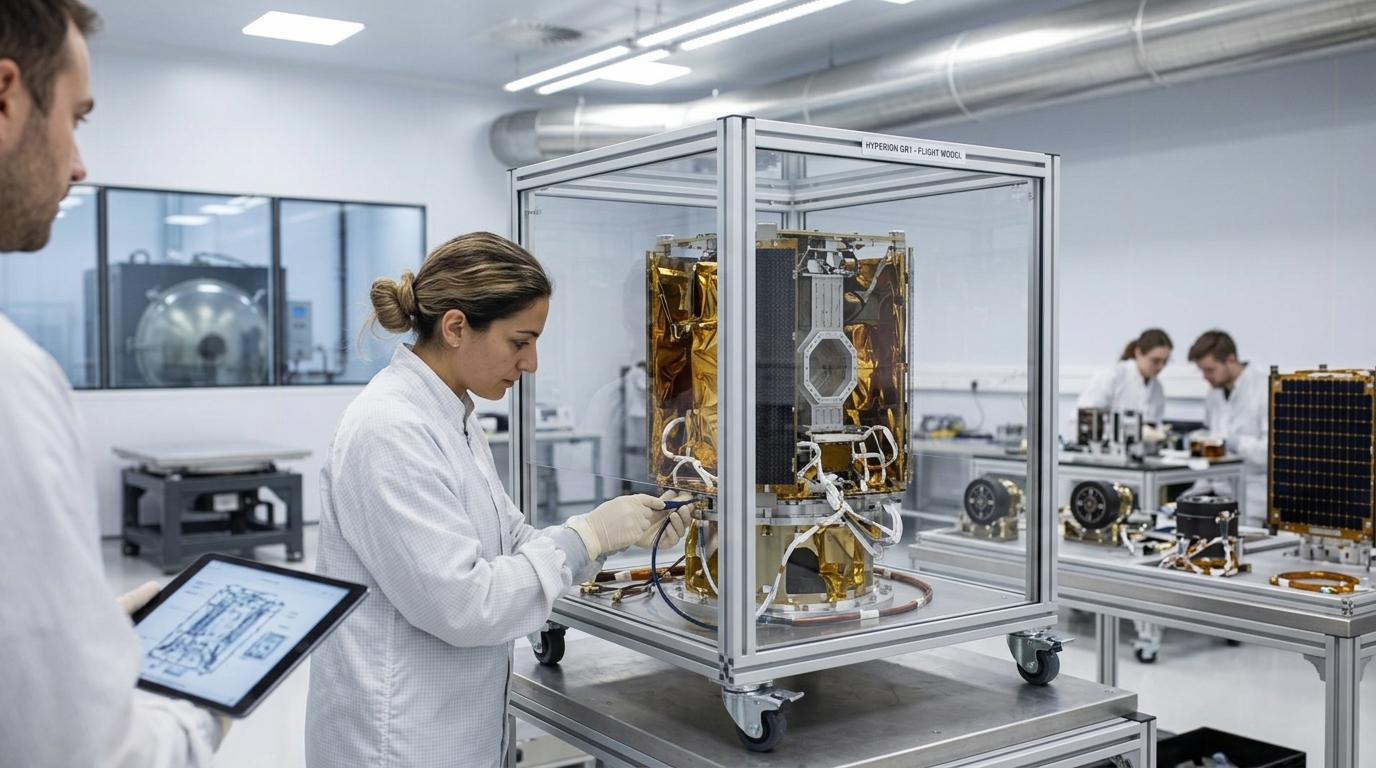
In July 2026, Greece is poised to write a new chapter in its technological history. The launch of Hyperion GR1, the first of seven microsatellites under the National Small Satellites Programme, is not merely a scientific achievement but a strategic pivot for the nation—from being a consumer of space services to becoming a producer of high-value data and expertise. Manufactured by Open Cosmos Aegean, this satellite represents the vanguard of an investment designed to fortify the country against the escalating challenges of the climate crisis.
The Strategic Significance of the Programme
The National Small Satellites Programme, with a budget nearing 200 million euros funded by the Recovery and Resilience Facility (RRF), is one of the most ambitious initiatives of the Greek government. The objective is clear: the creation of a domestic satellite constellation providing high-resolution, real-time data. Hyperion GR1 is the first milestone toward complete national autonomy in Earth observation.
For decades, Greece relied on international partnerships and commercial providers for satellite imagery. This dependency often meant delays and high costs, particularly during critical events such as wildfires or flash floods. With Hyperion GR1, Greek Civil Protection will possess a tool capable of 'seeing' through smoke and clouds, delivering vital information to operational centers within minutes of a pass.
Technological Excellence and Local Added Value
Hyperion GR1 is not your standard satellite. It integrates advanced hyperspectral imaging sensors, allowing for the analysis of soil composition and vegetation health from orbit. This is particularly crucial for wildfire prevention, as it can identify areas with dangerously low moisture levels in vegetation before a fire even ignites.
- Earth Observation: Land use mapping and coastal zone monitoring.
- Civil Protection: Real-time fire detection and flood progression tracking.
- Maritime: Surveillance of Greek waters for illegal activities and oil spills.
- Precision Agriculture: Optimizing crop yields through satellite-driven data.
Open Cosmos Aegean, the company leading the manufacturing, has successfully mobilized an entire ecosystem of Greek businesses and research centers. This ensures that a significant portion of the investment remains within the country, fostering high-tech employment and reversing the 'brain drain' in the aerospace sector.
Towards an Autonomous Space Policy
The July launch is just the beginning. The roadmap includes the deployment of six additional satellites over the next two years, creating a constellation that will cover every corner of Greek territory with a continuous data stream. Collaboration with the European Space Agency (ESA) ensures that these Greek satellites meet the most rigorous international standards.
"Greece is no longer just following space developments; it is beginning to co-shape them. Hyperion GR1 is proof that with a strategic plan and political will, the country can lead in cutting-edge sectors," sources from the Ministry of Digital Governance noted.
In an increasingly uncertain geopolitical environment, possessing space infrastructure is a component of national power. Greece's ability to monitor its borders, its seas, and its natural environment without relying on third parties adds a new dimension to national security. Named after the Titan of Light, Hyperion aims to illuminate areas that were previously obscured by the shadows of technological dependency.