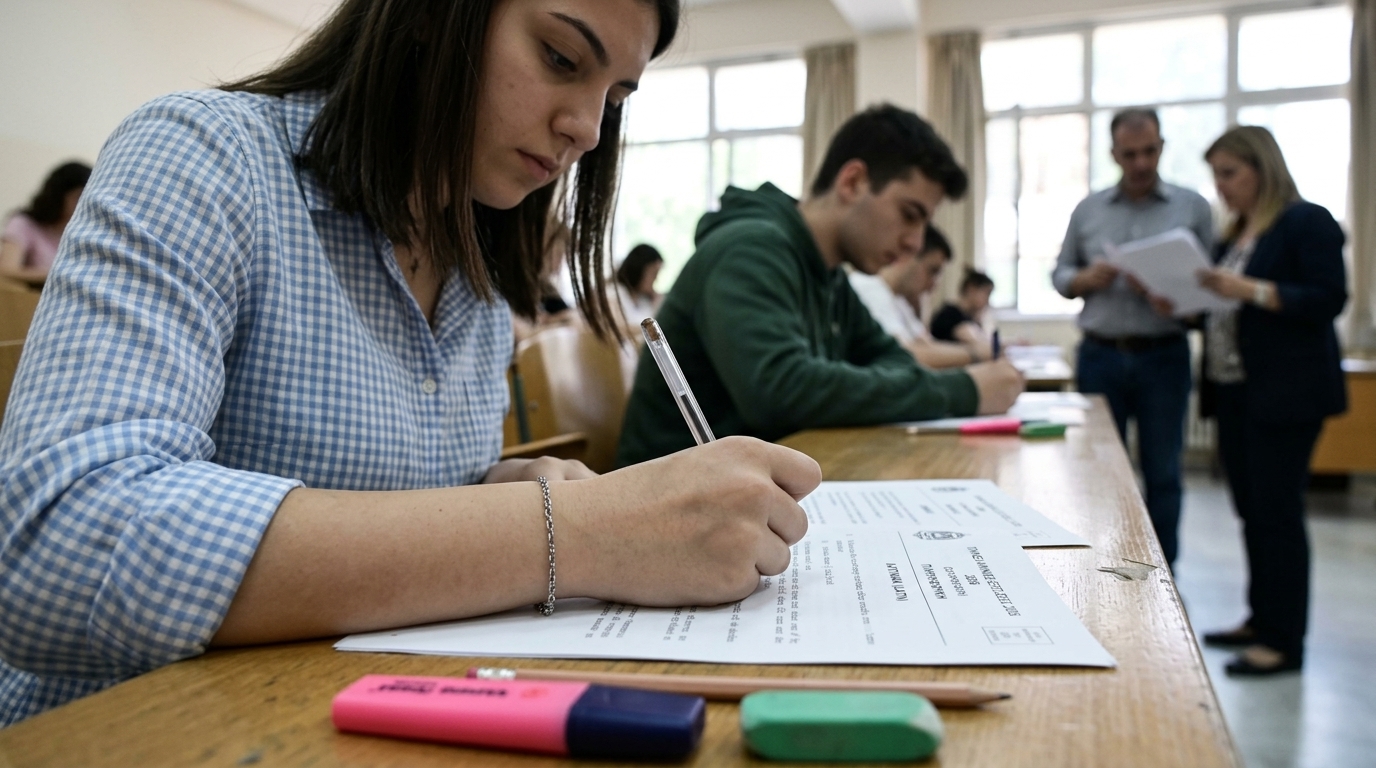
Friday, June 5, 2026, marked one of the most significant milestones in this year's Panhellenic Examinations marathon. Candidates from the Humanities, Sciences and Health Studies, and Economics and Informatics orientation groups were called upon to compete in Latin, Chemistry, and Informatics, respectively. In a year where educational discourse is dominated by digital transition and high school reform, the topics selected by the Central Examination Committee (KEE) reflect an effort toward a more integrative approach to knowledge.
Latin: A Return to Classical Precision
For students in the Humanities track, Latin was a test that required not only a good memory but primarily a deep understanding of syntactical structure. The texts selected (from the school textbook units) were deemed "expected"; however, the grammar and syntax exercises contained certain points that required particular attention. Specifically, the translation did not present significant difficulties for the well-prepared student, but observations on subordinate clauses and the conversion of active to passive voice required composure.
Educational analysts point out that Latin remains the "fortress" of precision. Unlike Ancient Greek, where interpretation plays a larger role, here the slightest carelessness in an ending can cost valuable points. This year's exam confirmed the trend of the last three years for topics covering the full range of the curriculum, avoiding the "traps" of the past but raising the bar in lexical affinity exercises.
Chemistry: Experimental Thinking and Complex Problems
In Chemistry, the difficulty level moved to higher ground compared to the previous year. Question C and Question D, which traditionally determine the "excellent" grade, required combined thinking between Organic Chemistry and Chemical Equilibrium. Of particular note was the inclusion of questions referring to laboratory applications, indicating the Ministry of Education's intention to bridge theory and practice.
Health Studies candidates faced calculations that required speed and precision. "It was an exam for well-trained solvers," private tutors typically noted. Understanding enthalpies and redox reactions was key to approaching the final questions, while the theory in Questions A and B was clear but required attention to the details of intermolecular forces.
Informatics: Algorithmic Thinking in the Age of AI
Perhaps the most relevant subject of the day, Informatics, attracted interest due to the increasing demand for corresponding university departments. The topics focused on algorithmic thinking and control structures. Question D, the classic programming exercise, concerned data management from a hypothetical environmental monitoring application, linking the course to the climate crisis.
Students had to demonstrate proficiency in using arrays and implementing subprograms. The difficulty lay not so much in the syntax as in conceiving the logic for solving the problem. In a world where Artificial Intelligence (AI) automates code, this year's exams sought to test the human mind's ability to design the logic behind the machine. The theory was clearly formulated, although some multiple-choice questions required critical ability rather than simple rote memorization.
The Social and Educational Impact
The 2026 Panhellenic Exams are being held in an environment of intense questioning of the traditional examination model. Despite efforts to introduce the "Free High School" and alternative assessment methods, this form of examination remains the main pillar of selection for higher education in Greece. The pressure on teenagers remains high, with the phenomenon of private tutoring (frontistiria) continuing to flourish, despite the digital remedial teaching platforms launched by the state.
In conclusion, today showed that the KEE seeks a balance: on one hand, maintaining traditions (Latin) and on the other, adapting to the requirements of the 21st century (Informatics, Chemistry). The coming days will show whether the grades will move at levels that will allow the admission thresholds (bases) to remain at last year's levels or if we will see fluctuations, especially in the high-ranking schools of the 2nd and 3rd scientific fields.