The era of bulky wearables, such as smartwatches and health-tracking rings, appears to be nearing its end, making way for a new, almost invisible technology: "electronic skin." Researchers have recently announced the development of a groundbreaking, stretchable computing patch integrated with Artificial Intelligence, capable of processing complex biological data directly on the user's body. This advancement is not merely an improvement of existing devices but a radical reimagining of how technology can merge with biology.
The Engineering Feat of Stretchable Patches
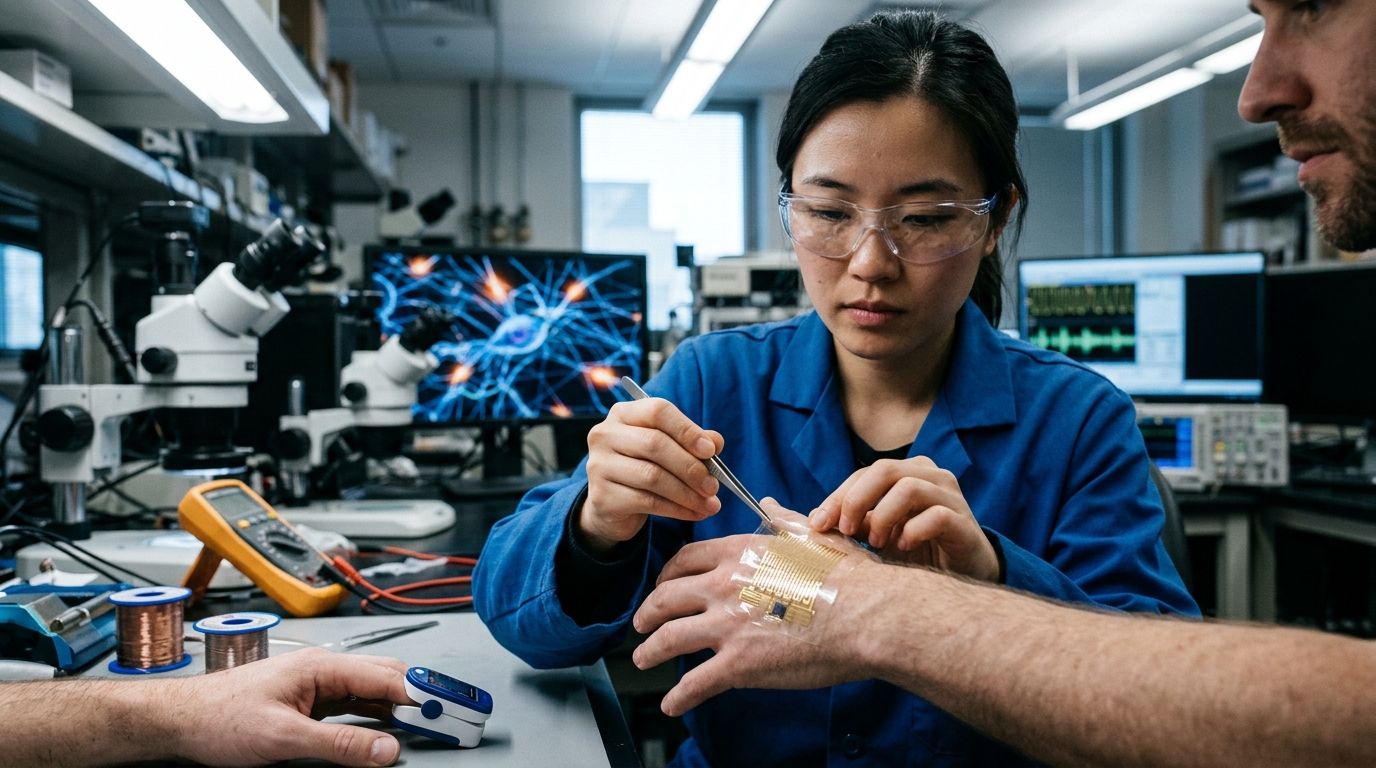
Creating a computer that can stretch, bend, and twist without losing functionality is one of the greatest challenges in modern engineering. Traditional silicon chips are rigid and brittle, making them unsuitable for continuous contact with the moving human body. This new technology relies on organic semiconducting polymers and nanomaterials that maintain their electrical conductivity even when elongated by 100% or more.
The key to success lies in the patch's structure, which mimics the lattice organization of human skin. Within this elastic matrix, researchers have managed to integrate thin-film transistors and high-precision sensors. The patch is so thin and light that the user often forgets its presence, allowing for continuous data collection without the discomfort caused by traditional medical devices. This seamless integration is the holy grail of human-machine interfaces.
Neuromorphic Computing: AI at the Edge of the Body
What sets this specific patch apart from previous "smart skin" attempts is the integration of local AI processing capabilities, known as Edge AI. Instead of sending raw data to a smartphone or a remote server via Bluetooth—which consumes energy and poses privacy risks—the patch utilizes neuromorphic circuits. These circuits are designed to function similarly to human neurons, enabling pattern recognition with minimal power consumption.
For instance, the patch can immediately recognize a cardiac arrhythmia or an unusual muscle contraction by analyzing electrical signals in real-time. The AI's ability to filter out "noise" caused by body movement is crucial, as it allows for medically valid conclusions even during intense physical activity. This local processing dramatically reduces latency, which could prove life-saving in emergency medical situations. By keeping the data on the device, it also adds a layer of security against data interception.
Applications in Medicine and Prosthetics
The applications of this technology extend far beyond fitness tracking. In the field of medical rehabilitation, the stretchable patch can be used to monitor patients with chronic conditions, such as Parkinson's disease, accurately recording tremors and mobility throughout the day. In cardiology, it offers a non-invasive alternative to traditional Holter monitors, providing weeks of data instead of just 24 hours.
Perhaps the most exciting application lies in the realm of advanced prosthetics. By coating a prosthetic limb with this "AI skin," scientists can provide amputees with a sense of touch that approaches natural sensation. The patch can translate pressure, temperature, and texture into electrical signals that the user's nervous system can understand, creating a two-way communication channel between human and machine. This could redefine the quality of life for millions of people worldwide.
Challenges and the Future of Digital Flesh
Despite the excitement, significant hurdles remain before this technology reaches mass production. The long-term durability of the materials, resistance to sweat and water, and the biocompatibility of the chemical components are issues that require further investigation. Furthermore, power supply remains a challenge; although consumption is low, the need for recharging or integrating energy harvesting technologies (such as those powered by body heat or movement) is imperative.
Beyond the technical aspects, the emergence of computers that "become one" with our bodies raises profound ethical questions. Who has access to the biometric data continuously generated? How do we ensure that this technology will not be used for illicit surveillance or the creation of a two-tier society between "enhanced" and "natural" humans? The debate over biodata governance must keep pace with scientific progress, ensuring that our digital skin remains a protective shield rather than a means of control. As we move toward a future of ubiquitous sensing, the definition of personal space and bodily autonomy will inevitably be challenged.