In the rapidly evolving landscape of Artificial Intelligence, the next frontier is not merely the development of more powerful individual models, but the seamless orchestration of multiple models working in concert. Multi-Agent Systems (MAS) hold the promise of solving intricate problems—from autonomous software engineering to sophisticated market analysis—by partitioning tasks among specialized entities. However, these systems have long been hampered by a fundamental inefficiency: their inherent loquacity. The reliance on text-based communication between agents introduces significant latency and prohibitive token costs.
The Bottleneck of Textual Dialogue
Current MAS frameworks, such as Microsoft’s AutoGen or CrewAI, function by having agents exchange natural language messages. When Agent A completes a sub-task, it generates a text response that Agent B must then read, parse, and respond to. This methodology is fundamentally flawed for high-scale applications. Firstly, text generation is a sequential, token-by-token process, which is inherently slow. Secondly, translating internal representations into human language and back into embeddings is computationally wasteful. Thirdly, the financial burden of token usage on commercial platforms (like GPT-4 or Claude) scales exponentially as the inter-agent dialogue grows more complex.
Furthermore, textual communication creates a barrier to end-to-end optimization. Because text is a discrete and non-differentiable medium, researchers cannot utilize backpropagation to fine-tune the entire multi-agent pipeline as a single unit. Each agent remains an isolated "black box" communicating through a lossy, high-latency interface.
The RecursiveMAS Innovation
A team of researchers, primarily from the University of California, Santa Cruz, has unveiled a transformative solution: RecursiveMAS (Recursive Multi-Agent System). The core innovation lies in replacing textual exchanges with "latent communications." Instead of generating strings of words, agents exchange high-dimensional vectors that encapsulate information density without the overhead of linguistic syntax.
RecursiveMAS employs a recursive architecture that allows the system to manage complexity through a hierarchical structure. Upon receiving a query, a lead agent can spawn sub-agents that communicate within a shared hidden state. This architecture makes the entire system differentiable, enabling end-to-end training where the communication protocol itself can be optimized for the specific task at hand.
- Inference Speed: By bypassing the need for intermediate text generation, the system achieves a 2.4x speedup in task completion.
- Cost Efficiency: Reducing the number of tokens processed by the LLM backbone results in a staggering 75% reduction in operational costs.
- Performance Stability: Despite the leaner communication, RecursiveMAS maintains or exceeds the accuracy of text-based systems on rigorous benchmarks like HumanEval and GSM8K.
The Interpretability Trade-off
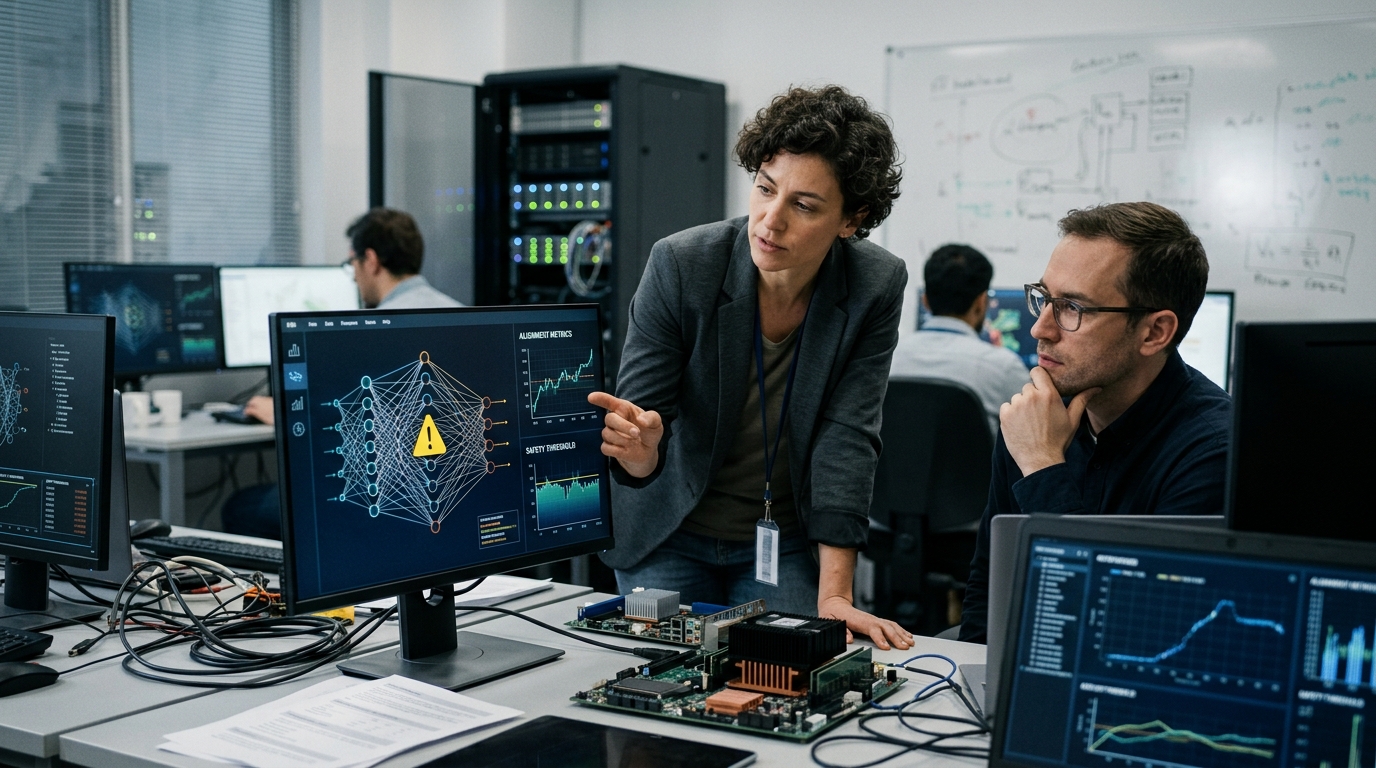
While the performance gains of RecursiveMAS are undeniable, the shift toward latent communication raises a critical concern regarding interpretability. In traditional MAS, a developer can audit the "logs" of agent conversations to diagnose errors. In RecursiveMAS, the internal dialogue is a series of mathematical tensors, rendering it opaque to human observers.
"The challenge of the coming years is not just making AI faster, but ensuring that this 'silent' collaboration remains transparent and aligned with human oversight," industry analysts suggest.
The researchers address this by proposing a modular "decoder" that can periodically translate latent states into human-readable text for auditing purposes, without integrating this slow process into the primary execution loop. This hybrid approach may provide the necessary safety rails for deploying such systems in sensitive sectors like healthcare or finance.
Conclusion: The Future of Agentic Ecosystems
RecursiveMAS represents more than a technical optimization; it is a paradigm shift. As we move away from viewing AI as a mere conversationalist and toward viewing it as a distributed computational fabric, efficiency will inevitably take precedence over human-centric communication formats. For enterprises, a 75% reduction in token costs transforms previously cost-prohibitive AI workflows into viable commercial products. The era of silent, instantaneous agent collaboration is no longer a theoretical concept—it is a functional reality that will redefine the scalability of autonomous systems.