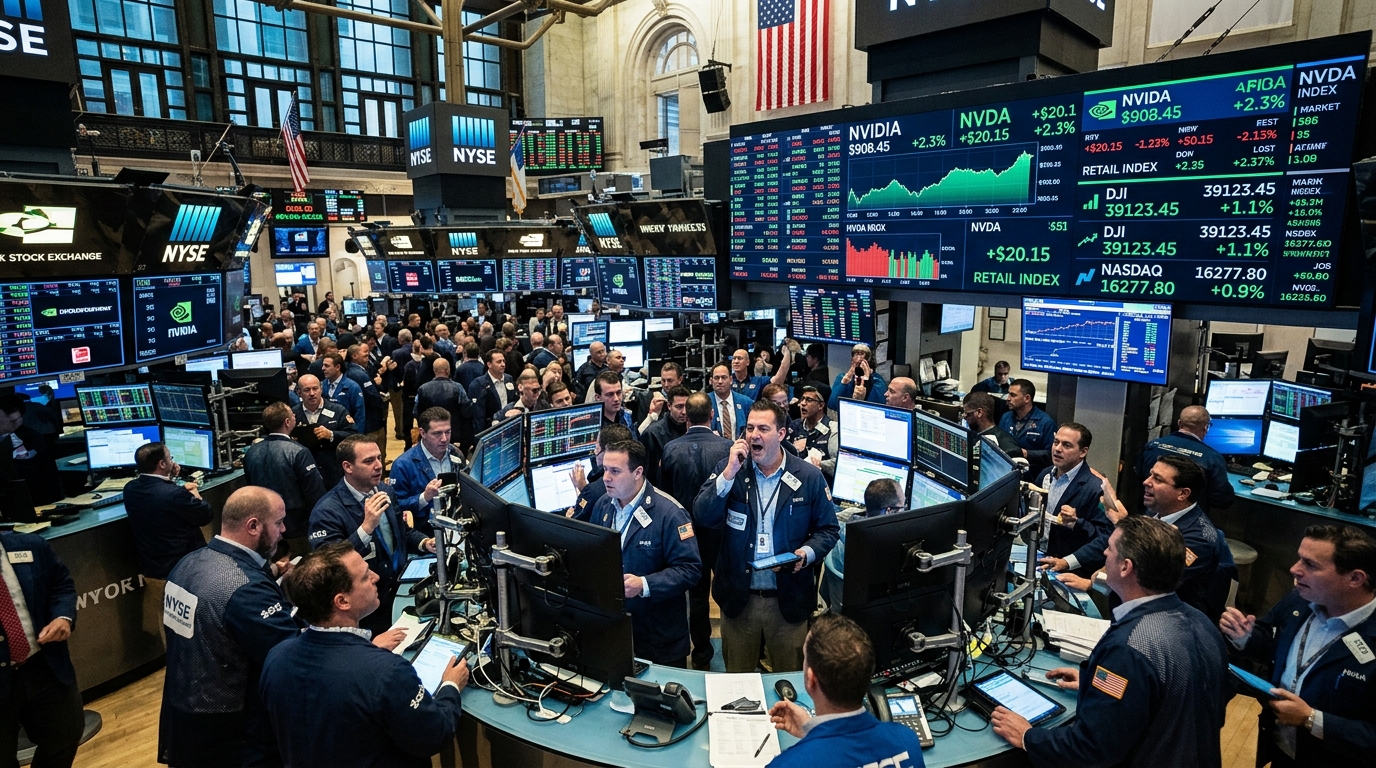
The upcoming week on Wall Street is not merely another earnings cycle; it is a definitive test for the dual narrative that has sustained markets into 2026. On one side, Nvidia, the undisputed sovereign of the Artificial Intelligence revolution, must prove that the hunger for semiconductors remains insatiable. On the other, reports from retail giants like Walmart and Target will offer an unvarnished look at the state of "Main Street" and the purchasing power of the average American consumer.
The Nvidia Phenomenon and AI Maturity
For investors, Nvidia is no longer just a tech stock; it is a global economic bellwether. As we move through the first half of 2026, the question is not whether the company will post profits, but whether its growth trajectory can justify its premium valuations. The central theme has shifted from infrastructure to application. Analysts will be scouring the data for evidence of how Nvidia’s customers—ranging from nation-states building "Sovereign AI" to multinational conglomerates—are beginning to realize actual return on investment (ROI) from the hardware they frantically acquired over the past two years.
Nvidia's dominance in the GPU market remains formidable, despite aggressive moves from competitors and in-house silicon developments by the likes of Google and Amazon. However, the geopolitical chessboard, specifically export restrictions and stability in Taiwan, continues to cast a shadow. Should Nvidia show even a minor deceleration in its forward guidance, the resulting jitteriness could trigger a domino effect across the entire technology sector.
Consumer Resilience Under Pressure
While Silicon Valley celebrates AI-driven billions, the real economy is navigating a more complex reality. Retail reports will reveal whether inflation, despite its relative cooling, has left permanent scars on consumer behavior. We are witnessing a persistent trend of "trading down," where consumers opt for cheaper private-label goods over premium brands to make ends meet.
- Walmart: Expected to demonstrate whether its digital sales strategy and AI integration in logistics have successfully bolstered margins.
- Target: Will serve as a proxy for discretionary spending—indicating whether shoppers are sticking to essentials or if there is still room for home goods and apparel.
- Home Depot/Lowe's: Their results will reflect the health of the housing market and the willingness of homeowners to invest in renovations amidst stabilized but historically high interest rates.
The accumulation of credit card debt and the depletion of pandemic-era savings are factors that can no longer be ignored. The retailers that manage to post positive numbers will likely be those that have leveraged technology to offer hyper-personalized promotions and logistical efficiency.
The Convergence: Where AI Meets the Shelf
A fascinating aspect of this earnings season is the intersection of these two worlds. These are no longer separate stories. Retailers are now among the largest consumers of AI technology. From inventory forecasting to automated checkout systems and sophisticated customer service bots, the profitability of traditional brick-and-mortar businesses is now directly tied to the success of their digital transformation.
"AI is no longer an experiment in Nvidia’s labs; it is the engine that determines which product sits on a Walmart shelf at the exact moment a consumer needs it," notes a senior Wall Street analyst.
This organic link means that a failure in Nvidia’s outlook could be interpreted as a slowdown in the modernization of the broader economy. Conversely, if retailers announce a pullback in tech spending due to sagging sales, it will directly impact the growth forecasts for semiconductor firms.
Macroeconomic Implications and the Fed’s Stance
All of this unfolds under the watchful eye of the Federal Reserve. If the data suggests consumer spending is too robust, hopes for further interest rate cuts may evaporate as the fear of reigniting inflation persists. On the other hand, a sharp decline in retail sales could sound the alarm for an impending recession, notwithstanding the brilliance of the AI sector.
In conclusion, the coming week will set the tone for the remainder of the year. The market is searching for a "Goldilocks" scenario: an Nvidia that continues to grow at a sustainable yet impressive clip, and a consumer who, while cautious, remains engaged. Any deviation from this script will test the resilience of the indices and the psychology of investors worldwide.