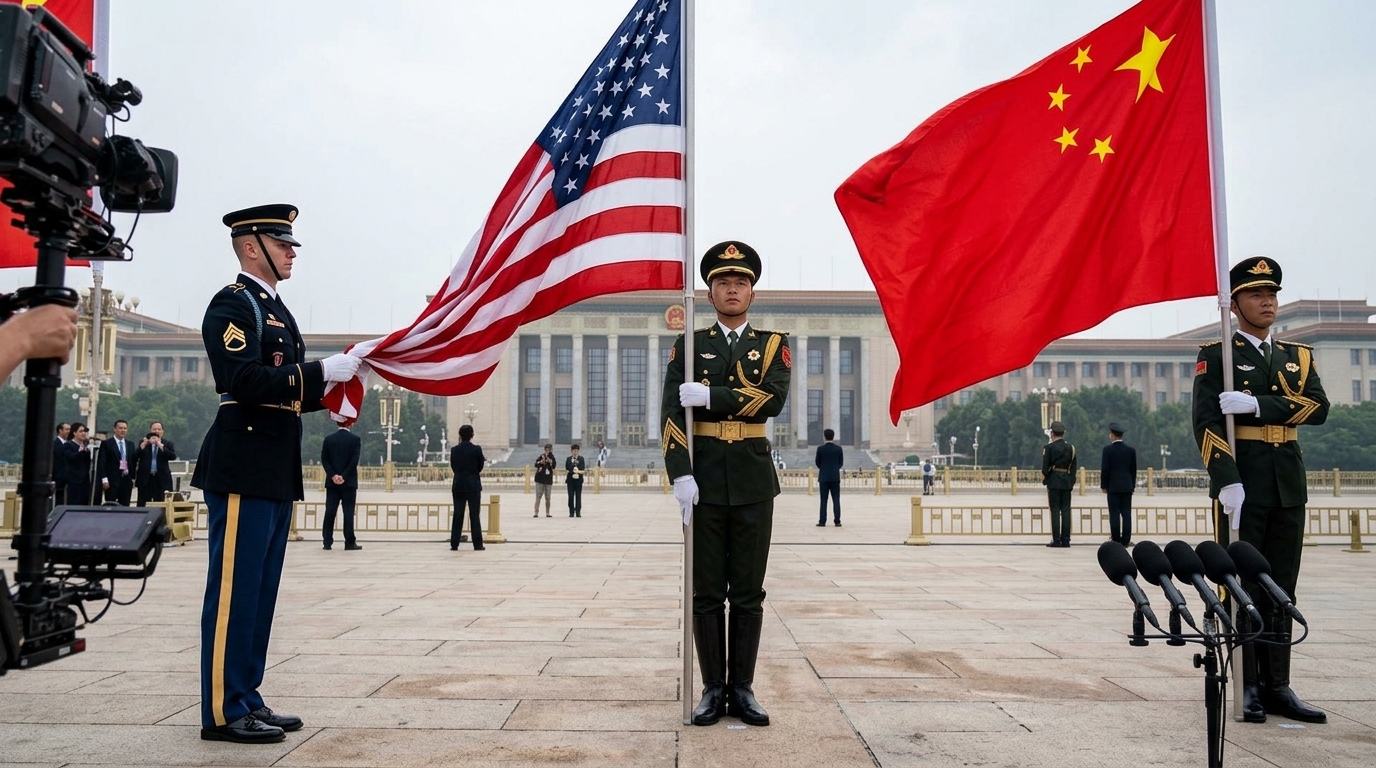
In a move that has sparked cautious optimism across international markets, China and the United States have reached an agreement to fully implement all existing trade commitments. The news, emerging after intensive consultations, is not merely about maintaining the status quo, but also about establishing new institutional bodies: trade and investment councils designed to serve as communication channels for resolving disputes before they escalate into full-scale trade wars.
This development comes at a time when the global economy is desperately seeking stability. After years of retaliatory tariffs, export restrictions on semiconductors, and rhetoric surrounding "decoupling," the return to the negotiating table with such a clear commitment suggests that both sides recognize the catastrophic costs of a complete rupture. However, analysts remain skeptical, as the "devil is in the details" and the concept of "existing agreements" includes the controversial Trump-era "Phase One" deal, which was never fully realized by Beijing.
Institutionalizing Dialogue: The New Councils
The creation of the trade and investment councils is perhaps the most significant practical step of this agreement. Instead of unilateral actions, the two superpowers are seeking to create a "first aid" mechanism for economic friction. These councils are expected to meet regularly, addressing issues ranging from intellectual property protection to market access for agricultural and industrial firms.
According to sources close to the negotiations, Washington sought assurances that China would honor its promises to purchase American products, while Beijing focused on lifting restrictions affecting Chinese investments on U.S. soil. The formation of these bodies is an acknowledgment that the global supply chain is far too complex to be managed via social media posts or simple Department of Commerce press releases.
"Stability is not the end of competition, but the management of it in a way that does not destroy global prosperity," said a senior official from the U.S. Department of Commerce.
The Thorn of High-Tech and Artificial Intelligence
Despite the agreement on "existing trade deals," there is an elephant in the room: cutting-edge technology. The U.S. continues to implement its "small yard, high fence" strategy, restricting China's access to advanced AI processors and chip-making equipment. This agreement appears to decouple "traditional" trade (agriculture, automobiles, energy) from the geopolitical competition for dominance in Artificial Intelligence.
For China, adhering to trade agreements is a way to buy time and reduce domestic inflationary pressures while simultaneously continuing its push for technological self-reliance. For the U.S., it is an attempt to protect its exporters without yielding on national security concerns. The balance is delicate: how can you be a "partner" in soybean trade and a "rival" in AI source code?
- Agricultural Products: China commits to increasing imports from the American Midwest.
- Intellectual Property: Stricter controls to prevent forced technology transfer.
- Financial Services: Greater opening of the Chinese market to American banks.
- Dispute Resolution: Regular meetings at the undersecretary level.
Geopolitical Implications and the Future
This agreement does not signify the end of Cold War 2.0. On the contrary, it represents a tactical realignment. With elections approaching in several Western nations and the Chinese economy facing challenges in the real estate sector, neither side desires a new economic crisis triggered by tariff hikes. The European Union is watching closely, fearing that a bilateral U.S.-China approach could leave it on the sidelines or lead to trade diversion toward the European market.
In conclusion, the commitment to implement these agreements is a positive step for global market predictability. However, the true test will be the first time one of these new councils is called upon to manage a crisis. History has shown that trade agreements are only as strong as the political will backing them, and in the case of Washington and Beijing, that will remains contingent on shifting geopolitical winds.