The management of nuclear waste stands as one of the most daunting environmental and technical challenges of the 21st century. At the Hanford Site in Washington State, millions of gallons of radioactive sludge—a legacy of the Cold War arms race—await a permanent solution. The definitive answer lies in "vitrification": the process of mixing waste with glass-forming materials and melting them at extreme temperatures to create a stable, solid form. However, discovering the optimal "recipe" for this glass is a chemical and engineering nightmare. This is where the Pacific Northwest National Laboratory (PNNL) has stepped in, deploying Artificial Intelligence to revolutionize a process that once dictated decades of painstaking laboratory work.
The Complexity of Vitrification: A Chemical Jigsaw
Vitrification is far more complex than simple glassmaking. Radioactive waste is a chaotic slurry of chemical elements, ranging from heavy metals to volatile isotopes, each reacting uniquely under intense heat. To produce a stable glass that can endure for millennia, scientists must balance dozens of competing variables: melt viscosity, electrical conductivity, crystallization temperature, and long-term chemical durability.
Historically, this was a trial-and-error endeavor. A single glass formulation could take weeks to test in a lab setting. Given the billions of potential combinations of chemical additives, achieving a truly optimized formula was statistically impossible. The stakes are also incredibly high; if a mixture is slightly off, it can cause crystals to form in the melter, potentially clogging the system and causing millions of dollars in damage, while setting the cleanup timeline back by years.
Machine Learning as a Scientific Catalyst
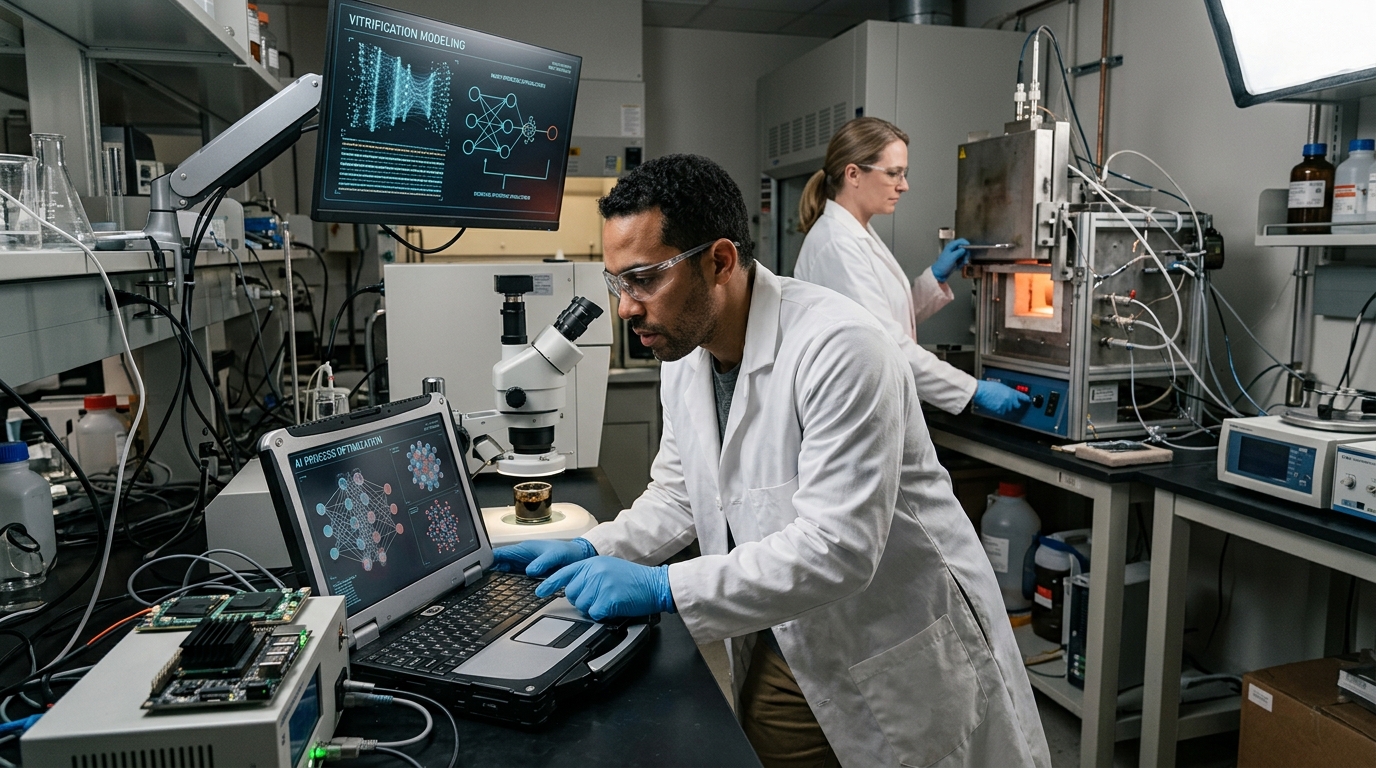
The research team at PNNL, in collaboration with the American Nuclear Society (ANS), has developed sophisticated machine learning models capable of predicting glass properties with unprecedented precision. Instead of physically melting thousands of samples, researchers feed the AI algorithms data from decades of prior experiments. The AI "learns" the intricate relationships between components like aluminum oxide, silica, and boron, and how they dictate the final glass structure.
These models are not merely statistical tools; they are computational engines capable of running millions of simulations in a single day. This allows scientists to identify "sweet spots"—formulations that maximize "waste loading" (the amount of waste incorporated into the glass). By increasing the waste loading even by a small percentage, the total volume of glass canisters produced is significantly reduced, leading to massive savings in storage and disposal costs.
- Acceleration: Analyses that previously took years are now performed in weeks or even days.
- Risk Mitigation: AI predicts and prevents the formation of harmful crystals that could jeopardize the melting equipment.
- Fiscal Responsibility: Optimizing formulas can save billions of dollars in long-term cleanup budgets.
Beyond Hanford: A Global Environmental Legacy
While the immediate focus of PNNL’s research is the Hanford cleanup, the implications are global. Nations such as France, the United Kingdom, and China, all of which maintain significant nuclear infrastructures, face similar waste management hurdles. The integration of AI into materials science marks the dawn of a new era of "computational materials discovery," where complex problems are solved in the digital realm before a single drop of material is melted in the real world.
Furthermore, PNNL’s success highlights the critical role of data transparency and interdisciplinary collaboration. By using open datasets to train AI models, the project demonstrates how technology can bridge the gap between academic theory and industrial application. As the world increasingly looks toward nuclear energy as a low-carbon solution to climate change, our ability to manage its byproducts safely and cost-effectively will be the deciding factor in public and political acceptance.
"Artificial Intelligence does not replace the scientist; it provides a high-powered lens to peer through billions of possibilities, finding the needle in the haystack of nuclear chemistry," researchers noted during the project's unveiling.
In conclusion, the PNNL initiative is a prime example of how AI can address the "dirtiest" legacies of our past. By transforming radioactive hazards into stable, inert glass, technology is allowing us to secure the future, ensuring that the mistakes of the atomic age do not become a permanent burden for generations to come. This is not just a win for science; it is a win for the planet.