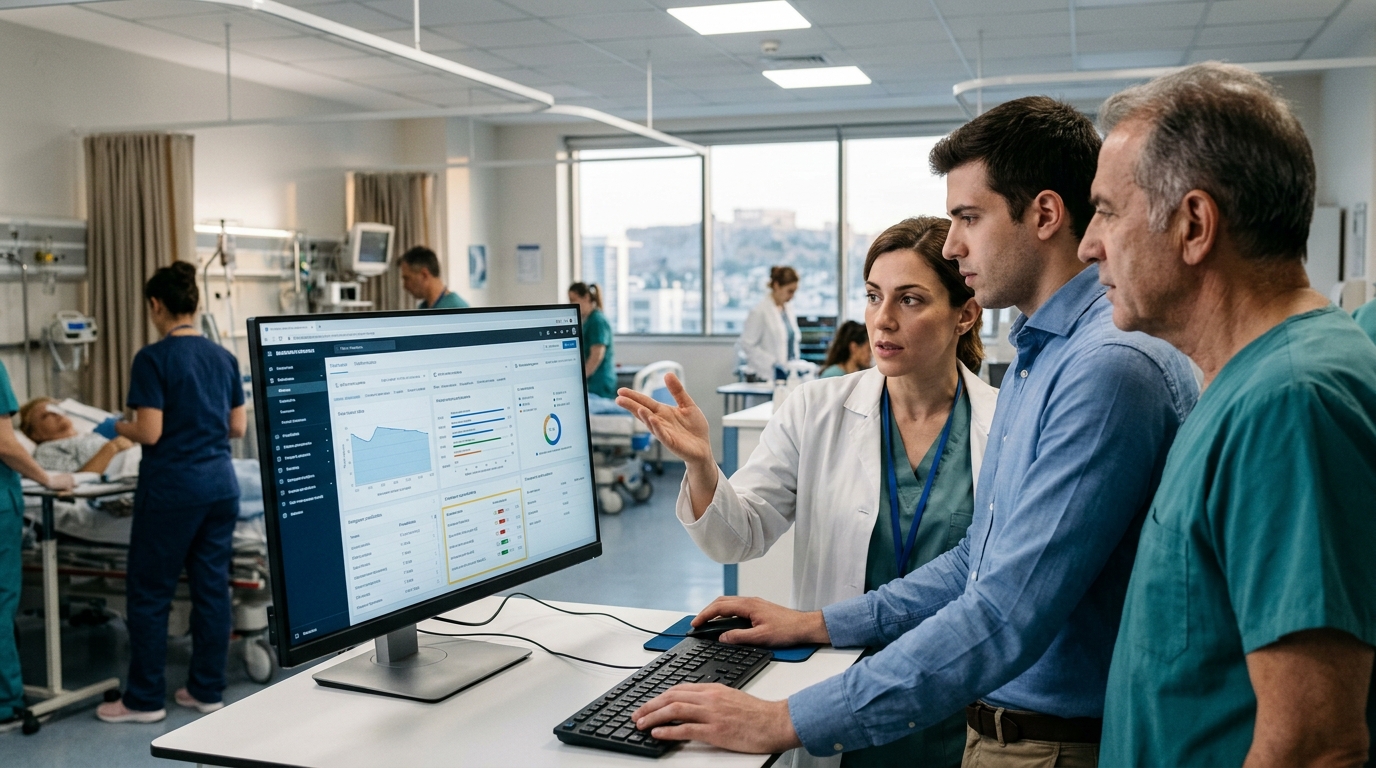
The image of a crowded Emergency Room (ER) is often synonymous with chaos: doctors running under extreme pressure, patients presenting with vague symptoms, and the constant threat of a mistake that could prove fatal. In this environment, speed and diagnostic accuracy are the holy grail of medicine. A new study from Harvard University and Beth Israel Deaconess Medical Center, recently published, is shaking the foundations of clinical practice by proving that AI Large Language Models (LLMs) now achieve higher accuracy rates in differential diagnosis than seasoned clinicians.
The Methodology of Disruption
The study was not limited to theoretical scenarios. Researchers used real-world cases from ER archives, presenting the same data—symptoms, medical history, lab results—to both a group of experienced physicians and the GPT-4 model. The result was startling: the AI ranked the correct diagnosis at the top of its list with significantly higher frequency than its human counterparts. While doctors are often limited by cognitive biases or shift fatigue, the AI processes every possible scenario coldly and exhaustively.
Specifically, the study showed that the AI achieved an accuracy score nearing 90%, while doctors scored lower, particularly when symptoms were atypical or pointed toward rare conditions. This doesn't necessarily mean doctors are "inferior," but it highlights the inherent limitations of human information processing in high-stress situations.
The Phenomenon of Cognitive Bias
One of the study's most significant findings concerns how doctors make decisions. Humans tend to rely on recent experiences or "heuristics" (mental shortcuts). If a doctor saw five cases of the flu in the morning, they are more likely to diagnose flu in the sixth patient, even if the symptoms suggest something rarer. AI lacks this type of "memory"; every case is treated as a unique data set compared against a global database of medical knowledge.
- Elimination of fatigue as a factor in errors.
- Instant access to literature on rare diseases.
- Objective evaluation of lab findings without emotional involvement.
- Ability to process hundreds of parameters simultaneously.
The Global Healthcare Crisis and the AI Safety Net
In many parts of the world, including Greece and the US, public health systems are on the brink of collapse due to understaffing and burnout. In this context, integrating AI tools is no longer a luxury but a necessary safety net. The diagnostic gap—the difference between the correct diagnosis and the one initially given—is a leading cause of patient harm globally. AI could act as a persistent, tireless co-pilot, flagging risks that a sleep-deprived resident might miss.
"AI will not replace the doctor, but the doctor who uses AI will replace the one who does not," the study notes, echoing a growing sentiment in the medical tech community.
However, the implementation of such systems faces bureaucratic hurdles, a lack of digitized health records in many regions, and skepticism from parts of the medical establishment. The need for a strategic national and international framework for AI in healthcare is now urgent.
Ethical Dilemmas and Diagnostic Liability
Despite its superiority in accuracy, AI remains a tool without empathy. Medicine is not just about diagnosis; it is about communicating with the patient, understanding pain, and making decisions that affect quality of life. Furthermore, the critical question of legal liability arises: If the AI makes a mistake, who is responsible? If a doctor ignores the AI and makes a mistake, are they negligent?
The Harvard researchers propose a model of "augmented intelligence," where the physician acts as the final arbiter, using AI suggestions as a high-reliability "second opinion." The study concludes that human-machine collaboration produces the best results, significantly reducing diagnostic errors which are among the top causes of death worldwide.
The Future of Medical Education
This study forces medical schools to rethink their curricula. If data memorization and diagnosis can be performed better by a machine, what is the role of the future physician? The focus seems to be shifting toward critical thinking, the ethical management of technology, and patient-centered care. The 21st-century doctor will need to be as proficient with an algorithm as they are with a stethoscope.
As we move forward, the challenge will be to integrate these tools without losing the "human touch" that defines the medical profession. The Harvard study is not a death knell for doctors, but a clarion call for a new era of high-tech, high-accuracy healthcare.