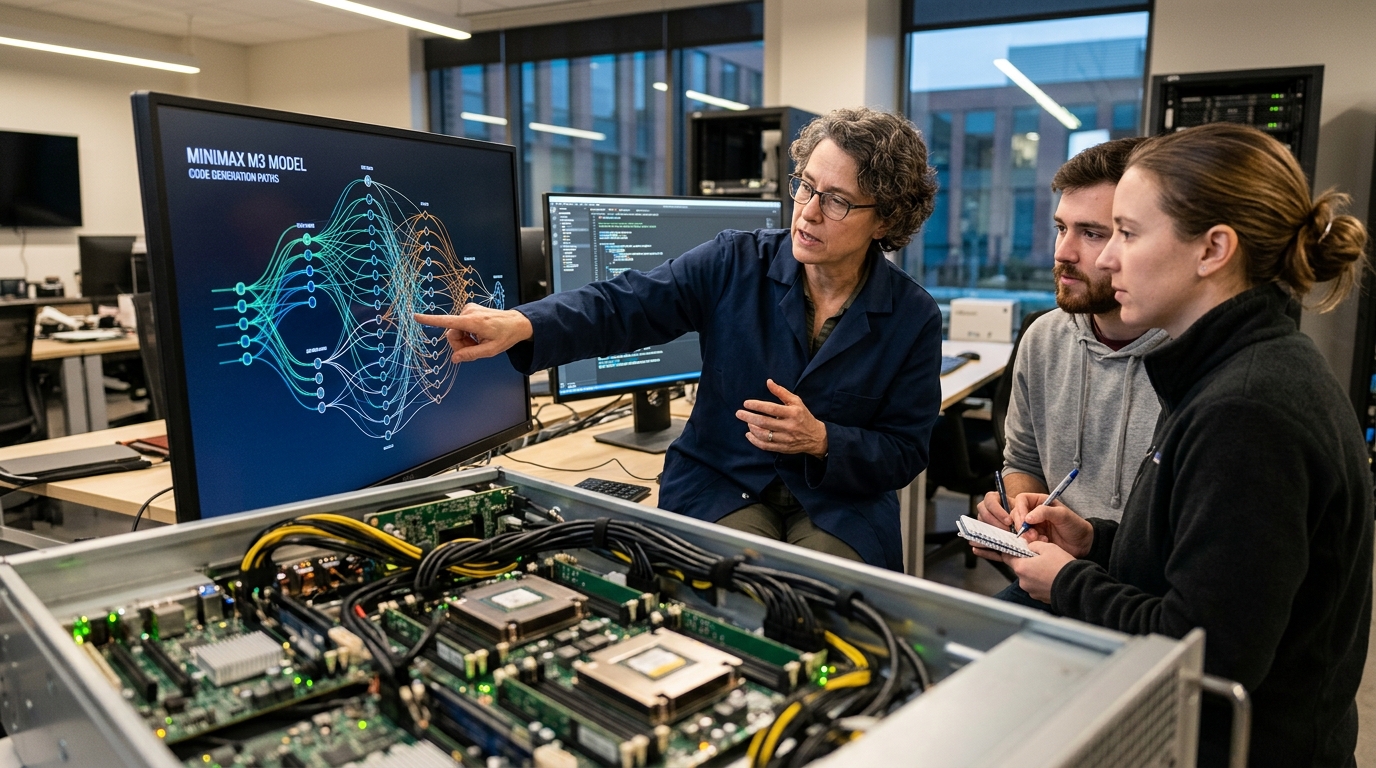
In the breakneck world of artificial intelligence, the line between genuine innovation and strategic marketing is often blurred. The recent announcement from MiniMax, one of China's most promising AI startups, regarding the release of its MiniMax M3 model, has sent ripples through the developer community. Positioned as an "open-weight" coding specialist, M3 arrives with bold claims of reaching or even surpassing the performance of closed-source giants like OpenAI’s GPT-4o and Anthropic’s Claude 3.5 Sonnet. However, the lack of independent verification for its benchmarks has sparked significant skepticism across the global tech landscape.
The MiniMax Strategy and the Open-Weight Movement
MiniMax, backed by heavyweights like Alibaba and Tencent, is no minor player. Its decision to release M3 as an open-weight model follows a broader trend observed in China, where firms like DeepSeek have already gained international traction by offering powerful tools for local deployment. An open-weight model allows developers to download the model's weights and run them on their own infrastructure, providing a level of privacy and customization that closed APIs simply cannot match.
M3 focuses exclusively on code, a domain where precision is paramount. MiniMax asserts that its model has been trained on a massive corpus of programming data, utilizing advanced optimization techniques that enable it to grasp complex logical structures and generate code that is not just syntactically correct, but functionally efficient. Nevertheless, the history of Chinese LLMs is punctuated by impressive benchmark scores that frequently fail to translate into equivalent real-world performance.
The Controversy of Unverified Benchmarks
The crux of the debate surrounding M3 lies in its performance on standardized tests such as HumanEval and MBPP (Mostly Basic Python Problems). MiniMax has published results that place M3 at the top of global leaderboards. Yet, the tech community remains wary. The issue of "benchmark contamination"—where a model is inadvertently or intentionally trained on the test questions themselves—is a persistent concern. If a model has seen the answers during its training phase, its high scores are essentially meaningless.
"Benchmarks in the era of generative AI have become a form of digital theater. Without access to training methodology and without independent third-party evaluation, any claim of 'frontier performance' must be met with healthy skepticism," industry analysts suggest.
MiniMax has yet to provide full transparency regarding the evaluation datasets used, nor has it submitted the model to platforms like LiveCodeBench. LiveCodeBench is widely considered harder to "game" because it utilizes problems from recent coding competitions that did not exist when the models were being trained.
Geopolitical Implications and the US-China Tech Rivalry
The release of M3 is not merely a technical milestone; it is a strategic move in a larger geopolitical game. As the United States imposes strict export controls on advanced AI chips to China, Chinese firms are forced to become more inventive with their model architectures and efficiency. The pivot toward open-source and open-weight models is a calculated attempt to build an ecosystem independent of Western gatekeepers.
If M3 proves to be as capable as MiniMax claims, it would offer Chinese developers—and the global community—a tool capable of challenging American monopolies. This could accelerate software development worldwide, lowering costs and increasing accessibility to cutting-edge technology. Conversely, the lack of transparency fuels concerns regarding safety, alignment, and the provenance of training data.
The Developer Experience: Moving Beyond the Numbers
For the average software engineer, a model's success isn't determined by a spreadsheet of scores but by daily utility within an Integrated Development Environment (IDE). MiniMax M3 promises enhanced code completion, more intuitive debugging, and the ability to translate natural language prompts into sophisticated scripts. The true litmus test for M3 will be its integration into tools like VS Code or JetBrains and how it handles real-world, messy, and poorly documented codebases.
- Privacy: Open-weight models allow for on-premise execution, a critical feature for enterprises handling sensitive proprietary code.
- Cost-Efficiency: Avoiding per-token API fees from major providers can save large development teams thousands of dollars monthly.
- Customizability: The potential for fine-tuning M3 on specific programming languages or internal company frameworks.
In conclusion, MiniMax M3 is an ambitious endeavor that highlights the growing prowess of the Chinese AI industry. While claims of "frontier performance" remain to be proven in the wild, the introduction of another potent open-weight model is a net positive for technological pluralism. The community now awaits the first wave of independent audits to see if M3 is the new king of code or simply another case of over-promising on paper.