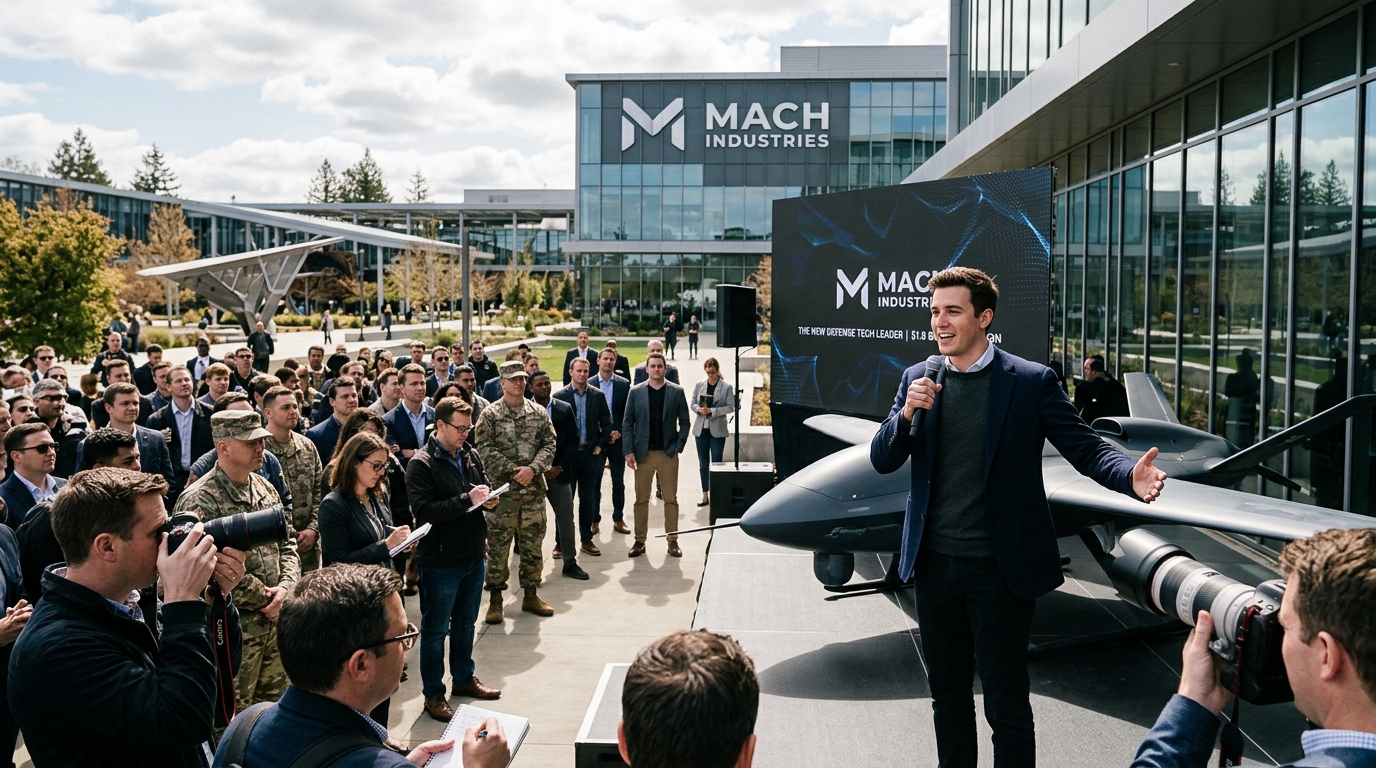
In an era where geopolitical instability has thrust the defense industry back into the spotlight of investment activity, Mach Industries is emerging as one of Silicon Valley's most influential players. According to recent reports, the defense tech startup has secured new funding that elevates its valuation to an impressive $1.8 billion. This development is not merely a business success; it is a clear indication of the direction the Pentagon and its allies are taking: toward autonomous, affordable, and technologically advanced weapon systems.
The Hydrogen Revolution on the Battlefield
The defining characteristic of Mach Industries, led by visionary founder Ethan Thornton, lies in its choice of energy source. While most drone and autonomous vehicle companies rely on lithium batteries or traditional fuels, Mach is betting big on hydrogen. Hydrogen offers a unique solution to the logistics problem in combat zones. The ability to produce fuel on-site using local resources reduces dependence on vulnerable supply lines, which often represent the 'Achilles' heel' of modern militaries.
The company's systems utilize hydrogen combustion to power both propulsion and kinetic strike systems. This allows its aircraft to remain airborne for longer durations and achieve speeds that surpass conventional electric drones. Furthermore, using hydrogen as a propellant in projectiles offers a new dimension in firepower, making Mach Industries' weapons exceptionally cost-efficient relative to their production expense.
The Replicator Doctrine and the Paradigm Shift
The meteoric rise in Mach Industries' valuation is inextricably linked to the U.S. Department of Defense's 'Replicator' initiative. This doctrine aims to deploy thousands of inexpensive, autonomous 'attritable' systems that can be mass-produced to counter the numerical superiority of adversaries in regions like the Indo-Pacific. Mach Industries fits this profile perfectly, as its products are designed for mass production at low cost, in stark contrast to the exorbitant 'legacy' systems of traditional contractors like Lockheed Martin or Northrop Grumman.
This shift toward 'disposable' technology is a game-changer. Instead of a single aircraft costing $100 million, the military can now field thousands of Mach drones at a fraction of the price. Losing a few units in battle is no longer considered a strategic disaster but part of the operational plan. This quantitative superiority, combined with artificial intelligence that allows these systems to operate in swarms, represents the new nightmare for traditional defense doctrines.
Investor Confidence and the Future of Defense
The participation of top-tier venture capital firms, such as Sequoia Capital, in the recent funding round underscores market confidence in the company's vision. Investors view Mach Industries not just as a defense firm, but as a deep-tech company solving fundamental energy and autonomy problems. The $1.8 billion funding will primarily be used to scale production. The transition from prototype to mass manufacturing is the critical challenge for any startup, and Mach now appears to have the resources to meet it.
However, the rise of such companies also raises serious ethical questions. The automation of lethality through autonomous strike systems remains a controversial issue. While Mach Industries emphasizes that its systems operate under human supervision, the speed and scale of operations enabled by these weapons make human control increasingly blurred. As we move into the latter half of the 2020s, the balance between technological superiority and ethical responsibility will be the central theme of discussion in international security forums.
- Hydrogen usage allows for on-field fuel production, mitigating logistics risks.
- The $1.8B valuation reflects a massive investor pivot toward defense technology.
- Autonomous swarm systems are fundamentally altering Pentagon strategy.
- Mach Industries directly challenges legacy defense giants with lower-cost alternatives.