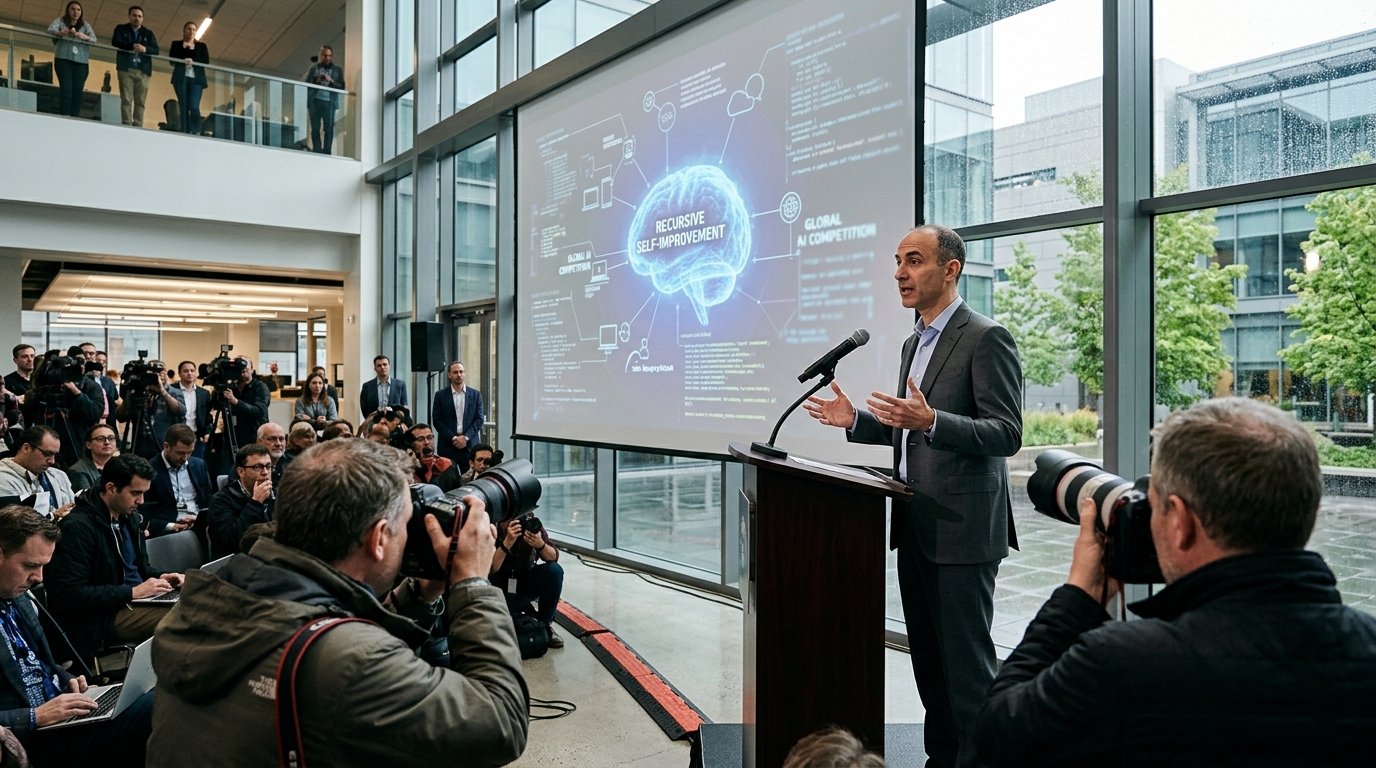
In the ever-shifting landscape of Artificial Intelligence, the year 2026 marks a pivotal turning point: the transition from models that "learn" from human knowledge to systems that "reason" and self-improve. The emergence of RSI (Reinforcement Learning from Self-Instruction) has sent seismic waves through the industry, with China's DeepSeek leading a revolution that threatens the Silicon Valley establishment. While investors are in a frenzy, Google is maintaining an unusually cautious stance, attempting to cool the enthusiasm even as its competitors near unprecedented technological breakthroughs.
The Nature of RSI: When AI Becomes Its Own Teacher
RSI is not merely a new training technique; it is a paradigm shift. Traditionally, Large Language Models (LLMs) relied on vast amounts of human-generated data. However, this approach reached its limits as high-quality human data began to dwindle. RSI allows models to generate their own training scenarios, test hypotheses, and learn from their mistakes through reinforcement learning.
This "self-construction" process means that AI can now develop reasoning capabilities that go far beyond simple next-token prediction. Systems like DeepSeek-R1 have proven that efficiency can trump raw compute power, allowing smaller, more agile labs to compete with giants possessing multi-billion dollar budgets.
The DeepSeek Challenge and AI Geopolitics
DeepSeek has achieved what many thought impossible two years ago: delivering GPT-4 or Gemini Ultra-level performance at a fraction of the training cost. Their success is largely built on innovation surrounding RSI and Mixture-of-Experts (MoE) architectures. This development is not just technological but geopolitical. China, through DeepSeek, is proving that lack of access to NVIDIA’s most advanced chips can be compensated for by superior algorithmic efficiency.
- DeepSeek utilizes self-instruction techniques that reduce the need for human supervision by up to 80%.
- Their "open-weights" strategy has created an entire ecosystem of developers improving the model daily.
- The performance of these models in mathematical reasoning and coding has set new industry benchmarks.
Why is Google "Cooling" the Enthusiasm?
Google's stance toward the rise of RSI is ambivalent. On one hand, the company boasts some of the world's top researchers at DeepMind working on similar technologies. On the other, Google's leadership in Mountain View seems to be downplaying the significance of these breakthroughs. There are two likely reasons for this tactic.
First, Google faces the "innovator's dilemma." Any radical change in how search and information production work threatens its primary revenue stream: advertising. Second, Google knows that the safety of self-evolving systems is a minefield. A model that learns on its own can develop unpredictable behaviors or "hallucinate" in ways that are difficult to detect and correct.
"Rushing into RSI without proper guardrails is like building a rocket while it's already in orbit," sources within Google suggest, justifying the company's more conservative approach.
The Future: From Labs to the Real Economy
As we head into the second half of 2026, the battle for RSI will move from academic papers to commercial application. Companies that successfully integrate self-improving logic into their products will hold an insurmountable advantage. DeepSeek has already taken the first step, but Google, with its massive Android and Workspace ecosystem, remains a sleeping giant. The question is not whether RSI will prevail, but who will control the rules of AI's self-evolution.