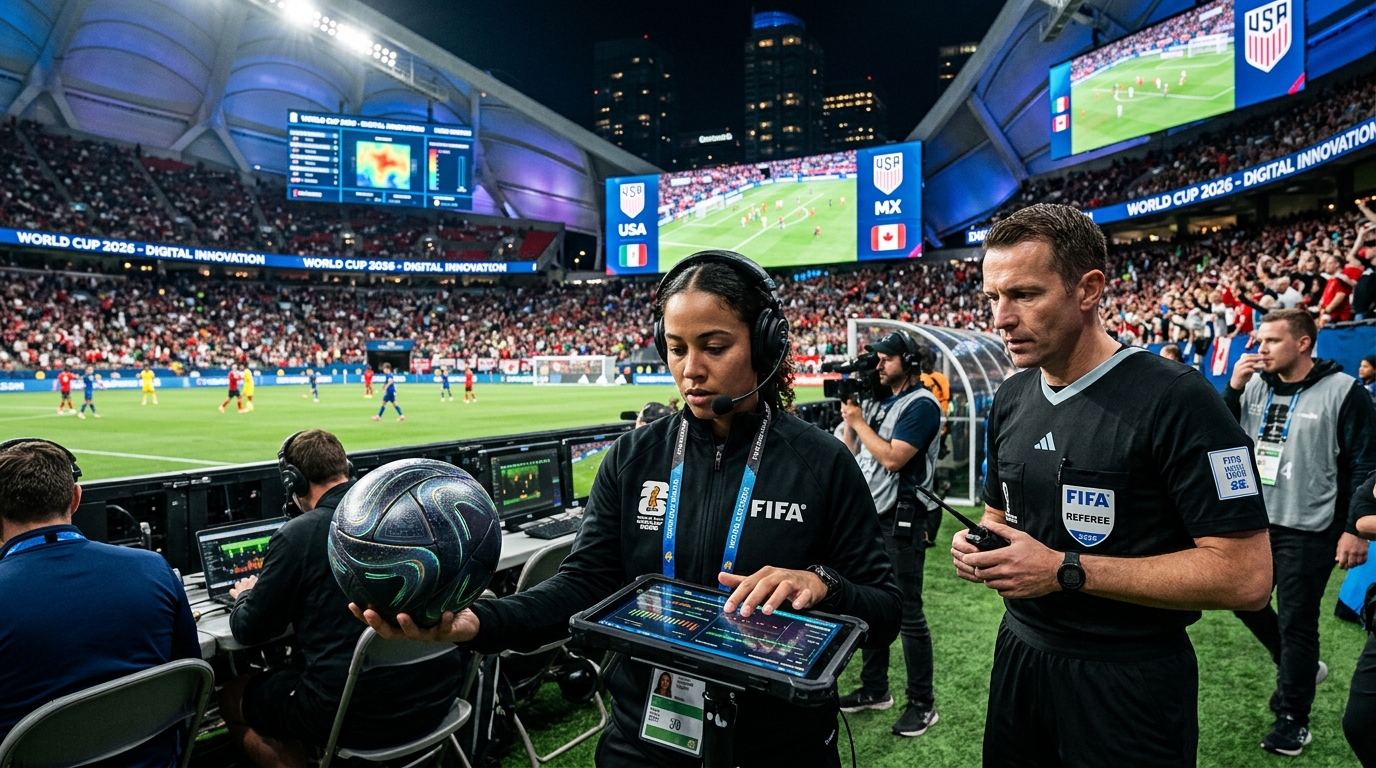
As the footballing world looks toward 2026, the World Cup set to take place across the United States, Canada, and Mexico is not just being heralded as the largest in terms of participation, but as the most technologically advanced sporting event in human history. At the heart of this transformation lies Artificial Intelligence (AI) and the evolution of the 'smart' ball—tools that promise to eliminate human error, accelerate the pace of play, and offer an unprecedented viewing experience.
The Anatomy of the Smart Ball: A Sensor at the Heart of the Game
The 'smart' ball is no longer a futuristic scenario but a reality that was tested in Qatar and is now preparing for its full maturity. Inside the ball to be used in 2026, there will be a high-precision Inertial Measurement Unit (IMU) sensor. This sensor will send data 500 times per second to a central system, allowing for the detection of the exact point of contact between the ball and a player's foot or hand, in case of an infraction.
This technology, combined with a network of cameras positioned under the stadium roof, creates a digital ecosystem. These cameras will track 29 different points on each player's body, 50 times per second. AI processes this data in real-time, creating a three-dimensional model of the play. When a ball leaves a player's foot, the system instantly knows if the attacker was in an offside position, reducing the waiting time for VAR decisions from minutes to seconds.
Semi-Automated Offside and the Justice of Algorithms
The biggest challenge for FIFA has always been maintaining the flow of the game. The delays caused by VAR have been heavily criticized by fans and analysts alike. AI in the 2026 World Cup aims to provide a solution through the Semi-Automated Offside Technology (SAOT). The system does not make the final decision—that remains with the referee—but it provides indisputable visual evidence in minimal time.
- Millimetric Precision: AI can distinguish if the tip of a boot or a player's shoulder is exposed, something the human eye cannot see in real-time.
- Visualization for Fans: Data is instantly converted into 3D graphics displayed on stadium giant screens and televisions, explaining the decision to the public.
- Reduced Pressure: Referees are relieved of the burden of marginal calls, focusing more on match management and discipline.
However, this 'algorithmic justice' raises questions about the loss of spontaneity. Football, historically, has been a game of errors—both by players and referees. The full digitization of decision-making risks turning the sport into a sterile exercise in geometry.
The Data Revolution for Coaches and Fans
Beyond officiating, AI will change how we consume football. For coaches, access to live data from the smart ball and players means that tactical changes can be based on accurate fatigue and performance statistics. AI can predict when a player is at risk of injury or where there are gaps in the opposition's defense that are not visible from the bench.
"We are no longer just watching a game; we are watching a live data stream that happens to have a ball involved," sport-tech analysts remark.
For fans, the 2026 World Cup will offer Augmented Reality (AR) applications. Imagine pointing your phone at the pitch and seeing each player's speed, Expected Goals (xG) probability, or passing accuracy in real-time above them. AI will also enable personalized broadcasts, where the viewer can choose to watch the match from the perspective of their favorite player, thanks to image processing from multiple cameras.
Ethics and the Future of the Sport
The introduction of such advanced technology is not without its challenges. There is a fear that wealthy federations, which have already integrated data analysis into their training, will gain an even greater advantage over emerging footballing nations. Furthermore, the collection of biometric data from players raises privacy concerns. Who owns this data, and how can it be used in future transfer negotiations?
In conclusion, the 2026 World Cup will be the milestone where Artificial Intelligence ceases to be an experimental tool and becomes the invisible director of the game. The challenge for FIFA and the global football community is to ensure that, amidst the sensors and algorithms, the 'soul' and passion of football remain intact.