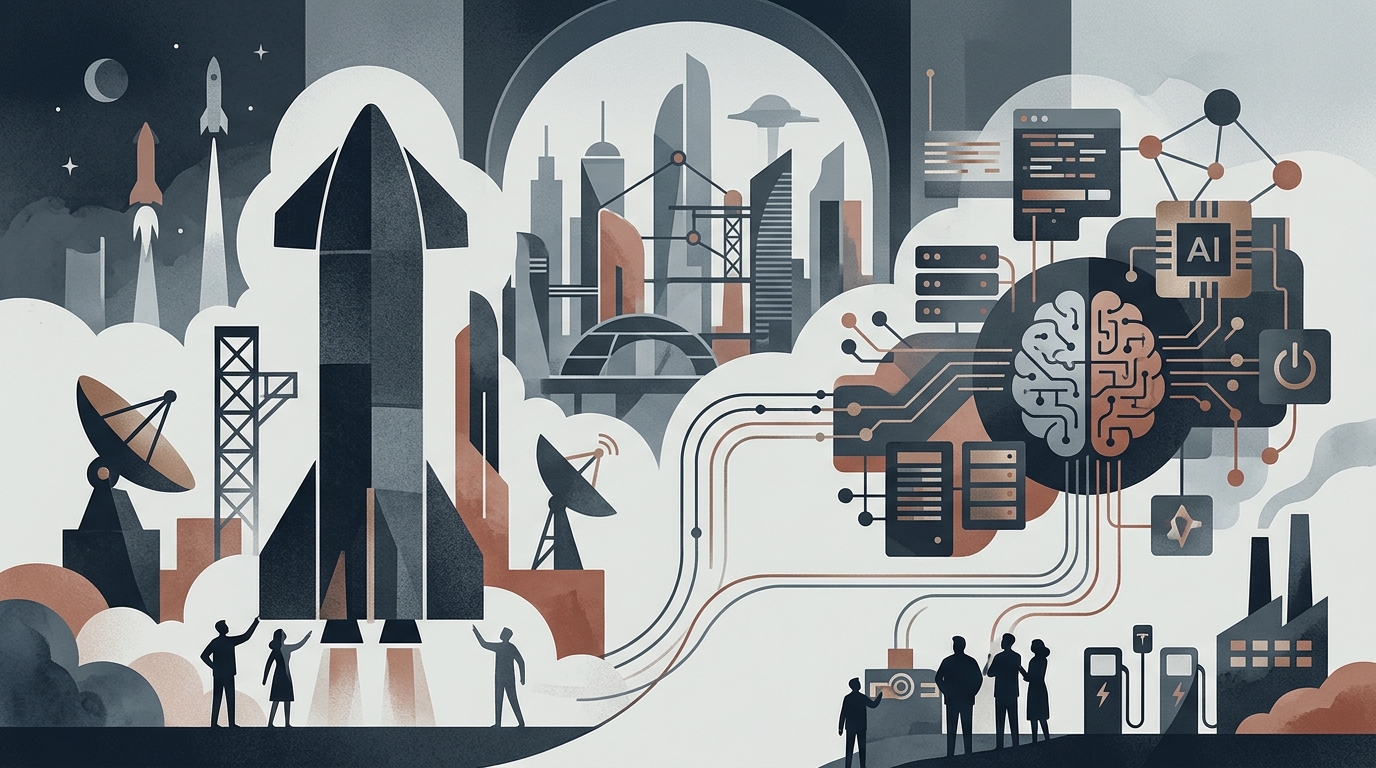
In the intricate web of the "Muskonomy," rumors of a grand merger between Tesla and SpaceX have persisted for years. However, recent market shifts and the explosive trajectory of artificial intelligence point toward a different conclusion. Instead of a cumbersome union between two giants with vastly different regulatory profiles, SpaceX appears to be positioning itself for a strategic acquisition that will place it at the apex of the AI hierarchy. The core of this prediction involves SpaceX acquiring a specialized AI firm backed by Nvidia, completing the circle of vertical integration for Elon Musk’s empire.
The Fallacy of the Tesla-SpaceX Merger
The idea of merging Tesla and SpaceX has always been more of a fan-favorite theory than a financial reality. Tesla is a publicly-traded company, subject to the rigorous oversight of the SEC and the relentless pressure of shareholders for quarterly growth. In contrast, SpaceX remains private, granting Musk the freedom to undertake monumental risks—like the Starship program—without answering to Wall Street’s short-termism. A merger would "pollute" SpaceX’s operational purity with Tesla’s stock volatility and create a regulatory labyrinth that no CEO would willingly enter.
Furthermore, Tesla has its hands full with its own AI challenges, namely Full Self-Driving (FSD) and the Optimus humanoid robot. While Tesla is fundamentally an AI and robotics company, SpaceX’s requirements are distinct. SpaceX needs AI for the autonomous management of the Starlink constellation, precision guidance for orbital maneuvers, and eventually, the complex logistics of Martian colonization. The need for an independent "intelligence core" that isn't tethered to the automotive industry's cycles is becoming critical.
The Nvidia Connection and the Acquisition Target
Why an Nvidia-backed company? Nvidia is no longer just a chipmaker; it is the gatekeeper of the AI era. Companies like xAI (Musk’s own venture) or infrastructure giants like CoreWeave, which have received both funding and preferential hardware access from Nvidia, represent the "crown jewels" of the new economy. The prediction that SpaceX will acquire such an entity is rooted in the logic of infrastructure. SpaceX builds the hardware of the future (rockets, satellites) and requires the ultimate software and compute power to animate it.
Such an acquisition would allow SpaceX to immediately integrate advanced machine learning models to optimize orbital trajectories and manage the colossal data flows generated by Starlink. Starlink, with millions of users and thousands of satellites, is effectively the world’s largest distributed computing experiment. Adding an AI firm with deep Nvidia ties would grant SpaceX a fast-track to next-generation H100 and Blackwell chips, bypassing global supply chain bottlenecks.
The Strategy of Vertical Integration
Elon Musk is a staunch believer in vertical integration. At Tesla, he builds his own seats, chips, and software. At SpaceX, nearly every component of the Falcon and Starship rockets is manufactured in-house. Acquiring an AI company is the next logical step. Rather than paying external providers for compute power or relying on open-source models that might be restricted by future regulations, SpaceX will own the source of its intelligence.
- Spaceborne Autonomy: Mars missions will face communication delays of up to 20 minutes. AI must make split-second decisions locally without human input.
- Data Dominance: Starlink is poised to become the world's largest data provider, and AI is the primary tool for monetizing that data.
- Capital Efficiency: Using SpaceX’s massive private valuation (approaching $200 billion) as "currency" to absorb AI assets is a masterstroke of financial engineering.
The Future of the Muskonomy
In conclusion, the market is awaiting a move that unifies Musk’s disparate visions. While Wall Street analysts often focus on a Tesla-SpaceX merger, the real value lies in the convergence of space logistics and artificial intelligence. SpaceX is no longer just a rocket company; it is an infrastructure provider for the future of humanity. In this future, AI is a fuel just as critical as methane or liquid oxygen.
"Artificial intelligence will be the navigator of the stars, and SpaceX intends to own the navigator."
This evolution will redefine competition, leaving traditional aerospace players like Boeing or Lockheed Martin in the dust as they struggle with 20th-century bureaucratic structures. SpaceX, bolstered by its own AI powerhouse, is evolving into an entity that resembles a sovereign state more than a traditional corporation.