In a world often designed for the "average" person, more than one billion people with disabilities frequently encounter invisible walls. However, the dawn of the Artificial Intelligence (AI) era promises more than mere convenience; it promises a radical overhaul of accessibility. From automated image descriptions for the visually impaired to real-time sign language translation, AI is no longer a futuristic promise but a daily tool for autonomy.
Vision Through Data: Breaking the Darkness
For individuals with visual impairments, AI acts as a "digital companion" that never tires. Applications based on multimodal models can now analyze the environment through a smartphone camera and describe in stunning detail what is happening in front of the user. This is not just about reading a sign or a menu. Modern AI can recognize emotions on the faces of conversational partners, identify obstacles on the sidewalk, or even guide the user to find an empty seat on a bus.
Computer vision technology has reached such a level of precision that distinguishing between a medication and a vitamin, or identifying the denomination of a banknote, happens in fractions of a second. What previously required the presence of another human is now offered via an algorithm, granting the user the most precious commodity: independence.
Communication Without Borders: The Voice of the Silent
The revolution in Natural Language Processing (NLP) has opened new avenues for people with hearing impairments or speech disorders. Real-time speech-to-text capabilities allow deaf individuals to follow conversations, lectures, and professional meetings without the constant need for an interpreter. Conversely, "voice cloning" technology allows individuals who have lost their voice due to diseases like ALS (Amyotrophic Lateral Sclerosis) to communicate using a digital voice that sounds exactly like their own, preserving their identity.
Furthermore, AI is beginning to bridge the gap between sign language and spoken language. Through sophisticated motion recognition systems, hand gestures and facial expressions are instantly translated into text or audio, allowing for a two-way, fluid communication that until recently seemed impossible.
Neural Interfaces and the Freedom of Movement
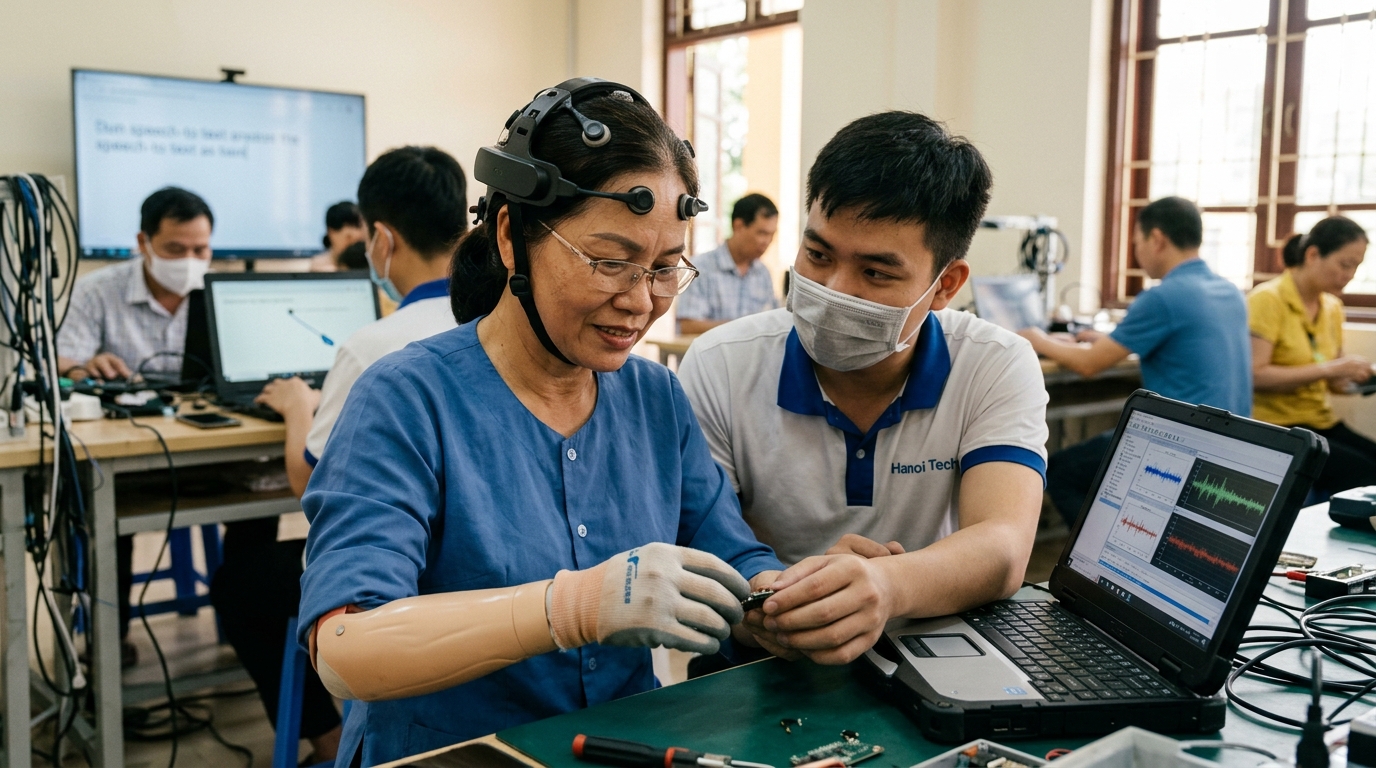
Perhaps the most impressive application of AI lies in the Brain-Computer Interface (BCI). Research centers and tech companies are developing systems where AI "reads" electrical signals from the brain and converts them into movement commands. This means that a person with quadriplegia can operate a computer, a wheelchair, or even an exoskeleton using only the power of their thought.
These systems are not merely mechanical. They use machine learning algorithms to "learn" the specific thought patterns of each user, improving accuracy and response speed over time. AI here is not just a tool, but an extension of the nervous system itself.
Ethical Challenges and the Data Gap
Despite the excitement, the path toward full inclusion is not without obstacles. One of the greatest challenges is the "disability data gap." AI algorithms are trained on massive datasets that often underrepresent people with disabilities. If a gait recognition algorithm has never "seen" how a person with cerebral palsy moves, it might fail to recognize them as a human in an autonomous driving system.
Furthermore, the issue of cost and access arises. While AI can be liberating, if it remains a privilege of the few in developed nations, it risks creating a new form of digital exclusion. The ethical use of AI demands design "with" people with disabilities rather than just "for" them, ensuring that the technology respects their privacy and dignity.
"Technology is not neutral. If we do not design for inclusion, we are designing for exclusion."
In conclusion, Artificial Intelligence offers a historic opportunity to redefine what "ability" means. As machines become smarter, our society has the chance to become fairer, provided that innovation is guided by empathy and social responsibility.