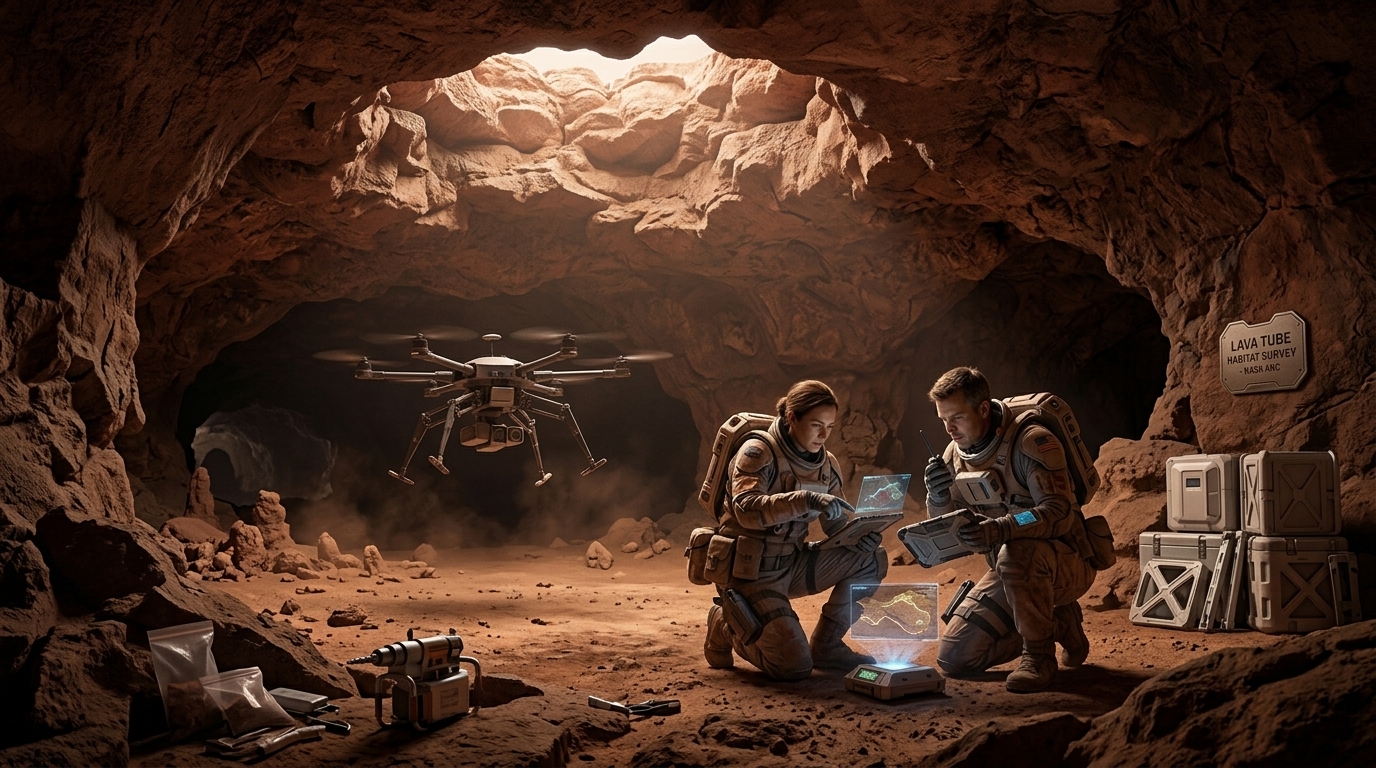
The conquest of Mars will not be decided solely on its surface, but within its depths. As NASA and other space agencies lay the groundwork for the first crewed mission to the Red Planet, a critical question remains: how will astronauts survive in an environment that relentlessly bombards them with lethal cosmic radiation and extreme temperature fluctuations? The answer appears to lie underground, in the vast volcanic tunnels known as 'lava tubes,' and NASA is deploying cutting-edge drone technology to explore them.
The Legacy of Ingenuity and the Next Generation
The success of Ingenuity, the small helicopter that exceeded all expectations on Mars, proved that flight in the planet's thin atmosphere is possible. However, Ingenuity was just the beginning. The new generation of drones being developed at NASA laboratories, such as the Jet Propulsion Laboratory (JPL), will not be limited to simple reconnaissance flights over plains. They are being designed to enter dark, unknown caverns where GPS signals do not reach and real-time communication with Earth is impossible.
These drones must possess unprecedented levels of autonomy. Using SLAM (Simultaneous Localization and Mapping) technology, they will be able to create 3D maps of the tunnels as they fly, avoiding obstacles and identifying safe paths. The use of Artificial Intelligence is essential, as the latency in data transmission between Earth and Mars makes remote control impossible in environments requiring split-second reactions.
Why Lava Tubes are the Key to Survival
Lava tubes formed billions of years ago when lava flowed beneath the Martian surface. As the outer layer cooled and solidified, the interior continued to flow, leaving behind massive empty tunnels. On Earth, such formations exist in Hawaii and Iceland, but on Mars, due to low gravity, these tunnels can be hundreds of meters wide.
- Radiation Protection: Mars lacks a strong magnetic field and a thick atmosphere. Lava tubes offer a natural rock layer tens of meters thick, capable of blocking dangerous cosmic rays.
- Thermal Stability: While surface temperatures can range from 20°C during the day to -125°C at night, the interior of the caves remains stable, facilitating equipment operation and human habitation.
- Micrometeorite Shielding: Without a thick atmosphere to burn them up, small meteorites constantly pelt the surface. The subsurface provides ultimate safety.
Bio-inspired Design: Birds and Insects on Mars
The challenges of flying in enclosed spaces with extremely thin air are driving scientists toward innovative designs. The traditional rotor approach may not be sufficient for the maneuvers required inside narrow tunnels. Consequently, NASA is investigating bio-inspired drones. Ornithopters that mimic the flight of birds or bats could offer greater maneuverability and energy efficiency.
"Nature has solved the problem of flight in complex environments over millions of years. We are simply trying to transfer that wisdom to another planet," a program researcher notes.
Furthermore, the 'swarm' strategy is gaining traction. Instead of one large and expensive drone, a mission could include dozens of smaller, cheaper robots. If one is lost or destroyed, the mission continues. These swarms can collaborate, sharing data to map entire cave networks more rapidly.
The Future: From Cave Dwellers to Colonists
The idea that the first inhabitants of Mars might live in caves seems ironic, given the technological advancement required to get there. However, it is the most realistic solution for long-term stays. The drones exploring these tunnels will not only find shelter but perhaps also traces of water in the form of ice or even evidence of ancient microbial life, protected from the harsh surface conditions.
This mission represents the next great leap in space exploration: the transition from simple observation to a substantive understanding of how we can inhabit an alien world. Drone technology is the key that will unlock the gates of the Martian subsurface, transforming the Red Planet from a hostile destination into a potential second home for humanity.