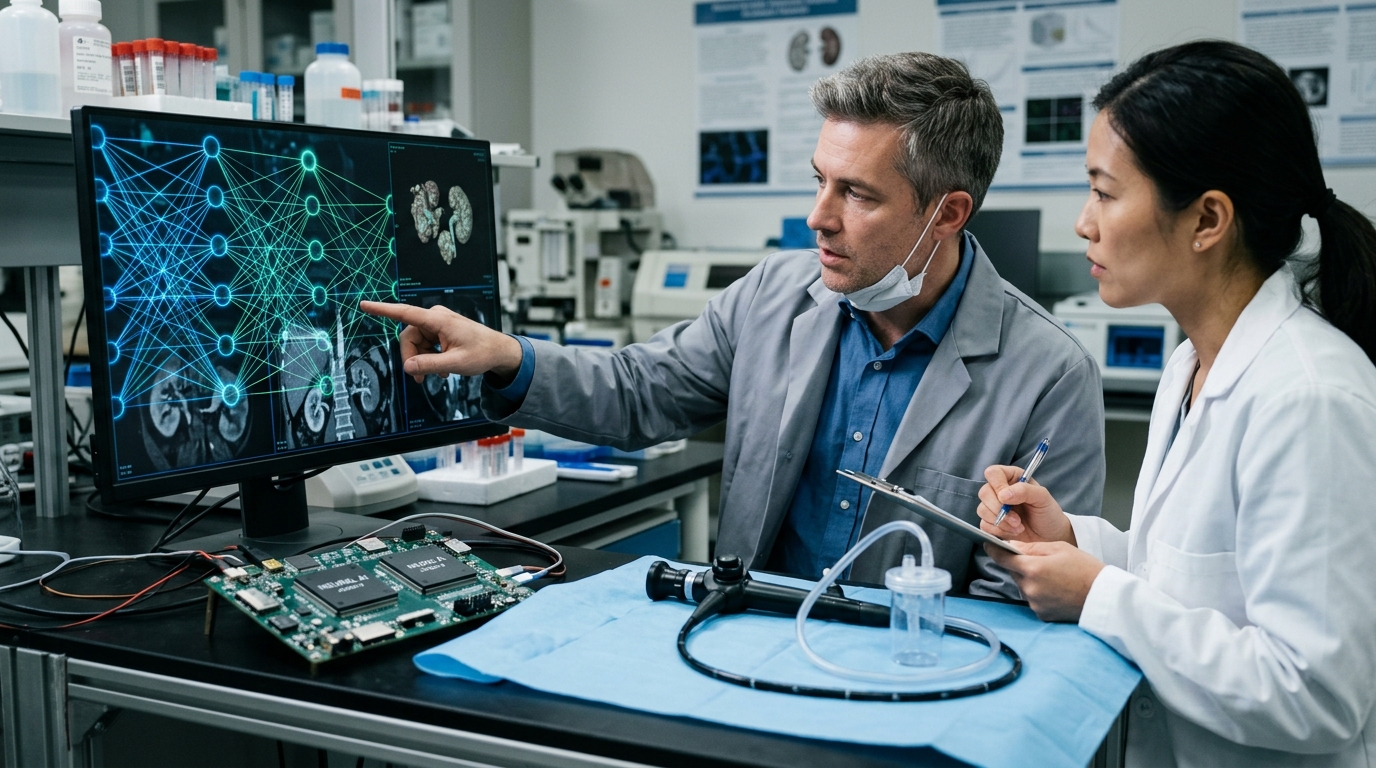
The management of urolithiasis is standing on the precipice of a historic transformation. For decades, ureteroscopy (URS) has been the "gold standard" for treating kidney stones, yet its limitations—such as elevated intrarenal pressure and the difficulty of complete fragment clearance—remained significant hurdles. Today, the advent of suction-enabled URS (sURS) technology combined with Artificial Intelligence (AI) promises to dismantle these barriers, offering a more predictable and safer surgical experience.
The Suction Revolution: From Passive to Active Clearance
Traditionally, during a ureteroscopy, the surgeon uses a laser to break the stone into "dusting" or small fragments which are then removed using specialized baskets. However, this process often results in impaired visibility due to floating debris and, more critically, a dangerous increase in pressure within the kidney. High intrarenal pressure is directly linked to postoperative infections and septic episodes, as it forces bacteria and toxins into the bloodstream via pyelovenous backflow.
As noted by Dr. Dinesh Singh, Director of Endourology at Yale University, the integration of suction systems is a game-changer. This technology allows for the active aspiration of fragments and dust in real-time, while simultaneously maintaining intrarenal pressure at consistently low levels. "It’s not just about improving visibility," explains Dr. Singh. "It is a safety mechanism that dramatically reduces the risk of urosepsis and accelerates patient recovery, ensuring the kidney remains clear of residual fragments that could serve as a nidus for future stones."
AI as the Surgeon’s "Invisible Partner"
If suction represents the "hands" of this new era, Artificial Intelligence is the "brain." The integration of AI in urology is no longer limited to diagnosis via X-rays; it is moving forcefully into the operating room. Machine learning algorithms are now being trained to recognize stone composition in real-time by analyzing the video feed from the endoscope. This allows the system to suggest optimal laser settings—adjusting frequency and pulse energy—to ensure fragmentation is as efficient as possible.
Furthermore, AI can continuously monitor surgical parameters, such as fluid flow and pressure, alerting the surgeon to potential risks before they become clinically evident. According to Dr. Singh, AI’s ability to process vast amounts of data from thousands of previous procedures offers a "collective wisdom" that no individual human surgeon could possess alone. This "digital guidance" reduces the learning curve for younger physicians and standardizes the quality of care globally.
Toward a Future of True Stone-Free Status
One of the most persistent problems in urology is "clinically insignificant" residual fragments—tiny pieces left behind after surgery that often lead to re-intervention within a few years. The combined power of suction and AI aims to achieve true "stone-free status" in a single session. AI can map the internal anatomy of the kidney and ensure that no fragment has been missed in difficult-to-reach areas, such as the lower pole calyx.
Dr. Singh’s analysis also highlights the economic dimension of this technological convergence. Although high-tech equipment requires an initial investment, the reduction in complications, hospital readmissions, and secondary procedures leads to significant cost savings for healthcare systems. "Technology allows us to be more precise, faster, and ultimately more humane, offering our patients a life without the constant fear of the next renal colic," Dr. Singh concludes. As these technologies mature, kidney stone surgery is evolving from an experience-based art into a data-driven precision science.