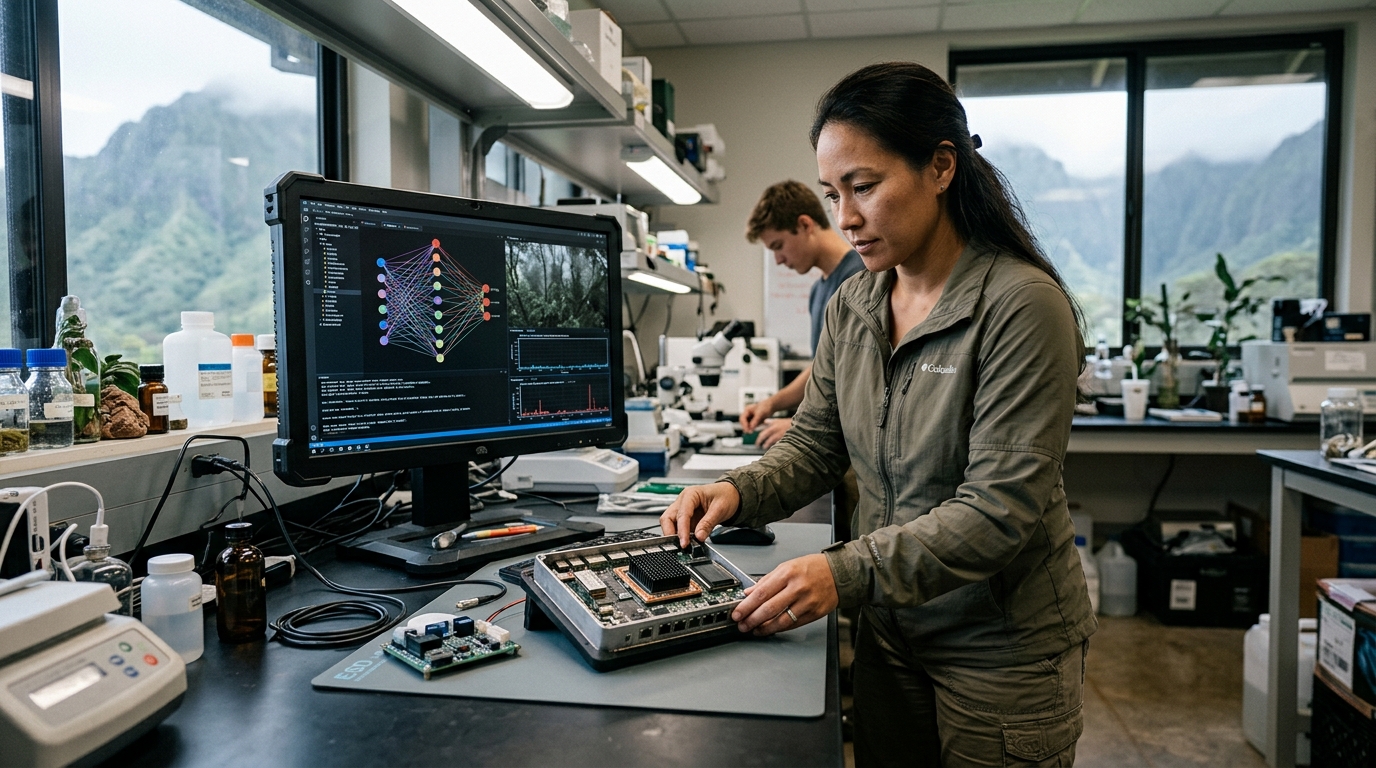
At the summit of Mount Kaʻala, the highest point on the island of Oʻahu, reality is often obscured by a thick, white shroud. These "cloud forests" are not merely landscapes of ethereal beauty; they are critical engines for the island's survival, acting as natural water towers that recharge vital aquifers. However, climate change threatens to unravel this fragile equilibrium. This is where the University of Hawaiʻi System's research steps in, deploying Artificial Intelligence and advanced field technology to peer through the mist.
The Threat of the Lifting Cloud Base
The primary challenge scientists face is the phenomenon known as the lifting cloud base. As global temperatures rise, clouds form at increasingly higher altitudes. For a mountain like Kaʻala, this means the fog that once enveloped the peak and deposited water droplets onto leaves—a process known as "fog drip"—is beginning to recede. The loss of this water source could be catastrophic, not only for local biodiversity but also for the freshwater supplies of the island's residents.
Monitoring these changes in real-time was, until recently, nearly impossible. Traditional weather stations often fail in the extreme humidity of the summit, and manual data collection is both hazardous and prohibitively expensive. The solution emerged from a synergy of low-cost sensors and powerful machine learning algorithms.
AI as the Eyes of Science
The research team developed a system utilizing high-resolution cameras and infrared sensors that feed data into an AI model. Instead of relying solely on mechanical humidity measurements, the AI is "trained" to recognize fog density and duration through visual analysis. This Computer Vision system can distinguish between simple cloud cover and active fog deposition, providing data with a level of precision previously thought unattainable.
- Utilization of LoRaWAN networks for long-range data transmission with minimal power consumption.
- Implementation of Edge Computing, where data processing occurs locally on the device, reducing the need for constant high-bandwidth connectivity.
- Automated mapping of vegetation health in relation to moisture levels.
This technology allows researchers to understand exactly how the ecosystem responds to weather shifts within minutes, rather than months.
"It’s not just about collecting data; it’s about understanding the dynamics of life in a rapidly changing environment,"members of the research team emphasize.
Toward a Global Model for Conservation
The significance of the work on Mount Kaʻala extends far beyond the shores of Hawaiʻi. Many island nations and coastal regions worldwide rely on cloud forests for their water security. The methodology being pioneered here—combining accessible field tech with sophisticated AI—can be exported to other regions facing similar existential threats. AI enables the creation of predictive models that can warn of impending droughts or the need for immediate intervention in specific forest sectors.
In conclusion, the technology on Mount Kaʻala proves that Artificial Intelligence does not belong solely in the sterile labs of major cities or the data centers of Silicon Valley. It is a tool that, when placed in the right hands, can become nature's guardian, offering a clear view through the fog of climate uncertainty. The success of this program signals a new era for ecological research, where technology and biology walk hand-in-hand to preserve the planet's most vital resources.