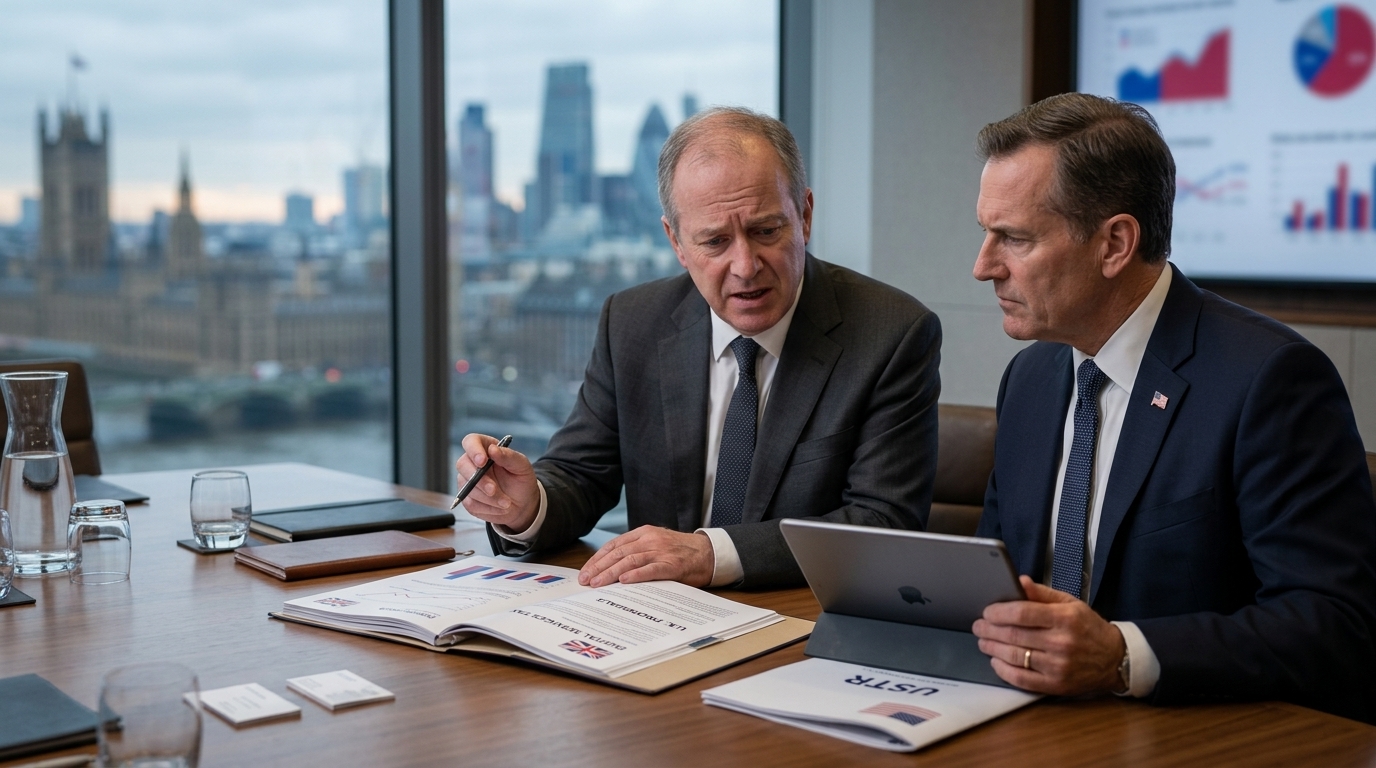
The diplomatic "special relationship" between Washington and London is being tested to its limits once again, as the Donald Trump administration escalates pressure on the United Kingdom to abolish its controversial Digital Services Tax (DST). According to recent reports and statements from officials at the Office of the United States Trade Representative (USTR), the American side is prepared to impose billions of dollars in tariffs on British goods if Keir Starmer’s government does not yield to demands for the protection of US tech giants.
The Bone of Contention: The 2% Tax
The UK’s Digital Services Tax, introduced in 2020, applies a 2% rate on revenues derived from UK users for search engines, social media platforms, and online marketplaces. While the tax targets companies with global revenues exceeding £500 million, in practice, it primarily hits US firms such as Google, Amazon, and Meta. For London, the tax is a critical tool for ensuring tax fairness, as these companies often shift their profits to low-tax jurisdictions.
However, for Washington, the DST is viewed as "discriminatory" and "protectionist." The Trump administration, faithful to the "America First" doctrine, argues that the tax unfairly targets American innovation. The threat of tariffs is not new, but the intensity with which it has returned in 2026 signals a determination to close this front at any cost, even if it means a full-scale trade war with one of the US's closest allies.
Tariffs as a Lever of Pressure
The proposed US tariffs would not hit the tech sector but rather traditional British industries, aiming to create maximum internal political pressure within the UK. The list of potential "victims" includes Scotch whisky, luxury goods, ceramics, and automotive parts. This strategy has been tested before and is designed to turn British producers against their own government.
- Scotch Whisky: An industry that has already suffered from previous tariffs and risks losing 25% of its exports to the US.
- Automotive Industry: Imposing tariffs on British cars could destabilize the sector's already fragile post-Brexit recovery.
- Fashion and Luxury: Iconic London fashion houses would see their prices soar in the US market, rendering them uncompetitive.
The OECD Deadlock and British Diplomacy
The root of the problem lies in the slow progress of negotiations at the Organization for Economic Co-operation and Development (OECD) regarding the so-called "Pillar One." The international agreement aimed to replace national digital taxes with a unified global system. However, the US's reluctance to ratify the agreement in Congress has led to a stalemate. London maintains that it will only abolish the DST once the global solution is implemented, a position Washington now finds unacceptable.
"We cannot allow foreign powers to impose arbitrary taxes on our leading companies while we wait for a hypothetical global deal that may never materialize," said a source close to the White House.
For Keir Starmer, the situation is exceptionally difficult. On one hand, the British economy desperately needs a trade deal with the US to offset losses from leaving the EU single market. On the other hand, yielding to American threats would be seen as a blow to national sovereignty and would deprive the public treasury of billions in revenue during a period of fiscal tightness.
Conclusion: Towards a Head-on Collision?
2026 appears to be the year of crisis for digital tax policies. If Washington proceeds with tariffs, London will face a dilemma: retaliate, starting a trade war that harms both sides, or capitulate, sending the message that its economic policy is dictated by the White House. The outcome of this confrontation will determine not only the future of Big Tech in Europe but also the nature of transatlantic relations in the new era of protectionism.