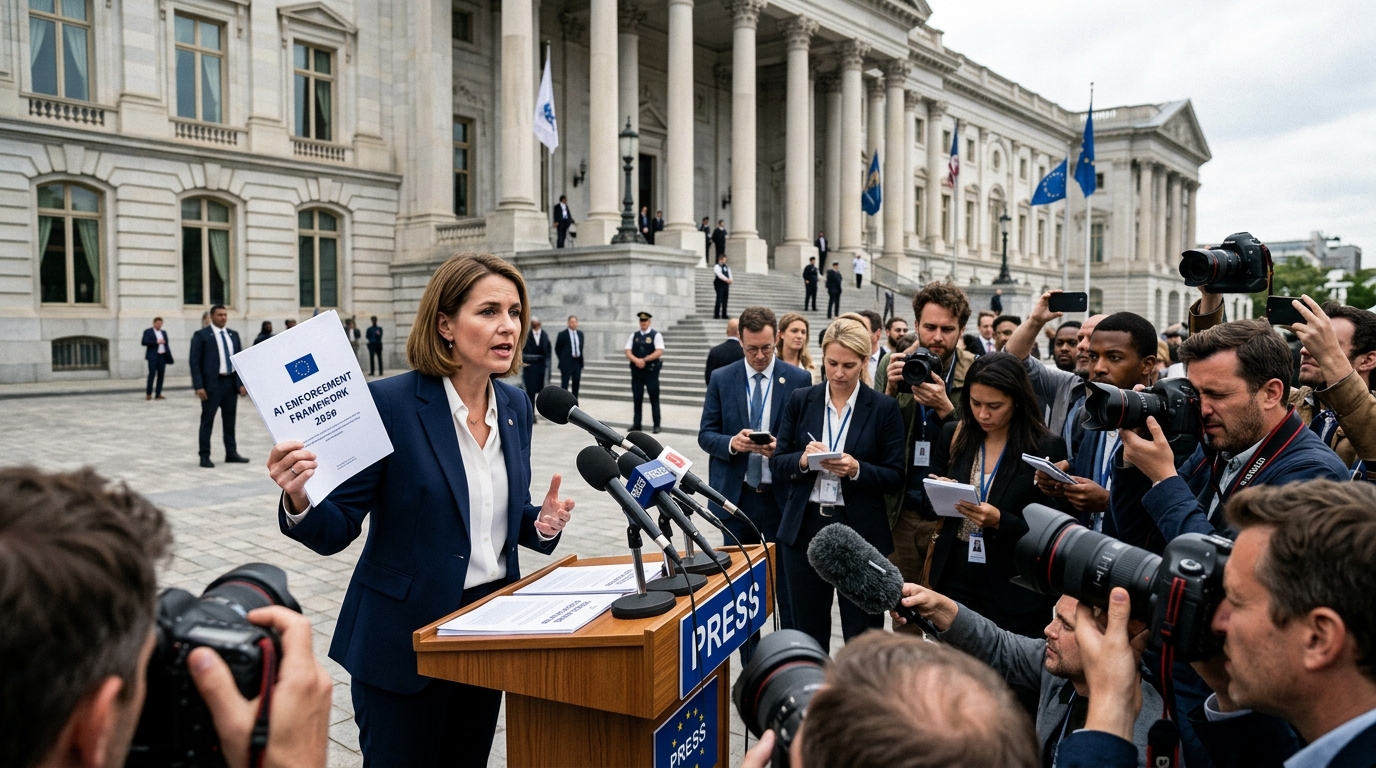
The spring of 2026 marks a pivotal moment for the global community. The 'Wild West' era of Artificial Intelligence (AI) appears to be drawing to a close as the first comprehensive legal frameworks transition from consultation phases to rigorous enforcement. The debate has shifted from whether AI should be regulated to how it can be governed in a way that protects fundamental rights without ceding technological leadership to authoritarian regimes or monopolistic giants.
The EU AI Act as a Global Beacon
The European Union, consistent with its role as a global standard-setter, is leading the charge with the Artificial Intelligence Act. 2026 is a landmark year, as most of the Act's provisions are now fully enforceable. The EU's approach remains risk-based, categorizing AI applications into four levels: from 'unacceptable risk,' leading to total bans (such as China-style social scoring), to 'minimal risk.'
This year, particular emphasis is placed on 'high-risk' systems used in healthcare, education, and law enforcement. Companies operating in the European market are now legally required to demonstrate absolute transparency in their algorithms, ensure the quality of training data, and maintain human oversight at every stage. The 'Brussels Effect' is already visible, as multinational corporations adopt European standards globally to avoid fragmenting their services and to ensure international compliance.
The American Approach: Between Executive Orders and State Initiatives
Across the Atlantic, the situation remains more complex. In the absence of comprehensive federal legislation, the U.S. government continues to rely on Executive Orders and NIST guidelines. However, 2026 has seen significant movement at the state level. California, New York, and Texas have enacted their own rules, focusing primarily on combating algorithmic discrimination and protecting consumer privacy.
The big question for Washington remains the balance between national security and economic sovereignty. The drive for the U.S. to remain the leading power against China often clashes with calls for stricter control over 'black box' models. Recent Congressional hearings highlighted deep concerns regarding deepfakes in the lead-up to elections, driving a bipartisan consensus on mandatory watermarking for AI-generated content. The focus is shifting toward 'Safe AI' as a competitive advantage rather than a burden.
The Enforcement Challenge and Technological Diplomacy
Establishing rules is only half the battle. Enforcing them in 2026 is proving to be a Herculean task for regulators. AI evolves at a speed that consistently outpaces bureaucratic mechanisms. 'General Purpose AI' models are becoming increasingly autonomous, making it difficult to assign liability in cases of error or harm. Who is responsible? The model creator, the developer who fine-tuned it, or the end-user?
Furthermore, international cooperation through organizations like the OECD and the G7 is intensifying. The creation of an 'International AI Agency,' modeled after the International Atomic Energy Agency (IAEA), remains a top discussion point. The goal is to prevent 'regulatory arbitrage,' where companies move their headquarters to 'AI havens' with lax legislation, potentially jeopardizing global safety and ethical standards.
- Training data transparency is now a legal requirement in most major Western economies.
- Real-time biometric identification systems are subject to extreme restrictions and oversight.
- Intellectual property remains a major sticking point, with thousands of lawsuits pending worldwide.
- Public education in digital literacy is recognized as the first line of defense against AI-driven misinformation.
In conclusion, the regulatory landscape of 2026 reflects a newfound maturity. Society no longer views AI as an alien threat but treats it as a powerful tool requiring robust governance. The success of these regulations will determine whether AI serves as the catalyst for a new renaissance or the instrument of a digital dystopia.