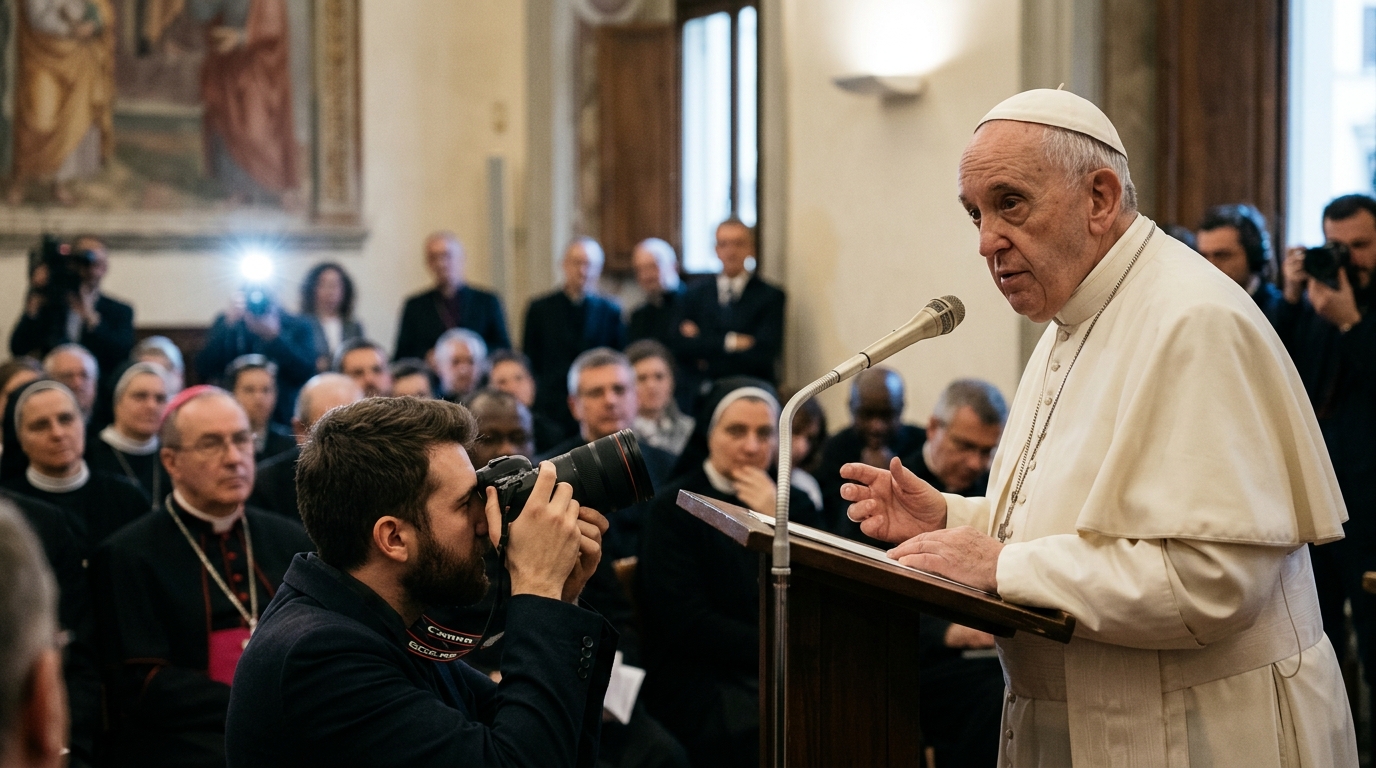
In an era where technological progress seems to gallop faster than society's ability to assimilate it, the Vatican's voice echoes as a reminder of the moral compass that risks being lost. Pope Leo, during his recent address, did not limit himself to generalities but launched a sharp warning about how Artificial Intelligence (AI) is reshaping the fabric of human existence. This intervention, reported by NBC News, comes at a critical juncture as global powers and tech giants compete for dominance in the field of generative intelligence.
The Concept of 'Algor-ethics'
The Pontiff reintroduced the term "algorethics," arguing that technology is never neutral. According to Pope Leo, the algorithms that govern our daily lives—from hiring employees to the administration of justice—contain the biases of their creators and the data on which they were trained. "We cannot allow cold calculations to replace the warm heart of human judgment," he stated characteristically, emphasizing that decision-making concerning the lives and futures of people should never be delegated exclusively to machines.
The Vatican's concern is particularly focused on "digital marginalization." The Pope warned that AI, instead of bridging inequalities, risks creating a new class of "digitally dispossessed." Those who lack access to technology or the skills to use it will find themselves on the fringes of an economy moving at the speed of light, reinforcing the gap between rich and poor nations.
AI and the Danger of War
One of the darkest points of the Pope's speech concerned the use of AI in military applications and autonomous weapons systems. Pope Leo called on the international community to ban weapons that can decide on life and death without human intervention. "Humanity cannot cede the right to kill to an algorithm," he stressed, causing a stir in diplomatic circles. This position aligns with the concerns of many scientists and activists who see AI as the beginning of a new, dangerous arms race.
- The need for international regulatory frameworks that bind major tech companies.
- The protection of personal data as a fundamental human right, not a marketable commodity.
- Ensuring that AI is used to tackle climate change and hunger, rather than for speculation.
- Educating younger generations in critical thinking regarding digital content.
Social Cohesion Under Threat
Beyond technical and military issues, Pope Leo focused on the psychological and social impact of AI. The spread of deepfakes and misinformation threatens, according to him, the very concept of truth. In a world where reality can be artificially constructed, trust between people is shaken. The Pontiff called on the faithful, and every thinking citizen, to seek authenticity in human relationships, warning that excessive dependence on digital communication leads to a "loneliness within the crowd."
"Technology is a gift from God, but it must remain at the service of humanity, not become its master. True progress is not measured by the speed of processors, but by our ability to protect the most vulnerable among us."
Closing his address, Pope Leo appealed to the leaders of Silicon Valley and governments not to sacrifice ethics on the altar of profit and power. His intervention is not merely a religious exhortation but a political and social cry for the future of the human species in a world dominated by silicon. The challenge now shifts to the hands of legislators and citizens, who are called to decide whether AI will be the tool of our liberation or the shackles of a new digital tyranny.