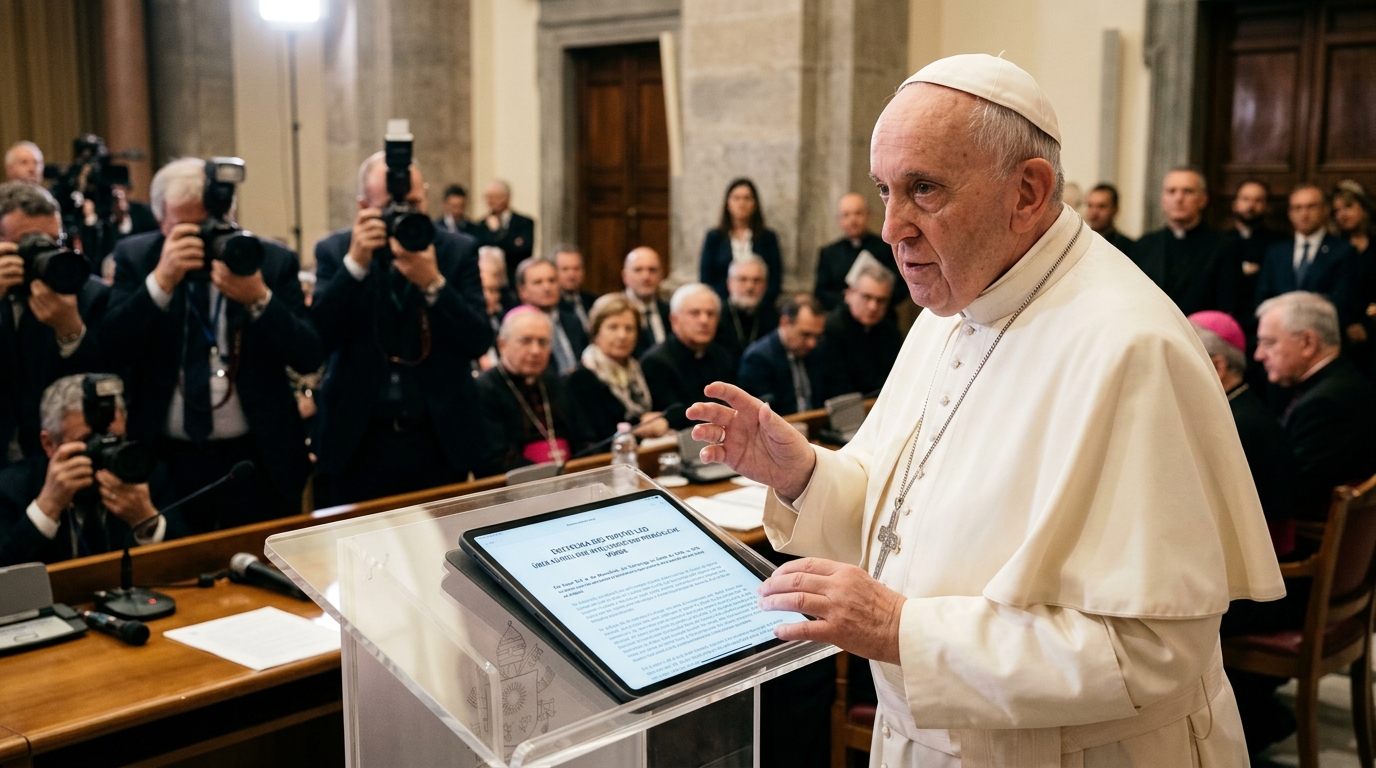
In the heart of the Vatican, beneath the awe-inspiring ceiling of the Sistine Chapel, Pope Leo released his first Encyclical today—a document poised to become a cornerstone for the relationship between faith, ethics, and technology in the 26th of May, 2026. Titled "Imago Dei in Machina" (The Image of God in the Machine), the Encyclical is not merely a theological treatise but a stern warning to the global community regarding the unchecked proliferation of Artificial Intelligence (AI).
The Ethics of 'Algor-ethics'
The Pontiff introduces the concept of "algor-ethics," arguing that technology is never neutral. According to Pope Leo, the algorithms governing modern life—from recruitment processes to judicial sentencing—carry the inherent biases of their creators and, often, a cold indifference to human complexity. "We cannot allow a line of code to determine the value of a human soul," the text asserts, emphasizing that efficiency must never be mistaken for justice.
The Encyclical focuses heavily on the danger of a "technocratic paradigm," where massive technology corporations amass power that rivals or exceeds that of nation-states. The Pope calls for a "binding international treaty" to ensure that AI remains a tool in the service of humanity, rather than a new idol to be worshiped. He warns that without moral guardrails, we risk creating a world that is optimized for profit but hollowed of purpose.
Autonomous Weapons and the Dehumanization of Warfare
One of the most provocative sections of the Encyclical addresses the military application of AI. Pope Leo calls for a total ban on Lethal Autonomous Weapons Systems (LAWS), which he describes as an "abominable abdication of the responsibility of blood." He argues that the decision to take a life must remain an exclusively human burden, as only humans possess the capacity for mercy, remorse, and moral discernment—qualities that no neural network can simulate, regardless of its processing power.
The Vatican's concern extends to the psychological impact of AI on the individual. The Encyclical warns against "digital loneliness," where individuals seek solace in artificial entities, gradually losing the capacity for genuine social interaction and empathy. The Pope describes a future society where the mechanical simulation of love replaces love itself, leading to a profound spiritual atrophy. He urges parents and educators to prioritize "analog connection" in an increasingly digitized world.
Social Justice in the Digital Frontier
Pope Leo also tackles the economic implications of AI, focusing on the "digital divide" affecting the Global South. He warns that AI could widen the gap between wealthy and poor nations, essentially turning the data of the world's most vulnerable populations into a new form of raw material to be exploited by technological superpowers. He advocates for open access to AI-driven educational and medical tools, ensuring that technology serves as a lever for upliftment rather than a tool for systemic oppression.
In conclusion, the Encyclical issues a direct challenge to scientists and developers: "You are the architects of the future. Do not build prisons of code, but bridges that unite humanity." This move by Pope Leo is seen as a strategic effort by the Catholic Church to reassert its role as a moral compass in a world moving faster than its ability to reflect. By framing AI as a theological issue, the Vatican is forcing a global conversation on what it truly means to be human in the age of the machine.
- Mandatory human oversight for all high-stakes algorithmic decisions.
- An absolute international ban on AI-controlled lethal weaponry.
- Recognition of personal data protection as a fundamental human right.
- Economic policies ensuring AI complements rather than replaces human dignity in labor.