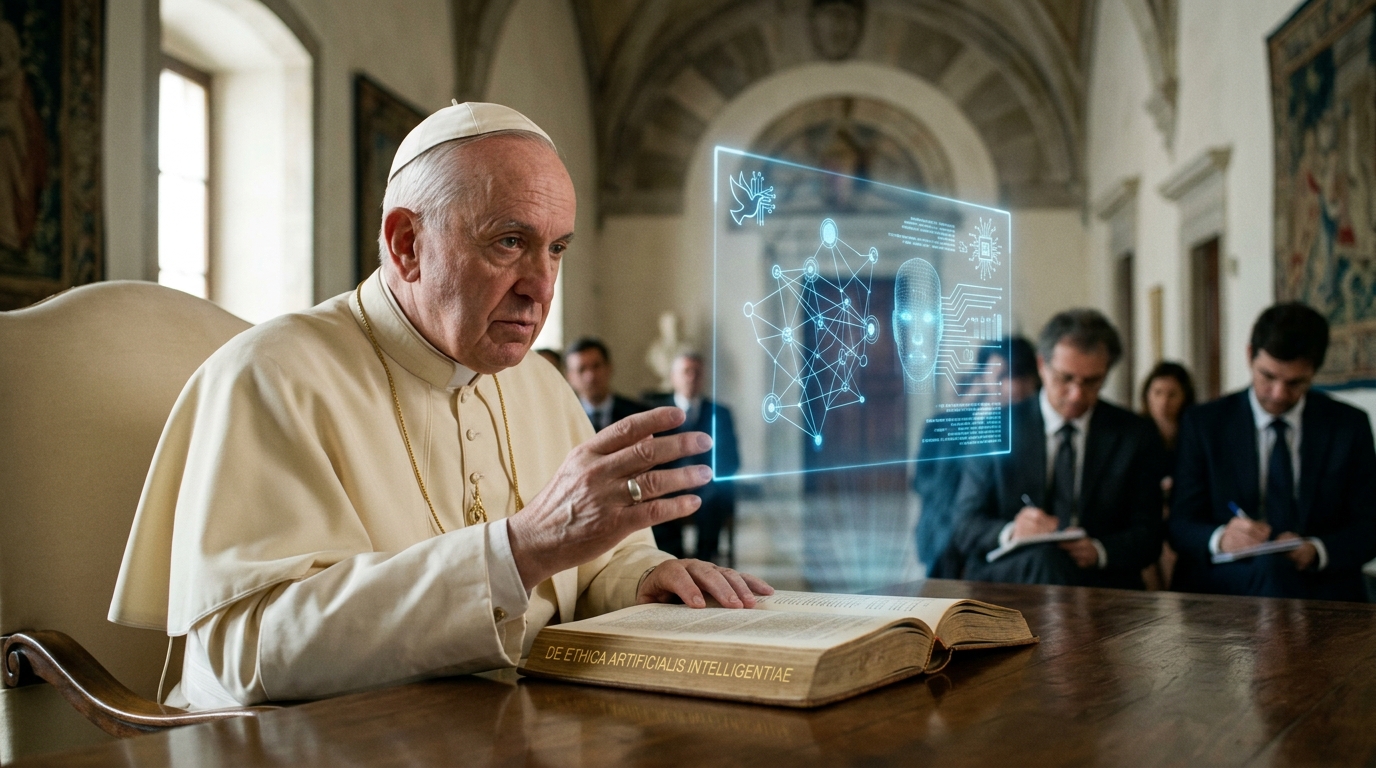
In a move already being hailed as a watershed moment for the intersection of faith and technology, Pope Leo has issued a profound new encyclical titled "Technica et Spiritus" (Technology and Spirit). Released by the Holy See on Monday morning, the document is far more than a theological treatise; it is a stark warning to the global community regarding the existential risks posed by the unchecked advancement of Artificial Intelligence (AI).
Human Dignity in the Age of Silicon
At the heart of the encyclical lies the concept of "algorethics," a term the Vatican has been systematically promoting to bridge the gap between algorithmic logic and moral philosophy. Pope Leo argues that AI is not a neutral tool but a technology embedded with the values, biases, and intentions of its creators. "A machine may calculate, but only a human can judge," the text asserts, emphasizing that delegating critical life-altering decisions—from judicial sentencing to healthcare diagnostics—to black-box algorithms constitutes an ontological threat to human agency.
The Pontiff focuses specifically on the danger of "digital alienation." He warns that an over-reliance on large language models and predictive behavioral systems could lead to a society where spontaneity and spiritual inquiry are replaced by data-driven optimization. For the Church, the human soul possesses a "sacred unpredictability" that no line of code can simulate or replace.
Social Justice and the New Digital Feudalism
Beyond metaphysical inquiries, the encyclical dives boldly into the realm of political economy. Pope Leo denounces the concentration of power within a handful of technology giants, referring to an emerging "digital feudalism." His concern is centered on how AI might widen the chasm between wealthy and developing nations, and how automation threatens the fundamental dignity of labor.
- The displacement of workers without adequate retraining frameworks is labeled a "sin against social solidarity."
- The deployment of AI in autonomous weapons systems is condemned as a "moral collapse" that removes the weight of lethal responsibility from the human person.
- Biometric surveillance and social scoring systems are critiqued as tools of oppression that violate the inherent right to privacy and dissent.
The Pope calls for a "Universal Declaration on AI Ethics," which would bind nations and corporations to transparent and accountable practices. He proposes the creation of an international body under the UN's auspices to oversee the development of "human-centric" algorithms.
A Call for Digital Humanism
Concluding the encyclical, Pope Leo addresses not only the faithful but all people of good will, including scientists and developers. He invites them to become "architects of a new digital humanism." The challenge, according to the Vatican, is not to halt progress but to ensure that progress serves humanity rather than the other way around.
"Technology is a gift from God when used to alleviate suffering, but it becomes an idol when it demands the sacrifice of our freedom at the altar of speed and profit," the encyclical concludes.
This intervention is expected to spark intense debate in decision-making hubs from Brussels to Silicon Valley, as the moral voice of the Church remains one of the few global institutions capable of posing questions that transcend quarterly profits or electoral cycles.